Jacob Morrow
Updated: 2026-07-15
If you run a phone-number login or sign-up flow, you already know the tradeoff:
SMS OTP is familiar and widely supported. When it arrives quickly, it’s a simple, trusted way to confirm a user’s number. Silent authentication can make the same flow feel faster by verifying in the background when conditions allow—while still keeping OTP available for universal coverage.
The goal isn’t to “replace OTP.” It’s to keep OTP as your dependable foundation, then add a silent layer to reduce unnecessary code-entry moments for legitimate users.
This is where silent authentication (sometimes called carrier-based authentication) fits in: as a practical enhancement that works best alongside a well-designed OTP experience.
What is silent authentication?
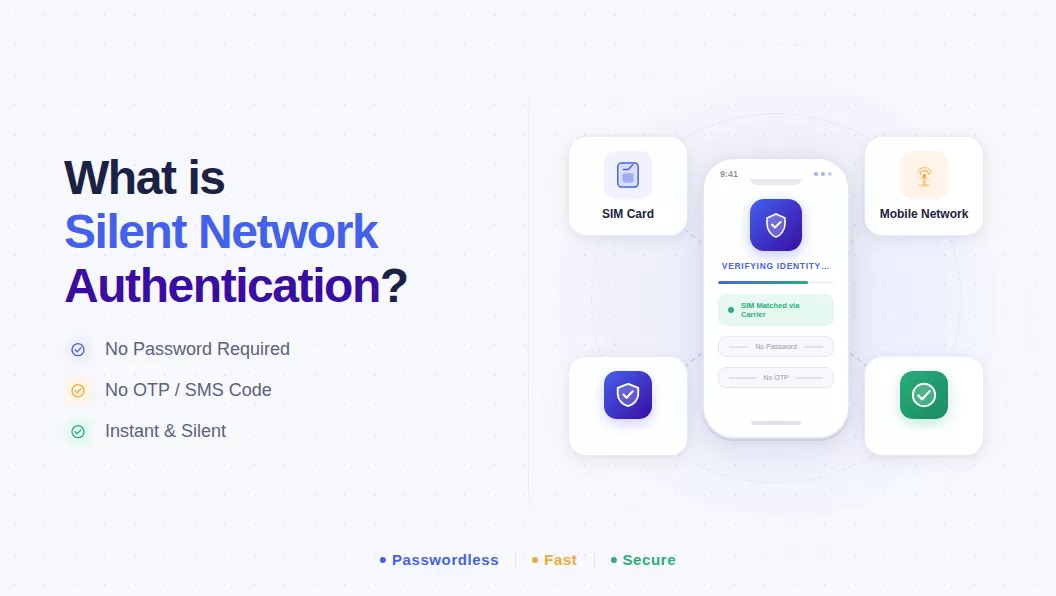
Silent authentication is a way to verify a user’s phone-number identity without asking them to type an SMS code.
You’ll also see it described as silent network authentication or SIM-based authentication, because it uses carrier/network signals to confirm the number-to-SIM relationship in the background.
At a high level, it works by using network-level signals to verify that the phone number provided matches the active SIM subscription—so the verification can happen in the background.
Key Takeaway: Silent auth isn’t “more UX polish.” It’s a structural way to reduce a major failure point in phone number verification: relying on a code the user must receive and retype.
Why OTP can still feel “slow” - even when everything is working
This isn’t a critique of any single SMS provider. It’s about the reality of code-based flows: they require an extra step from the user, and that step can add time.
1) Code entry adds a step to the user journey
Even when delivery is fast, OTP flows introduce:
- A wait (receive, read, copy, paste)
- Room for user error
- Retries and resends (often a proxy for frustration)
If you’re running paid acquisition, those drop-offs aren’t abstract—they’re spend.
2) Coverage expectations are high
Phone-number onboarding tends to be global and high-volume. That means you need a verification design that works across networks and devices, handles retries gracefully, and still feels smooth.
This is where a layered approach helps: silent authentication when possible, OTP when needed.
Where silent auth fits (and where it doesn’t)
Silent auth is best viewed as one tool in a layered verification design, not a magic replacement for everything.
A good fit
- Sign-up and login flows where you want speed and low drop-off
- Campaign participation where you want to reduce fake registrations and scripted abuse
- Step-up verification for higher-risk events (password change, payout, new device)—especially when you want to add a check without adding user steps
Not a good “only factor”
You still need a plan for:
- Users on unsupported networks or edge cases
- Scenarios where you need explicit user interaction for assurance
- Recovery flows (e.g., user changed numbers)
That’s why the strongest implementations treat silent auth as a first-line check, with controlled fallback when needed.
A practical rollout pattern: “silent first, OTP fallback”
If you’re operating at scale, the safest path is usually not a big cutover. It’s a layered approach that keeps OTP’s broad reach while reducing friction where possible:
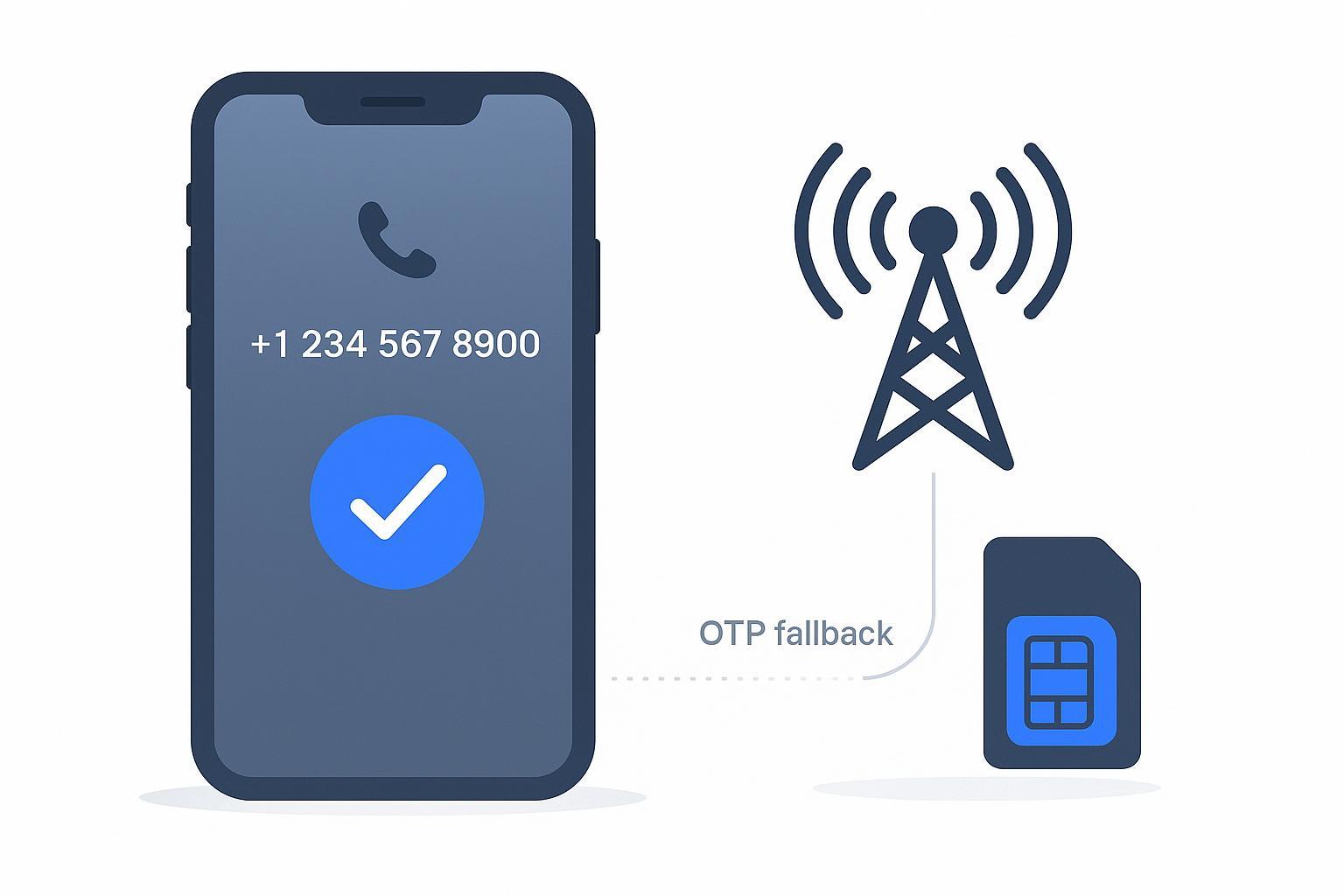
- Try silent authentication in the background when the user enters their number.
- If it succeeds, you finish verification with no code.
- If it can’t be performed (unsupported network, device conditions, or other edge cases), you fall back to an OTP flow.
This pattern keeps your coverage high—because OTP remains the universal backstop—while reducing code-entry moments for the portion of users that can be silently verified. In other words, you reduce OTP friction for legitimate users without giving up the reach and clarity that OTP provides.
Pro Tip: Treat fallback as a product decision, not a “resend loop.” Define when you fall back, how many attempts you allow, and what risk signals force step-up.
What to evaluate when choosing a silent authentication provider
If you’re exploring silent authentication, here are the decision criteria that matter in practice.
Coverage and fallback design
- Which countries and carriers are supported today?
- What’s the plan for users who can’t be silently verified?
- How do you measure “verification coverage” across both silent and fallback channels?
Security and privacy posture
- What device or subscriber data is (and isn’t) collected?
- How results are transmitted and stored?
- How the approach aligns with privacy expectations?
Latency under load
The whole point is to remove waiting. If a solution can’t stay fast under peak load, you’ve just moved the bottleneck.
A concrete example: carrier-based authentication (Silent Auth)
If you want to see what carrier-based silent authentication looks like in practice, EngageLab Silent Auth verifies the consistency between a mobile number and its SIM identity without SMS verification codes.
Two details worth noting because they shape how you would deploy it:
- The product messaging explicitly frames it as compatible with a flexible authentication strategy (not a rip-and-replace).
- It also states it doesn’t require sensitive device data collection like installed apps or location.
FAQ
Is silent auth the same as passkeys?
No. Passkeys (FIDO2/WebAuthn) are cryptographic, device-bound authentication methods. Silent auth is a phone-number verification approach that relies on carrier/network validation. Many products use both: passkeys where available, and phone flows where phone numbers are central to onboarding or recovery.
Does silent auth replace OTP?
In most real deployments, it reduces OTP usage rather than eliminating it. The practical goal is: fewer code-entry moments for legitimate users, while keeping a fallback path when silent checks can’t be performed.
Is SIM swap detection part of silent authentication?
It depends on the provider and the network signals available. Some carrier-based approaches can surface risk signals relevant to SIM swap detection during sensitive operations; others focus on basic subscriber validation.
Next steps
If you’re redesigning verification and want to reduce OTP friction while keeping fallback coverage, a good next step is to map where OTP drop-offs and fraud spikes happen in your funnel, then test a “silent first, OTP fallback” rollout for the lowest-risk flows.
If you’d like a second set of eyes on your current OTP funnel—where users drop, where fraud shows up, and what a safe rollout plan looks like—reach out here:
Contact EngageLab