Elena Rodriguez
Updated: 2026-08-14
SMS OTP has been the default identity checkpoint for over a decade. You add a phone number, receive a six-digit code, enter it, and you are in. The mechanism is universal, requires no app install, and works across virtually every mobile device on the planet. That familiarity is genuinely valuable, and it is why SMS OTP alternative is being searched with increasing urgency, not because SMS OTP is broken, but because businesses are running into real operational constraints it was never designed to solve.
Delivery failures in markets with inconsistent cellular coverage. Rising exposure to SMS pumping fraud and SIM swap attacks that exploit the SMS channel itself. Cost pressure from per-message pricing at scale. The kind of authentication fatigue that turns a routine login into a reason to abandon a registration flow entirely.
This guide covers every major OTP alternative available today, what each does well, where it falls short, and which business scenarios it actually fits.

Part 1. Why Businesses Look for an Alternative to SMS OTP
Understanding why organizations explore alternatives to SMS OTP starts with the specific problems they are trying to solve. None of these make SMS OTP obsolete, but each creates a scenario where a complementary method makes more sense.
Delivery Reliability Varies by Market
SMS relies on carrier network routing, and delivery reliability varies across regions. In parts of Southeast Asia, Sub-Saharan Africa, and Latin America, delayed or failed OTP delivery can increase drop-off during phone verification. For businesses serving global users, this becomes a conversion challenge as much as a security one.
SMS Pumping Fraud Is a Real Cost Driver
SMS pumping fraud, also known as Artificially Inflated Traffic (AIT), uses automated OTP requests to generate revenue through premium-rate numbers controlled by attackers. According to the CFCA Global Fraud Loss Survey, 2025, telecom fraud caused an estimated $41.82 billion in global losses. At scale, unprotected OTP endpoints can quickly become a significant cost risk.
SIM Swap and SS7 Vulnerabilities
SMS OTP can also be exposed to SIM swap fraud and SS7-based interception attacks. While these attacks require different levels of sophistication, both target the SMS channel itself rather than the authentication implementation. NIST SP 800-63B-4 classifies SMS/PSTN authentication as a restricted authenticator, meaning it remains acceptable but requires appropriate risk controls.
User Experience and Conversion Friction
Receiving a code, switching apps, and entering it before it expires all add friction. For mobile-first registration and login flows, these extra steps can reduce completion rates, especially for returning users.
Cost at Scale
SMS verification incurs a cost for every message sent. As verification volume grows, especially across international markets, per-message pricing can become a significant operational expense compared with newer authentication methods.
These challenges vary by business context. A regulated financial institution will evaluate them differently from a consumer app or global SaaS platform. For most organizations, the goal is not to replace SMS OTP entirely, but to complement it with other authentication methods where they provide a better balance of security, cost, or user experience.
Part 2. SMS OTP Alternatives Compared & Explained

No authentication method is universally superior. The right choice depends on your user base, the sensitivity of the action being protected, the geographic markets you operate in, your engineering capacity, and the regulatory environment you operate under. Below is a side-by-side view of the major authentication categories, followed by an explanation of each.
| Method | User Interaction | Security Level | Deployment Complexity | Typical Use Cases |
|---|---|---|---|---|
| Silent Authentication | None (fully automatic) | High (carrier-level) | Medium | Registration, login, fraud prevention |
| Passkeys | Single biometric or PIN | Very High (phishing-resistant) | Medium–High | Consumer apps, enterprise login |
| Push Authentication | Single tap to approve | High | Medium | Enterprise MFA, banking apps |
| SMS OTP (baseline) | Enter 6-digit code | Medium | Low | Universal coverage, fallback |
| Email OTP | Enter code from email | Medium | Low | Web apps, lower-risk flows |
| WhatsApp Verification | Enter code from chat | Medium | Low–Medium | Markets with high WhatsApp penetration |
| Authenticator Apps (TOTP) | Enter time-based code | High | Medium | Enterprise MFA, developer tools |
| Biometrics | Fingerprint or Face ID | Very High | Low (device-native) | Device-level unlock, payment confirmation |
Invisible Authentication
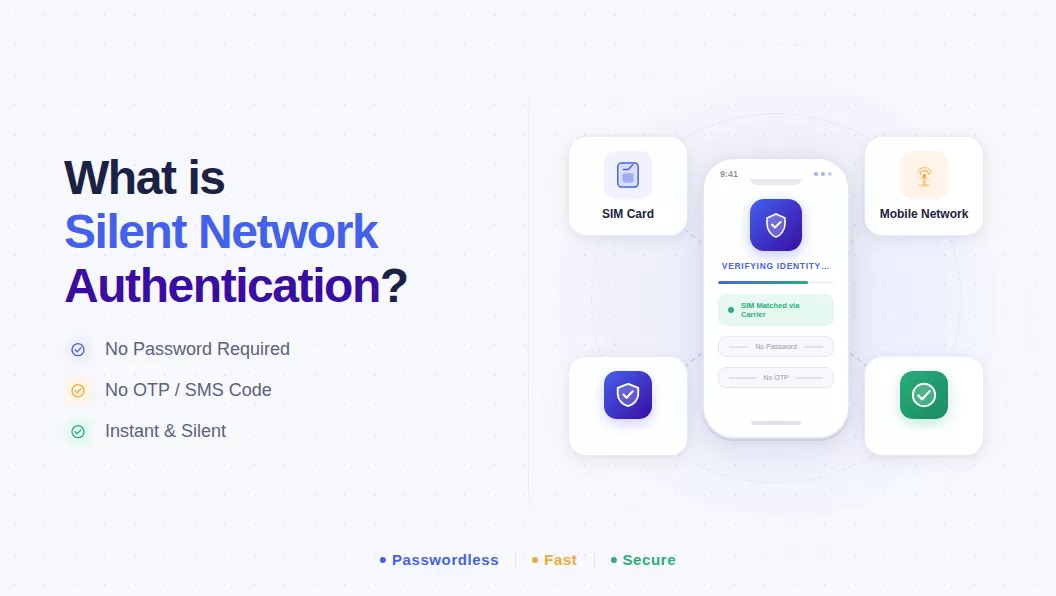
Silent authentication, sometimes called carrier authentication or the Number Verification API, performs mobile identity verification entirely through the carrier network, without any visible action from the user. The platform sends a request, the carrier verifies that the phone number provided matches the SIM currently active on that device, and the result comes back as a pass or fail. No code is sent. No code is entered. The user does not know anything happened.
The key strength is frictionless coverage at the point of registration or login. The main constraint is that carrier authentication requires mobile data through the verified carrier and is not yet universally available across all carriers and geographies (as of June 2026). For global deployments, it works best as a first-pass attempt with a reliable fallback.
One-Tap Authentication
This category covers methods that confirm identity with a single user action, either a biometric gesture or a tap on a push notification, without requiring a code to be read and entered.
Passkeys implement the WebAuthn standard defined by the FIDO Alliance, using public-key cryptography to authenticate without transmitting a secret. The private key never leaves the user's device. A biometric or device PIN unlocks it locally, and the authentication itself is phishing-resistant by design — there is no code to steal, no OTP to intercept. As of the FIDO Alliance's 2025 World Passkey Day research, 69% of users globally have at least one passkey, and passkeys achieve a 93% login success rate compared to 63% for traditional authentication methods (FIDO Alliance Passkey Index, 2025). The deployment consideration is that passkeys require compatible devices and browsers. Users on older hardware or in environments with limited platform support may still need a fallback path.
Push authentication sends a cryptographically signed approval request to a registered mobile app. The user taps approve or deny. Unlike SMS OTP, the approval cannot be replayed or intercepted in transit because it does not carry a transferable code. The limitation is that it requires a pre-installed, pre-registered app on the user's device, making it better suited to returning users in managed environments than to first-time mobile onboarding.
Code-Based Verification
This is the most universally supported category and includes SMS OTP, email OTP, and WhatsApp verification. All three work the same way at a high level: a code is generated server-side, delivered to a channel the user controls, and entered to complete verification.
SMS OTP remains the baseline precisely because of its coverage. It works on any mobile device with a SIM, requires no app, and is immediately understood by users everywhere. The limitations — delivery variability, SMS pumping fraud exposure, per-message cost — are real but manageable with proper controls, and for many markets and use cases, SMS OTP remains the most practical primary method.
Email OTP extends the same concept to the email channel. It is low-friction for web-based flows and works well as a secondary or recovery mechanism. It is inherently less tied to a physical device than SMS, which affects its identity assurance level — an email account shared or compromised is a weaker signal than a physical SIM.
WhatsApp Verification delivers OTPs through WhatsApp Business API. In markets where WhatsApp penetration is extremely high — parts of Brazil, India, Nigeria, and much of Western Europe — it can deliver better open and read rates than SMS. It is not a universal alternative; in markets where WhatsApp is not dominant, SMS coverage remains superior.
High-Assurance Authentication
This category covers methods that provide the highest identity assurance, typically used for sensitive actions rather than routine logins.
Authenticator apps (TOTP) — apps like Google Authenticator or Authy — generate Time-based One-Time Passwords locally on the user's device using a shared secret established at enrollment. They require no network connection to generate codes and are not vulnerable to SMS interception or SMS pumping fraud. The requirement for prior enrollment limits their use in first-time registration flows but makes them highly effective as a second factor in enterprise MFA stacks.
Biometrics — such as fingerprint sensors, Face ID, and similar hardware-based recognition — are device-native and do not introduce a network dependency. In most consumer contexts, biometrics operate as a local unlock rather than a standalone authentication method, confirming that the current user is the registered owner of the device. For payment confirmation and high-risk transaction authorization, they provide strong inherence-factor assurance.
Different categories complement each other rather than compete. Most mature authentication strategies combine two or more tiers, selecting the appropriate method based on the specific action being protected rather than applying one approach uniformly across every touchpoint.
Part 3. Which SMS OTP Alternative Is Right for Your Business?
Authentication requirements vary significantly by industry, regulatory environment, user device context, and risk tolerance. There is no single OTP alternative that is right across every scenario. The following guidance reflects common operational patterns, not universal recommendations.

Consumer Apps
Recommended approach: Silent Authentication → SMS OTP fallback → Passkeys for returning users
For mobile consumer applications — e-commerce, social, on-demand services — the priority is minimizing drop-off at registration and login without compromising account security. Silent authentication is worth implementing as a first-pass method where carrier coverage allows. Passkeys work well for returning users on compatible devices. SMS OTP remains the most reliable fallback for first-time registrations across heterogeneous device environments.
Financial Services
Recommended approach: Passkeys + Push Authentication + TOTP, with Silent Authentication for sensitive checks
Regulated financial institutions face both higher fraud risk and stricter compliance requirements, particularly around identity assurance levels. NIST SP 800-63B-4's "restricted" classification for SMS/PSTN authentication is directly relevant here. Passkeys and push authentication provide phishing-resistant authentication that satisfies higher assurance-level requirements. TOTP-based authenticator apps are well-established in this sector. Silent authentication used during sensitive operations, such as transaction confirmation, adds a carrier-level identity check without user friction.
Global SaaS
Recommended approach: Silent Authentication → Passkeys → SMS OTP fallback, with Email or WhatsApp OTP where relevant
Global SaaS platforms face the widest variation in carrier reliability, device capability, and user sophistication. A fallback chain that starts with silent authentication where available, moves to passkeys for enrolled users, and falls back to SMS OTP for everything else tends to be the most pragmatic approach. Email OTP can substitute for SMS where the product is primarily web-based. WhatsApp OTP may be worth implementing if significant user concentration exists in WhatsApp-dominant markets.
High-Risk Transactions
Recommended approach: Step-up authentication with TOTP, Push Authentication, Biometrics, or Silent Authentication as an additional signal
Step-up authentication — requiring an additional verification at the moment of a sensitive action rather than at login — is standard practice for high-risk transaction contexts. TOTP authenticator apps and push authentication are well-suited here because they require device possession and an additional user action. Biometric confirmation, where available at the device layer, adds an inherence factor without network dependency. Silent authentication can serve as a supplementary carrier-level identity check alongside the user-facing method.
Large Enterprise
Recommended approach: Passkeys + Push Authentication, with SMS OTP reserved for recovery
Enterprise authentication is typically governed by identity and access management (IAM) policies, existing infrastructure, and compliance mandates. Passkeys are increasingly becoming the enterprise standard, with 87% of businesses in a 2024 FIDO Alliance survey reporting they had deployed or were actively deploying passkeys (FIDO Alliance / HID Global Enterprise Survey, 2024). Push authentication through established vendors integrates cleanly with existing IAM stacks. SMS OTP can serve as a recovery method for employees without access to registered devices, rather than a primary factor.
Part 4. Why Modern Authentication Uses Multiple Verification Methods
Single-method authentication is increasingly a liability — not because any individual method is fundamentally broken, but because no single method covers every user environment, every risk level, and every geographic context equally well.
A practical layered mobile authentication flow might look like this:
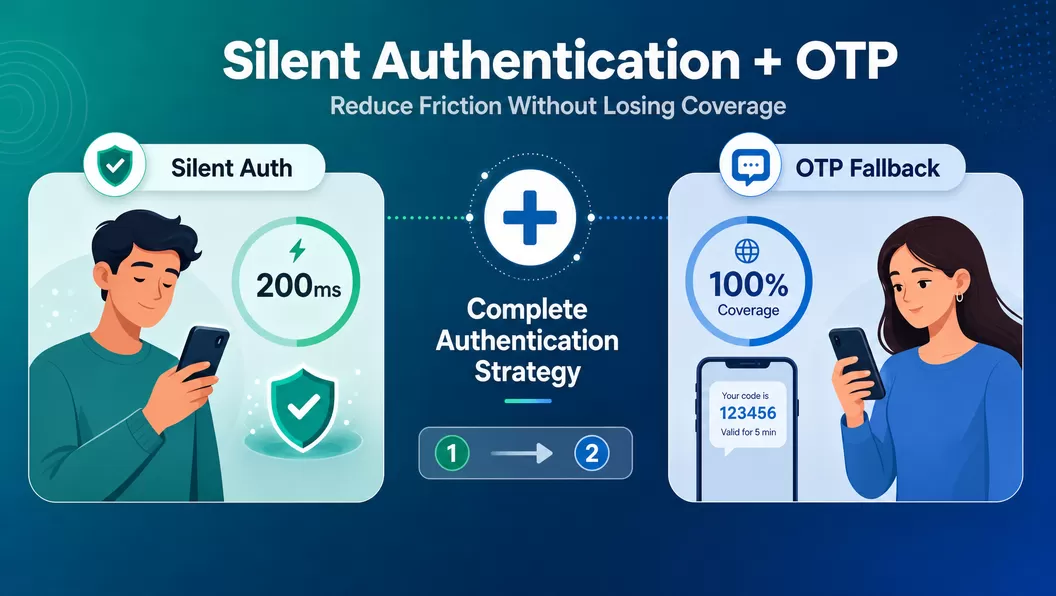
1 Silent Authentication (Primary)
The system attempts carrier authentication silently as the user enters their phone number. If the carrier returns a positive match — number confirmed against the active SIM — verification completes without any visible step. No code, no wait, no user action required.
2 SMS OTP (Fallback)
When silent authentication cannot be completed — the user is on Wi-Fi, the carrier is not integrated, or the coverage region is unsupported — the flow falls back to standard SMS verification. The user receives a code and enters it. This preserves universal coverage without abandoning the user.
3 CAPTCHA (High-Risk Signal Detected)
If the verification endpoint detects behavioral anomalies — velocity spikes, suspicious device fingerprints, sequential phone number patterns consistent with SMS pumping fraud — CAPTCHA introduces a challenge layer before the OTP is even generated, preventing fake requests from reaching the SMS provider at all.
4 Additional MFA if Needed
For sensitive actions — like password changes, high-value transactions, access from an unrecognized device — a second factor can be required on top of the primary verification. This might be a TOTP code from an authenticator app, a push notification approval, or a passkeys-based biometric confirmation.

Many authentication platforms now implement this layered approach in practice. EngageLab is one example, combining Silent Authentication with SMS OTP fallback in a single verification flow.
EngageLab's Silent Auth performs carrier-level phone number authentication by verifying that a submitted mobile number matches the active SIM on the device — without sending an OTP or requiring any user interaction beyond entering the phone number.
With coverage across 30+ countries and regions, it helps businesses reduce authentication friction wherever carrier verification is supported. When carrier verification is unavailable, the flow automatically falls back to SMS OTP, maintaining broad compatibility while reducing friction.

Key capabilities include:
- SIM-based identity verification — verifies that the submitted phone number matches the active SIM instead of relying on an SMS code.
- Reduced fraud and authentication friction — eliminates OTP delivery delays for supported users while helping prevent SMS pumping and fake registrations.
- Privacy-conscious, fallback-ready deployment — integrates with existing OTP workflows without collecting device-level data or requiring a complete authentication stack rebuild.
Verify Users Faster Across 30+ Countries
Improve mobile verification with carrier-based Silent Authentication, backed by SMS OTP fallback for maximum coverage.
The key insight behind layered passwordless authentication is not that one method replaces another; it is that each method handles the cases the others cannot. Silent authentication eliminates friction where carrier coverage supports it. SMS OTP provides universal fallback. CAPTCHA and MFA layers address elevated risk signals. The result is a verification strategy that is both more secure and less friction-heavy than any single method applied uniformly.
Part 5. FAQs about SMS OTP Alternatives
1 What is the most secure SMS OTP alternative?
It depends on your threat model. Passkeys (WebAuthn/FIDO2) deliver the highest phishing-resistant authentication assurance; the private key never leaves the device. Silent authentication via a Number Verification API offers strong carrier-level identity assurance with zero user friction. For sensitive enterprise actions, TOTP combined with push authentication is well-established. No single method is universally most secure.
2 Is SMS OTP still safe to use in 2026?
Yes, with proper controls. NIST SP 800-63B-4 classifies SMS-based authentication as restricted — permitted, but requiring SIM swap monitoring, rate limiting, and number porting detection (NIST SP 800-63B-4, 2024). SMS OTP still provides coverage advantages no other method matches. Managing its known limitations is more practical than eliminating it outright.
3 What is silent authentication and how does it work?
Silent authentication confirms whether a submitted phone number matches the SIM currently active on the user's device, without sending any code. The verification runs through the mobile carrier network in the background. The user enters their number, the platform queries the carrier, and the result returns in seconds. No code is generated, no code is entered, and the registration flow is uninterrupted.
4 Can passkeys fully replace SMS OTP?
Not universally yet. Over 95% of iOS and Android devices support passkeys as of 2025 (FIDO Alliance), but legacy device environments and unenrolled users still require a fallback. A practical strategy is passkeys as the primary method for returning enrolled users, with SMS OTP as a fallback for first-time registrations and edge cases.
5 How to prevent SMS pumping fraud?
SMS pumping fraud (Artificially Inflated Traffic) is when bots trigger fake OTP requests routed to premium-rate numbers the attacker controls. Prevention includes rate limiting per number and IP, blocking requests to high-risk country codes outside your user base, behavioral CAPTCHA triggers, and phone number type pre-verification. Silent authentication removes this attack surface entirely for carrier-verified sessions.
Conclusion
There is no single SMS OTP alternative that fits every business, every market, and every risk profile. SMS OTP remains one of the most widely supported verification mechanisms available — its limitations are operational and manageable, not fundamental disqualifiers. The businesses making real progress on authentication are not replacing SMS OTP wholesale; they are adding methods that handle the specific scenarios where SMS OTP underperforms.
Each method earns its place by solving a problem the others cannot. Passkeys eliminate phishing risk for enrolled users. Silent authentication removes friction and SMS pumping fraud exposure at the carrier level. TOTP and push authentication raise the floor for sensitive actions. The strongest strategies combine silent authentication as a frictionless first attempt with SMS OTP as a universal fallback, and step up to higher-assurance methods only when the risk level demands it.
Start For Free