Jacob Morrow
Updated: 2026-06-03
A traveler books a 10-day Bali trip with your agency. They get the confirmation, fly out, come home, and never hear from you again. Six months later, they book the same kind of trip with a competitor who sent a "ready for your next escape?" message at the right moment.
The booking wasn't lost on price. It was lost on silence.
According to Dotdigital (2024) , 81% of travel bookings are abandoned before completion. According to Adjust (2023) , travel apps sit around 5% Day 30 retention.
This comparison covers six marketing automation platforms for travel agencies that can help recover abandoned bookings, trigger post-trip follow-ups, and bring past travelers back for repeat trips. For a travel agency, retention is not an abstract dashboard metric. It is the difference between one-trip LTV and a client base that books with you every year.

Why Travel Retention Breaks After the First Booking
Most marketing tools are designed around e-commerce habits: add to cart, abandon cart, send a coupon. Travel does not work that cleanly. A traveler may research for weeks, ask questions on WhatsApp, request an itinerary by email, book offline, travel months later, and become ready for the next trip only after another seasonal trigger appears.
According to SleekFlow (2026) , travel industry conversion rates can range from 0.2% to 0.4%. Combined with high booking abandonment and low app retention, that means agencies cannot afford to let post-trip customers go quiet.

The math is simple. A customer who books a $3,000 trip each year for five years is worth $15,000 before referrals. Lose that customer after trip one, and your acquisition spend has to start over. A travel retention platform needs to understand booking history, trip dates, destination interest, region, preferred channel, and timing.
5 Capabilities That Bring Past Travelers Back
Before comparing vendors, define what "good" means for travel. A platform that creates beautiful emails but cannot trigger a post-trip win-back journey is not enough for retention.
Travel retention checklist
- Lifecycle workflow builder: welcome, pre-trip, in-trip, post-trip, and win-back journeys based on booking dates.
- Cross-channel delivery: email, SMS, WhatsApp, app push, and web push from one orchestration layer.
- Booking-history segmentation: destination, trip value, region, season, group type, and frequency signals.
- Loyalty and referral triggers: repeat-booker prompts, review requests, anniversary campaigns, and referral asks.
- Abandoned booking recovery: fast reminders and personalized offers when a traveler exits mid-booking.
These criteria also explain why a generic CRM is not the same thing as marketing automation . The CRM stores traveler and booking data; the automation platform turns that data into timely messages across channels.
6 Platform Picks by Agency Type and Channel Mix
Start with the fit map below. It separates cross-border SMB needs from enterprise OTA requirements and CRM-centered teams.
| Best fit | Recommended platform | Why it fits |
|---|---|---|
| Cross-border SMB and mid-market agencies | EngageLab | Marketing Automation plus email, SMS, WhatsApp, app push, and web push for region-based travel journeys. |
| Enterprise OTAs and regional travel brands | WebEngage | Strong journey orchestration, behavioral data, RFM-style segmentation, and multiple engagement channels. |
| Email-first EU travel brands | Dotdigital | Travel marketing resources, abandoned booking recovery, and email-led customer engagement workflows. |
| Shopify-style booking stores | Klaviyo | Email, SMS, WhatsApp credits, customer profiles, and commerce-oriented automation logic. |
| Teams already running HubSpot CRM | HubSpot Marketing Hub | CRM-native campaigns, forms, email, contact-based workflows, reporting, and broad ecosystem fit. |
| Global enterprise travel companies | Salesforce Marketing Cloud | Enterprise campaign operations, AI-assisted personalization, segmentation, SMS, WhatsApp, and Salesforce data alignment. |
6 Travel Marketing Automation Platforms Compared for Retention
The table scores each platform on what matters most for customer retention in travel. Treat the pricing column as a buying-model note, not a final quote.

| Platform | Lifecycle workflows | Cross-channel delivery | Booking-history segmentation | Best for | Pricing model, May 2026 |
|---|---|---|---|---|---|
| EngageLab | Strong | Email, SMS, WhatsApp, app push, web push | Strong when booking events and profile fields are connected | Cross-border SMB and mid-market agencies | Usage / MEP scale ; confirm channel mix in calculator. |
| WebEngage | Strong | Email, web push, mobile push, in-app, SMS, WhatsApp, and more | Strong for event and behavioral segmentation | Enterprise OTAs and regional travel brands | Quote-led; request demo or sales consultation. |
| Dotdigital | Strong | Email-led, with SMS and other engagement channels depending on setup | Good for travel campaigns and abandoned booking recovery | EU travel brands focused on email-first lifecycle automation | Tiered / quote-based, usually tied to contacts and modules. |
| Klaviyo | Strong for commerce-style flows | Email plus mobile messaging credits for SMS, MMS, and WhatsApp | Good when booking data behaves like customer profile and commerce events | Travel stores using Shopify-style booking infrastructure | Profile and message based ; WhatsApp uses mobile messaging credits. |
| HubSpot Marketing Hub | Strong from Professional tier upward | Email and CRM workflows natively; SMS, WhatsApp, and push depend on HubSpot features, credits, and integrations | Good for CRM-based segmentation; booking-specific data requires clean CRM fields or integrations | Agencies already running HubSpot CRM | Seat, contact, tier, and onboarding based . |
| Salesforce Marketing Cloud | Strong | Email, SMS, web, WhatsApp, personalization, and add-on capabilities depending on edition | Strong with Data Cloud, CRM, and engineering support | Global OTAs, TMCs, and enterprise travel groups | Flexible / quote-led ; depends on starting point and capabilities. |
Where Each Platform Wins by Travel Agency Stage
EngageLab: Cross-Border Agencies That Need One Journey Canvas
The Marketing Automation product fits travel agencies that need one journey canvas for email, SMS, WhatsApp, app push, and web push. That is useful when the same win-back trigger should send WhatsApp to a Singapore traveler, email to a German traveler, and SMS to a North American traveler.
- Best for: cross-border travel agencies and tour operators that need multi-channel retention without stitching together several vendors.
- Strengths: visual journey builder, channel coverage, customer profile logic, and usage-based planning.
- Watch-out: the platform is strongest when booking events, trip dates, and channel opt-ins are cleanly mapped into the workflow.
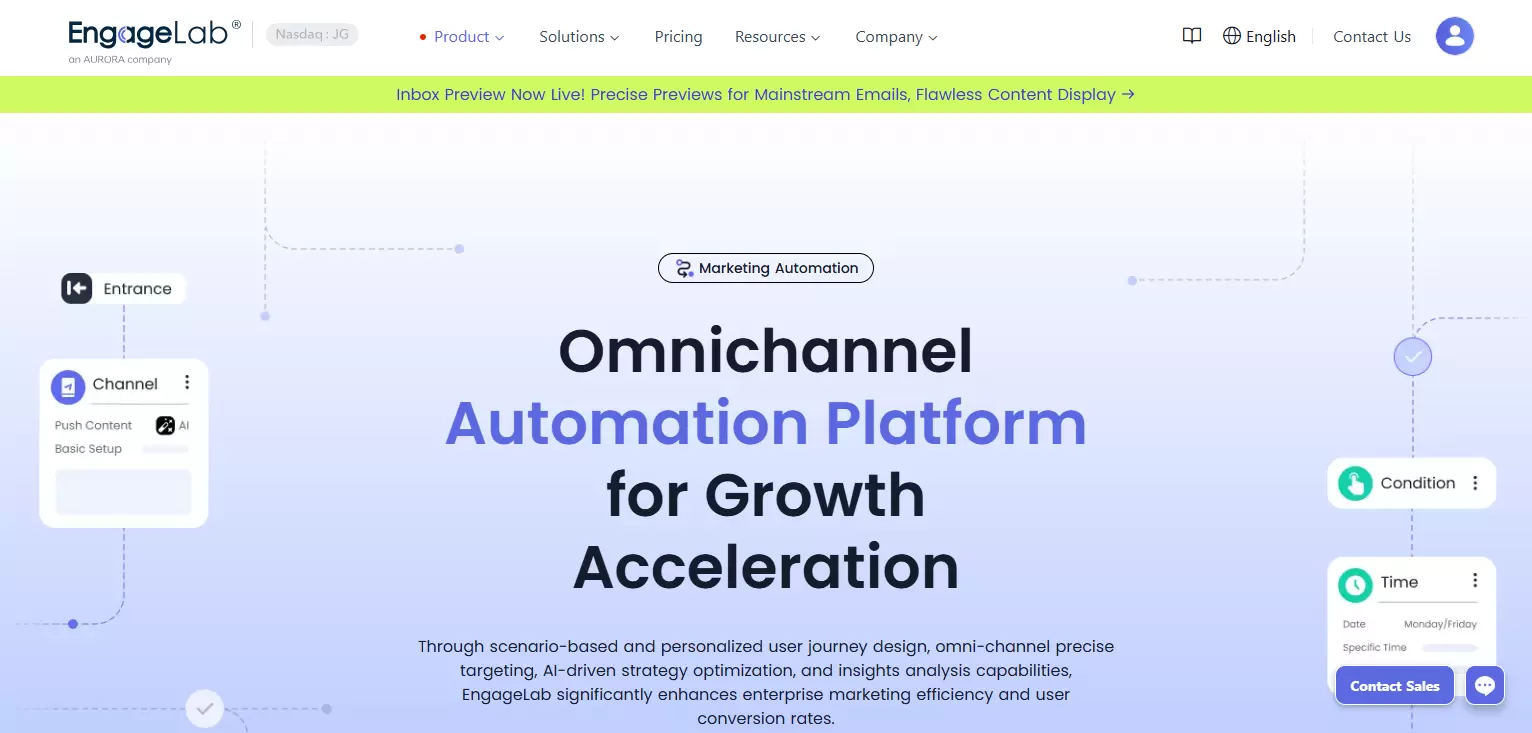
The product proof to look for is a journey layer, not another campaign calendar. The platform should let your team place condition, time, channel, and profile checks in one flow so retention logic does not split across separate email, SMS, WhatsApp, and push tools.
WebEngage: Enterprise OTAs with Dedicated Retention Teams
WebEngage is a strong fit for enterprise OTAs and regional travel brands with dedicated retention teams. Its channel and journey capabilities are broad, and its segmentation model is well-suited to high-volume event data.

- Best for: travel brands with marketing ops resources and enough volume to justify an enterprise engagement stack.
- Strengths: journey orchestration, behavioral segmentation, RFM-style analysis, and multiple engagement channels.
- Watch-out: smaller agencies may find implementation and governance heavier than necessary.
Dotdigital: Email-First Travel Brands in Europe
Dotdigital is strongest for email-first travel brands that want travel-specific marketing automation resources, abandoned booking recovery, and customer engagement programs without moving into a heavy enterprise suite.

- Best for: EU or email-led travel brands where email remains the primary retention channel.
- Strengths: email automation, travel campaign examples, abandoned booking flows, and marketing team usability.
- Watch-out: confirm WhatsApp, SMS, web, and CRM requirements before assuming it replaces your full engagement stack.
Klaviyo: Commerce-Style Booking Stores
Klaviyo works best when your travel booking process looks like commerce: customer profiles, checkout events, booking confirmation data, and post-purchase flows. Its email and mobile messaging model is practical for teams already using Shopify-like infrastructure.

- Best for: packaged travel sellers, experience providers, and agencies with commerce-style booking data.
- Strengths: profile-based segmentation, email flows, SMS and WhatsApp credits, and commerce integrations.
- Watch-out: travel agencies with offline booking, complex itineraries, or multiple regional systems may need extra integration work.
HubSpot Marketing Hub: CRM-First Agencies
HubSpot Marketing Hub is a logical option when the agency already uses HubSpot CRM for leads, deals, contacts, and service context. It is especially useful for teams that want marketing, sales, and reporting in one familiar workspace.

- Best for: agencies already committed to HubSpot CRM and inbound marketing operations.
- Strengths: CRM-native contact data, forms, landing pages, email, workflows, reporting, and sales alignment.
- Watch-out: advanced automation, SMS, WhatsApp, and booking-specific segmentation can increase tier, credits, and integration requirements.
Salesforce Marketing Cloud: Global Travel Groups with Data Teams
Salesforce Marketing Cloud is built for enterprise teams with complex data, governance, personalization, attribution, and engineering requirements. It is powerful, but usually too heavy for a small agency trying to launch its first win-back workflow.
- Best for: global OTAs, travel management companies, and large multi-region agencies.
- Strengths: enterprise segmentation, personalization, analytics, SMS, WhatsApp, Salesforce data alignment, and governance.
- Watch-out: implementation can require specialized Salesforce and data engineering ownership.
Build the itinerary around the customer journey
Map booking, trip-date, region, and channel signals before choosing your automation stack.
Build a 90-Day Win-Back Journey Across WhatsApp, SMS, Email, and Push
Cross-border travel retention is a multi-channel problem. A Bali traveler may book through WhatsApp, receive an itinerary by email, need pickup confirmation by SMS, and respond to a push reminder before the next trip. Separate vendors can work, but they often create split segments, duplicated logic, and manual data cleanup.
According to SleekFlow (2026) , BP Holiday reported 40% faster response times and 64% reply rates on targeted WhatsApp campaigns after adopting omnichannel automation. The broader lesson is not that every agency should copy the exact channel mix. It is that channel choice should follow traveler behavior by region.

90-Day Win-Back Workflow for Returning Travelers
Snippet-ready workflow
Day 90: trigger when trip return date plus 90 days passes and no new booking exists.
Data check: confirm last destination, home region, booking value, and channel opt-in status.
Regional routing: send WhatsApp in APAC, email in EU, and SMS in North America when those channels match opt-in and behavior.
Day 97: send a softer second touch on the highest-engagement channel if there is no click, reply, or booking.
Day 105: send a final incentive based on prior booking value, then exit immediately if a new booking appears.
Day 112: move non-converters into a dormant segment and schedule an anniversary campaign.
In practice, this workflow needs a few fields: trip_return_date
,
last_destination
, home_region
,
booking_value_last_trip
, and channel opt-in status. If any required field is missing, route the contact to a fallback segment instead of sending a generic message.

This is the backend capability that matters for travel retention: the same canvas can hold audience checks, channel actions, waiting periods, and message content. That keeps a 90-day win-back journey editable by marketing instead of turning every regional variant into a developer ticket.
A unified workflow can also combine related channels. For example, WhatsApp can handle conversational follow-up, SMS can support urgent reminders, and app push can bring mobile travelers back into an itinerary or booking app.
3 Signals You Have Outgrown Basic Travel Automation Tools
The right automation tool for tour operators depends less on logo size and more on timing. Map your agency against three axes: active contacts, team technical capacity, and regional channel footprint.
Tier 1: SMB, Under 10,000 Active Contacts
At this stage, choose a tool your team can launch without an engineering sprint. You need booking confirmation, pre-trip reminders, post-trip thank-you messages, abandoned booking recovery, and a simple win-back flow.
- Choose Dotdigital if most customers are email-first and you need straightforward travel lifecycle email.
- Choose EngageLab if customers are cross-border and WhatsApp, SMS, email, or push all matter from day one.
- Choose Klaviyo if your booking flow is close to Shopify-style commerce and customer profiles are already clean.
Tier 2: Mid-Market, 10,000 to 100,000 Active Contacts
This is where channel complexity starts creating real revenue leakage. If lifecycle campaigns live in separate tools, your team loses a single view of which travelers are likely to book again.
- Your monthly booking volume consistently exceeds 1,000 transactions.
- Your abandoned booking volume exceeds 200 to 300 sessions per week.
- Your team spends more than five hours per week manually managing campaign logic.
- You send on more than one channel but cannot orchestrate timing from one workflow.
- Your customers span multiple regions and channel preferences.
Tier 3: Enterprise, 100,000+ Active Contacts
Enterprise platforms become relevant when the challenge is no longer simply sending campaigns. At this stage, OTAs, TMCs, and global travel groups often need deeper integrations with booking systems, internal data warehouses, attribution models, real-time pricing data, and governance across teams.
Salesforce Marketing Cloud and WebEngage can both fit this stage, but they assume the agency has the people to own implementation, data quality, and ongoing optimization.
4 Buying Questions Travel Agencies Should Answer First
What is the best marketing automation platform for a small travel agency?
Short answer: choose by region and channel mix. Dotdigital is practical for email-first travel brands, Klaviyo fits commerce-style booking flows, HubSpot fits CRM-first agencies, and EngageLab fits cross-border agencies that need WhatsApp, SMS, email, and push in one retention workflow.
How do travel agencies recover abandoned bookings with automation?
Use a multi-step sequence: a reminder within 15 to 30 minutes, a second touch 24 hours later, and a final message at 72 hours if there is still no booking. The channel should match opt-in and region: WhatsApp for many APAC travelers, email for EU travelers, and SMS for urgent North American reminders.
Can WhatsApp be used for travel agency customer retention?
Yes. WhatsApp is useful for conversational travel follow-up, pre-trip reminders, itinerary questions, destination suggestions, and win-back messages where the customer has opted in. For implementation details, compare WhatsApp Business API integration before choosing a provider.
What is the difference between a travel CRM and a marketing automation platform?
A travel CRM stores contacts, leads, booking records, service notes, and sales pipeline data. A marketing automation platform uses those records to trigger messages over time. The CRM holds the customer knowledge; the automation tool turns that knowledge into retention journeys.
Key Takeaways: Build Travel Journeys That Recover Revenue
The five capabilities that define a travel retention platform are lifecycle workflows, cross-channel delivery, booking-history segmentation, loyalty and referral triggers, and abandoned booking recovery.
Cross-border travel is multi-channel by nature. APAC customers often expect WhatsApp, EU customers may respond better to email, and North American customers may act on SMS. Single-channel tools leak retention because they reach only part of the customer base.
If your current stack cannot fire a WhatsApp message to Singapore and an email to Berlin from the same win-back trigger, you are not running a complete retention program. You are running disconnected campaigns.
Need one workflow for WhatsApp, SMS, push, and email?
- Recover abandoned bookings, send post-trip messages, and trigger win-back journeys from one builder
- Route travelers by region, channel consent, booking date, and destination interest
- Coordinate WhatsApp, SMS, email, app push, and web push without rebuilding every campaign
- Launch retention journeys faster without turning each regional variant into custom development