Elena Rodriguez
Updated: 2026-09-10
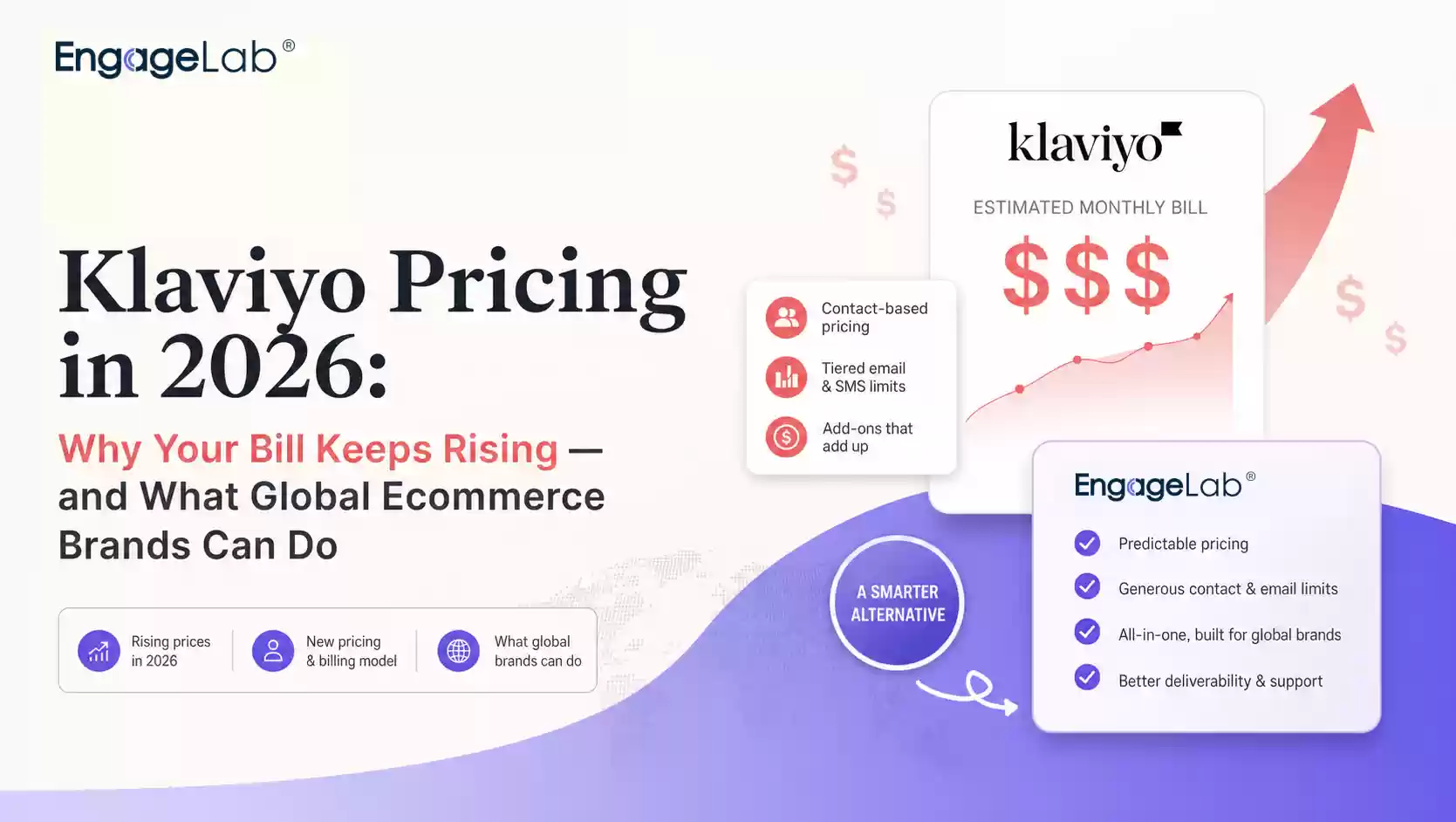
Looking for a Klaviyo alternative? Start with what stopped fitting. Maybe your bill keeps climbing with every billable active profile. Maybe your lifecycle program now spans WhatsApp, push, SMS, and email. Or maybe you are expanding into regions where delivery, data location, and channel operations matter as much as Shopify automation. This guide compares the Klaviyo alternatives worth shortlisting in 2026 by pricing model, channel coverage, ecommerce fit, and migration effort.
The short answer? If you mainly want a simpler Shopify email/SMS replacement, Omnisend or Sendlane are the easier moves. If you need one global engagement stack for email, SMS, WhatsApp, app push, and web push, EngageLab Marketing Automation is the strongest fit on this list. Its five-channel journey builder covers the orchestration layer, while channel-based pricing lets you model costs around the products and usage you actually need.
According to Klaviyo (2026) , its free plan supports up to 250 active profiles and 500 email sends per month. That model works for smaller, active lists; the comparison changes when you need to model cost across multiple channels or regions rather than email and SMS alone.
Best Alternatives at a Glance
Use this shortlist to match the replacement scope to the tool. A Shopify email/SMS swap, a pricing-model change, and a wider omnichannel architecture move are different decisions with different migration costs.
| Tool | Best For | Channels | Pricing Logic | Migration Effort |
|---|---|---|---|---|
| EngageLab | Global omnichannel customer journeys | Email, SMS, WhatsApp, app push, web push | Usage-based per channel (DAU, pay-per-message, or Monthly Engaged Persons) | Medium |
| Omnisend | Shopify email/SMS replacement | Email, SMS, web push | Contact and email-credit tiers, from $11.20/month | Low to medium |
| Sendlane | DTC email/SMS performance | Email, SMS | Custom pricing by list size (not publicly listed) | Medium |
| Brevo | Affordable alternative for smaller ecommerce lists | Email, SMS, WhatsApp, chat | Send-volume pricing; SMS and WhatsApp on prepaid credits | Low |
| Mailchimp | Simple email campaigns | Email, basic automation, add-ons | Contact-based tiers | Low |
| ActiveCampaign | CRM-heavy automation | Email, CRM, SMS add-on | Contact and feature-tier pricing | Medium |
| Drip | Ecommerce personalization | Email, onsite, SMS add-on | Contact-based tiers, from $39/month | Medium |
| Attentive | SMS-rooted omnichannel retention | SMS, email, RCS, push | Quote-based, by message volume and list size | Medium to high |
Data freshness: Pricing was checked against each vendor's own pricing pages in September 2026. Quote-based vendors (Sendlane, Attentive) do not publish rate cards, so their figures above describe the pricing model, not a specific price.
How We Compared the Tools
We compare each tool on the same four dimensions: pricing model (contact-based, send-based, or usage-based), channel coverage beyond email, ecommerce fit (Shopify workflows, segmentation, and product events), and migration effort (event mapping, template rebuilds, consent, and parallel-run risk). The shortlist is not a best-to-worst ranking; each recommendation changes with the constraint you are trying to remove.
Top Competitors Reviewed
1. EngageLab: Best for Global Omnichannel Customer Journeys
EngageLab is the best fit here for ecommerce teams expanding beyond an email/SMS-led retention stack. Its Marketing Automation product brings AppPush, WebPush, Email, SMS, and WhatsApp into one journey builder, giving global teams one place to design cross-channel lifecycle campaigns.

The fit is clearest when your customer base spans regions or your channel mix changes by market. You can keep email at the center in one market, rely more on WhatsApp in another, and use app or web push for re-engagement without rebuilding each journey in a separate tool. Its pricing page defines DAU for AppPush and WebPush and MEP for Marketing Automation, while other messaging channels follow their own usage rules; confirm your volumes before comparing annual cost.
Choose it if: you need global multi-channel orchestration, push, WhatsApp, and a usage model that can be evaluated by channel.
Choose Omnisend or Sendlane instead if: you mainly want a simpler Shopify email/SMS replacement and do not need a five-channel journey layer.
Pros:
 One journey builder covers email, SMS, WhatsApp, app push, and web push.
- Pricing follows each channel's own usage model instead of one flat contact rate.
-
SDK and REST API event reporting gives technical teams a defined path for rebuilding behavioral triggers.
Cons:
 More platform than needed if your entire program is email plus basic SMS.
- Requires migration planning for events, templates, channel consent, and analytics.
The key features of Marketing Automation include:
- Five built-in channels, App Push, Web Push, Email, SMS, and WhatsApp, run from one visual journey builder instead of stitched-together point tools.
- Journey design includes entry and exit conditions, action triggers, timing controls, and message orchestration.
- Pricing follows channel-specific usage models: DAU for AppPush and WebPush, MEP for Marketing Automation, and usage-based rules for messaging channels.
- Android, iOS, and Web SDKs plus REST API event reporting support the data work behind behavioral journeys.
2. Omnisend: Best Shopify Email/SMS Replacement
Omnisend is the most obvious Klaviyo alternative for Shopify-centric teams that still want ecommerce email/SMS automation, signup forms, segmentation, and templates without moving into enterprise customer engagement software. Its official pricing page lists the entry paid tier at $11.20/month as of 2026.

Pros:
-
Strong ecommerce templates for welcome, cart abandonment, product recommendations, and post-purchase flows.
- Easier transition for stores that already understand Klaviyo-style segmentation.
- Public pricing makes early cost modeling easier than quote-based tools.
Cons:
-
Still ecommerce-email centered; WhatsApp and regional messaging depth are not the main reason to choose it.
- Advanced teams may outgrow its broader customer engagement and data flexibility.
3. Sendlane: Best for DTC Email/SMS Performance
Sendlane is built for DTC brands that want strong email and SMS execution, particularly if the team cares about revenue attribution, segmentation, and list monetization more than broad channel orchestration. Pricing is quoted by list size rather than published as a fixed rate card.

Pros:
- Strong positioning for ecommerce email/SMS performance teams.
- Useful for brands that want deeper DTC execution without buying an enterprise CEP.
-
Good shortlist option when Klaviyo cost is the pain but the channel mix stays email/SMS.
Cons:
- Not the right fit if WhatsApp, app push, or web push are central revenue channels.
- No public pricing, so budgeting requires a sales conversation before you can compare.
4. Brevo: Best Affordable Alternative for Smaller Lists
Brevo is worth testing if you are leaving Klaviyo mainly because list-based pricing no longer matches send volume. It covers email, SMS, WhatsApp, and chat, with SMS and WhatsApp billed on prepaid credits, and it is especially attractive as an affordable alternative for a small ecommerce list that needs multi-channel basics on a simpler budget.

Pros:
- Send-volume model can be friendlier for large lists with uneven campaign frequency.
- Covers several channels without forcing a large enterprise contract.
- Practical for European SMBs that care about GDPR workflows and simpler billing.
Cons:
- Ecommerce segmentation depth can feel lighter than Klaviyo for complex catalog behavior.
- Advanced multi-region messaging and fallback logic may require extra setup.
5. Mailchimp: Best for Simple Email Campaigns
Mailchimp is a reasonable alternative when a brand has outgrown basic newsletters but has not yet built a sophisticated lifecycle program. It is familiar, easy to adopt, and widely integrated, but it is not a like-for-like replacement for advanced ecommerce automation.

Pros:
- Friendly campaign builder and a low learning curve for non-technical marketers.
- Good for newsletters, simple promotions, forms, and entry-level automation.
- Broad integration ecosystem and strong brand familiarity.
Cons:
- Not as strong as Klaviyo for ecommerce behavioral segmentation and revenue flows.
- Contact-based pricing can still become a problem as lists grow.
6. ActiveCampaign: Best for CRM-Heavy Automation
ActiveCampaign is a strong option when your business is not pure DTC ecommerce. If sales pipelines, account-level follow-ups, and conditional automation are part of the workflow, ActiveCampaign may replace both Klaviyo and part of your CRM process. SMS is available as an add-on rather than a core plan feature.

Pros:
- Flexible automation builder for branching, scoring, and CRM-triggered journeys.
- Strong fit for B2B/DTC hybrids and brands with sales-assisted journeys.
- Useful when lifecycle marketing and sales follow-up need shared logic.
Cons:
- Pure ecommerce teams may pay for CRM features they rarely use.
-
Channel breadth is weaker if your roadmap includes WhatsApp, app push, or regional messaging.
7. Drip: Best for Ecommerce Personalization
Drip is a Klaviyo competitor for ecommerce teams that want email automation, onsite behavior, segmentation, and personalization without adopting a broader enterprise platform. Plans are contact-tiered starting near $39/month, with SMS available as a separate volume-based add-on.
Pros:
- Good for ecommerce personalization, segmentation, and retention campaigns.
- More focused than enterprise suites, with less implementation overhead.
- Useful for teams that want a Klaviyo-like category but a different operating feel.
Cons:
- Not a natural fit for global messaging programs that depend on WhatsApp or push.
- Smaller teams should compare template and integration coverage before switching.
8. Attentive: Best for SMS-Rooted Omnichannel Retention
Attentive is a serious shortlist option when SMS is the center of the retention program. It started as an SMS specialist, but its current platform is positioned as omnichannel, covering SMS, email, RCS, and push from one workspace, with pricing quoted by message volume and list size rather than published rates.
Pros:
- Strong for SMS capture, segmentation, and DTC retention.
- Good fit for brands with mature offer, compliance, and list-growth operations.
- Can complement or replace part of a Klaviyo SMS program.
Cons:
- No public rate card, so cost only becomes clear after a sales conversation.
- SMS-heavy economics require careful compliance, opt-in quality, and margin modeling.
How to Choose an Alternative Without Recreating the Same Problem
Before switching, map your actual revenue workflows. A brand that sends weekly campaigns to an active list has different needs from a brand that holds 300,000 contacts but only messages 40,000 every month.
| Decision Point | What to Check | Why It Matters |
|---|---|---|
| Billing model | Billable active profiles, sends, SMS credits, WhatsApp fees, and add-ons. | An entry tier can become expensive if inactive profiles remain billable or channel add-ons grow. |
| Primary channel | Email, SMS, WhatsApp, push, or a channel mix. | The best email platform may be the wrong global retention platform. |
| Storefront stack | Shopify, WooCommerce, BigCommerce, headless, marketplace, or custom API. | Migration effort depends on event and catalog sync, not only CSV imports. |
| Data model | Customer properties, product events, consent state, suppression lists. | Bad mapping breaks abandoned cart, replenishment, and win-back workflows. |
| Reporting | Revenue attribution, channel contribution, holdout tests, and conversion windows. | Tool savings are meaningless if the new platform under-reports revenue quality. |
If your replacement project involves more than email and SMS, use a broader behavioral segmentation checklist before committing. It will help you evaluate journeys, events, and channel fallback before the migration begins.
Migration Checklist
Most failed migrations happen because the team compares software screenshots and forgets the data plumbing. Use this checklist before turning off Klaviyo flows.
Migration checklist
- Step 1: Export suppression lists first: unsubscribes and consent history must move before campaigns do.
- Step 2: Map event names: rebuild viewed product, added to cart, checkout started, ordered, refunded, and subscription events.
- Step 3: Rebuild templates: check rendering, dynamic product blocks, localization, and UTM rules.
- Step 4: Warm sending domains: move high-volume email gradually so deliverability does not reset overnight.
- Step 5: Run critical flows in parallel: keep password reset, checkout, post-purchase, and VIP journeys monitored during cutover.
- Step 6: Audit attribution: compare revenue reporting windows before declaring the migration cheaper.
When Klaviyo is still the right call: if your list is mostly active, your channel mix is email-first, and you already rely on its predictive analytics or ecosystem integrations, switching mainly to save on the invoice can cost more in migration risk than it saves. Alternatives make the most sense when a specific constraint, cost, channel, or workflow, has actually changed.
FAQ
-
1
What are the best Klaviyo alternatives?
The best Klaviyo alternative depends on why you are leaving. Omnisend is the cleanest Shopify-focused email/SMS replacement. Brevo is strong for send-volume pricing. Sendlane is useful for DTC email/SMS performance. EngageLab is a better fit when the issue is broader multi-channel orchestration across email, SMS, WhatsApp, and push. -
2
What is the cheapest Klaviyo alternative?
Brevo, Mailchimp, and Omnisend usually offer lower entry costs than Klaviyo, but "cheapest" depends on your contact count, send frequency, SMS volume, and add-ons. Always model a 12-month list-growth scenario instead of comparing only the starter tier. -
3
Is there a good Klaviyo alternative for Shopify stores?
Omnisend is built around Shopify workflows and is the closest like-for-like swap for teams that only need email and SMS. Stores that also need WhatsApp or push alongside Shopify should evaluate a broader multi-channel platform instead of a second point tool. -
4
Is there an affordable Klaviyo alternative for a small ecommerce list?
Brevo's send-volume pricing and Mailchimp's lower contact tiers are usually the most affordable starting points for a small list. Confirm whether SMS and WhatsApp are billed separately before comparing the entry price, since those add-on costs are where small-list budgets get surprised. -
5
Is Omnisend better than Klaviyo?
Omnisend can be better for ecommerce brands that want simpler pricing and standard Shopify email/SMS automation. Klaviyo may remain stronger for teams that depend on its deeper data model, predictive features, and mature ecommerce ecosystem. -
6
Is Mailchimp a good replacement for Klaviyo?
Mailchimp is a good replacement for simple newsletters and promotional email programs. It is not a full replacement if your Klaviyo account depends on advanced ecommerce flows, product recommendations, event-based segmentation, or SMS-heavy retention. -
7
Which Klaviyo alternative supports WhatsApp?
Klaviyo's WhatsApp integration and several alternatives now support WhatsApp, so the channel alone is not a sufficient differentiator. Compare whether you need WhatsApp alongside email, SMS, AppPush, and WebPush in one journey, then verify consent, regional delivery, and message pricing. For related channel planning, read the guide to WhatsApp Business Solution Providers . -
8
How long does it take to migrate from Klaviyo?
There is no single number, since scope drives duration. As a planning range, not a guarantee: a simple newsletter account with few flows can move in days. A revenue-critical setup adds time for every custom event you rebuild, every template and localization pass, consent and suppression migration, sending-domain warm-up, and the parallel-run window before you trust attribution. Size your own timeline from that list rather than a generic estimate.
Bottom Line: Which Tool Should You Choose?
If you are staying inside Shopify email and SMS, start with Omnisend or Sendlane. If your issue is list economics, compare Brevo and Mailchimp carefully against your actual send volume. If your next growth stage needs a scalable, WhatsApp-capable, push, SMS, and email program in one lifecycle workflow, evaluate EngageLab as the fit for that broader customer journey orchestration rather than treating it as a cheaper email-tool swap.
Explore the platform when your next growth stage needs five channels, one journey builder, and pricing you can model by usage.
![How to Make SMS Segmentation Worth the Effort [With 6 Examples]](https://img.engagelab.net/en/article/sms-segmentation-cover.webp)