


Elena Rodriguez
Updated: 2026-06-10
An SDR launches a 500-email-per-day sequence. Month one: 48% open rate, 4.2% reply rate. Month three: opens collapse to 11%, replies sit below 0.5%. The copy didn’t change. The list didn’t change. The shared IP pool the tool uses for inbox rotation got gray-listed by Google, and every campaign on that pool is now throttled.
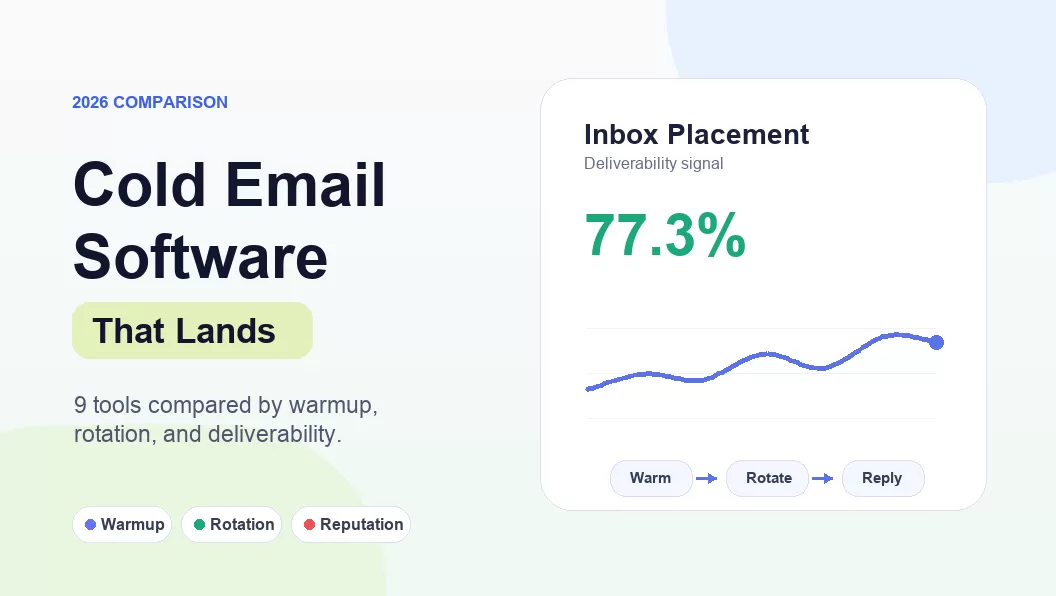
Smartlead’s 2025 deliverability benchmarks put cold email inbox placement at 77.3% in Q1 2025. Woodpecker’s State of Cold Email 2025 report shows how quickly placement can drop once domain reputation degrades. That gap explains a dead pipeline.
The right cold email marketing software does more than send messages: it manages warmup, inbox rotation, sequence logic, and deliverability reporting as a combined stack. This guide compares 9 tools on the criteria that close the placement gap, then covers what happens when volume outgrows shared-rotation infrastructure.
What Is Cold Email Marketing Software? How It Differs from ESPs and Marketing Tools
Cold email software is purpose-built for outbound prospecting: sending unsolicited B2B messages to contacts who have not opted in. It solves a fundamentally different problem than a standard email service provider (ESP) or marketing automation platform.
The capability stack that separates cold email tools from ESPs:
- Multi-step sequences with conditional logic: if a contact opens but does not reply, send step 2; if they reply, stop the sequence automatically
- Email warmup: automated send/receive/reply cycles on new domains to build sender reputation before real outreach begins
- Inbox rotation: distributing sends across 5–50 connected Gmail or Outlook inboxes to stay below per-inbox throttle thresholds
- Personalization tokens, spintax variants, and AI-generated first lines to reduce template fatigue across large prospect lists
- Reply detection that distinguishes human replies from auto-responders and pauses sequences accordingly
- Bounce and unsubscribe handling that preserves list hygiene without manual intervention
Standard ESPs (Mailchimp, SendGrid, Constant Contact) cannot substitute here. Their terms of service explicitly prohibit non-opt-in sending. Accounts sending cold email through shared ESP infrastructure face suspension, their shared IPs are tuned for engaged marketing lists, and there is no warmup, inbox rotation, or conditional sequence logic. Using them for cold outreach pollutes the deliverability reputation that transactional and opt-in campaigns depend on.
A brief compliance note: CAN-SPAM allows cold email in the United States with specific requirements, including valid sender identity, a physical address, and a clear opt-out mechanism. GDPR is stricter in the EU, where cold B2B email relies on “legitimate interest” (Recital 47), which requires narrowly relevant targeting and opt-out compliance. Broad cold email to EU residents carries compliance risk. California (CCPA) and Canada (CASL) impose additional requirements worth reviewing before sending to those regions.
For transactional email (receipts, verification codes, system notifications), the infrastructure is entirely separate. See the transactional email API guide for how those flows are built and scaled.
9 Best Cold Email Software Compared: Features, Pricing, and Deliverability [2026]
The table below maps each tool against the criteria that actually differentiate cold email platforms. All pricing is as of 2026.
Quick Comparison: 9 Cold Email Tools at a Glance
| Tool | Warmup | Inbox Rotation | Sequences | Free Tier | Starting Price | Best For |
|---|---|---|---|---|---|---|
| Lemlist | Lemwarm (built-in) | Yes (multi-sender) | Yes, conditional | 14-day trial | ~$39/user/mo | Personalization-heavy teams |
| Smartlead | Built-in, unlimited | Unlimited | Yes, conditional | 14-day trial | ~$39/mo | High-volume agency outbound |
| Instantly | Built-in, unlimited | Unlimited inboxes | Yes, basic | Trial | ~$37/mo | Volume-per-dollar optimization |
| Apollo | Deliverability center | Yes | Yes | Yes (limited) | ~$49/user/mo | Prospect database + outreach |
| Woodpecker | Built-in | Yes | Yes, advanced | 7-day trial | ~$29/user/mo | GDPR-aligned EU teams |
| Mailshake | Warmup add-on | Yes | Yes | No | ~$29/user/mo | SMB cold outreach entry |
| Reply.io | Built-in | Yes | Yes, multi-channel | 14-day trial | ~$49/user/mo | Multi-channel outbound (email + LinkedIn + phone) |
| Saleshandy | Built-in | Yes | Yes | Trial | ~$25/user/mo | ROI-conscious SMBs |
| Hunter Campaigns | Basic | Limited | Basic | Yes | ~$34/mo | Teams already using Hunter for email finding |
1. Lemlist

Lemlist leads this list on personalization depth. Dynamic image and video inserts, AI-generated first lines, and per-contact landing page variants make it the top choice for teams running hyper-personalized sequences at small-to-mid scale. Its Lemwarm network handles email warmup natively without a third-party add-on. Where it falls short: per-user pricing compounds quickly for larger SDR teams running high-volume sends across many inboxes. Teams optimizing for volume over personalization will find Smartlead or Instantly more cost-efficient.
2. Smartlead

Smartlead is built for scale. Unlimited connected inboxes, unlimited warmup slots, and agency-friendly multi-client management make it a strong fit for outbound agencies and sales teams sending more than 2,000 emails per day. The platform is feature-dense and takes time to navigate for new users, but its warmup, rotation, and deliverability controls are among the strongest in this category.
3. Instantly

Instantly competes on volume per dollar. Flat-rate pricing with unlimited inboxes and unlimited warmup makes it the most cost-efficient option when inbox count drives campaign scale. Sequence logic is basic compared to Lemlist or Woodpecker, and personalization depth is limited. For teams running broad outreach across large prospect lists where per-inbox economics matter most, the pricing model is hard to match.
4. Apollo

Apollo combines a 275M+ contact database with an outreach layer in one platform, removing the need for a separate prospecting tool. The deliverability center handles warmup and domain monitoring. It trades sequence depth for data coverage: teams that need prospect data and email sending in a single workflow will find it practical. Teams needing advanced conditional branching or deep personalization may find the sequence builder limiting.
5. Woodpecker

Woodpecker’s strengths are sequence depth and compliance-first design, which makes it the top pick for EU teams operating under GDPR. Advanced conditional branching, timezone-aware sending, and transparent opt-out handling are built into the core product. It does not offer the unlimited inbox rotation that Smartlead and Instantly provide, so high-volume teams will need to account for that ceiling. For teams where compliance documentation and sequence precision matter more than raw scale, it is well positioned.
6. Mailshake

Mailshake is the entry point for SMBs starting cold outreach. Setup is fast, the interface is clean, and the learning curve is low. Warmup is available as an add-on rather than a native feature, which means early-stage teams need a separate warmup process before their first real campaign. For teams with simple sequences, limited budgets, and no need for advanced rotation or deep personalization, it covers the core use case.
7. Reply.io

Reply.io is the multi-channel option in this list, combining cold email with LinkedIn automation and phone dialing in a single sequence builder. For SDRs running coordinated touchpoints across channels, it reduces tool sprawl. The breadth adds pricing complexity and workflow overhead that single-channel email teams do not need. Teams already managing outreach across email, social, and phone will find the consolidation valuable; teams focused exclusively on cold email will find simpler options in this list.
8. Saleshandy

Saleshandy offers the lowest per-user price point in this group while still including built-in warmup, inbox rotation, and sequence logic. It carries less brand recognition than Lemlist or Smartlead, but for ROI-conscious SMB teams where budget is the primary constraint, the feature-to-cost ratio is difficult to dismiss. Deliverability performance has improved consistently across recent product cycles.
9. Hunter Campaigns

Hunter Campaigns makes most sense for teams already using Hunter for email prospecting. The native connection between the email finder and the outreach module cuts the data-to-send workflow to a single platform. The sequence builder is basic, warmup is limited, and inbox rotation is not as deep as Smartlead or Instantly. The free tier covers light outreach without a paid commitment, making it a practical first step for small teams testing cold email before investing in a dedicated platform.
6 Criteria for Choosing Cold Email Software
Most cold email tools overlap on surface features. The differences that matter for deliverability and pipeline output are below.
1 Warmup Quality and Capacity
Is warmup built into the platform, available as a third-party add-on, or entirely manual? How many inboxes can the tool warm simultaneously? Without 2–6 weeks of warmup, new sending domains get filtered before real outreach begins. Platforms with native unlimited warmup (Smartlead, Instantly) remove a separate tool from the stack; platforms where warmup is an add-on (Mailshake) require additional setup before the first campaign.
2 Inbox Rotation Support
How many Gmail, Outlook, or SMTP inboxes can connect to the platform? Does it use native OAuth or app-password authentication? Sending all campaigns from a single inbox caps volume at roughly 50–100 emails per day before throttling. Teams scaling past that ceiling need a platform that distributes load across multiple warmed inboxes simultaneously. Platforms with unlimited rotation (Smartlead, Instantly) scale linearly; others impose inbox count ceilings.
3 Sequence Logic Depth
Does the platform support conditional branches (if opened but no reply, send variant A; if no open, send variant B)? Does reply detection pause the sequence automatically when a human responds? Is sending timezone-aware? Single-step blast sequences waste leads because every prospect gets the same follow-up regardless of engagement.
4 Personalization Engine
Beyond first name and company tokens, can the platform handle custom CRM fields, spintax variants per send, AI-generated first lines, or dynamic images? Generic outreach sits below 5% reply rate in most B2B verticals. Heavy personalization pushes that figure past 15% in the same vertical. Teams sending to smaller, higher-value prospect lists should weight this criterion more than teams optimizing for volume.
5 Deliverability Reporting
Open rates measure engagement with what reached the inbox, not how much reached it. Inbox vs. spam placement tests, domain reputation monitoring, bounce rate breakdowns, and spam complaint rate tracking tell the complete story. Platforms that surface placement test results (not just open rates) give teams the data to diagnose issues before domain reputation degrades irreversibly.
6 Pricing Model
Cold email platforms price per user, per inbox, per contact, or on flat-rate tiers. Per-inbox pricing (Smartlead, Instantly) scales linearly with outbound volume: adding inboxes adds sending capacity without adding per-user cost. Per-user pricing (Lemlist, Woodpecker) favors small, high-touch teams where each rep manages their own sequences. Evaluate the pricing model against your inbox-to-rep ratio before committing.
Cold Email Deliverability: Why Inbox Placement Drops 30–50% vs Opt-In Email
Smartlead’s 2025 deliverability benchmark puts cold email inbox placement at 77.3% in Q1 2025. Marketing email hits 84.7% globally, according to Validity’s 2025 Email Deliverability Benchmark. That 7-point baseline gap widens once domain reputation starts to slip.

Three structural reasons explain the placement gap:
Sender Reputation Starts at Zero
Opt-in marketing email inherits the reputation of a brand domain built over years of sending to engaged subscribers. Cold outreach typically runs from a secondary domain (acme-sales.com instead of acme.com) to quarantine reputation risk from the primary domain. That secondary domain starts with no send history, no positive engagement signals, and no established sender score. Every warmup day builds that reputation from scratch.
Engagement Signals Are Structurally Weaker
Cold email open rates range from 23–30% and reply rates from 1–5%, both structurally lower than opt-in benchmarks. Mailbox providers read low engagement as low relevance and route accordingly. The more consistently low engagement reads across a sending domain, the faster spam folder routing accelerates.
Spam Traps Are Denser on Prospecting Lists
Even clean prospecting data accumulates spam traps over time as contacts change roles, companies fold, and addresses get recycled. Woodpecker’s 2025 cold email research flags list quality as a major driver of reputation loss. Purchased or scraped lists carry significantly higher trap density than organically built opt-in lists.
What protects placement:
- 2–6 week domain warmup before the first real send
- SPF, DKIM, and DMARC correctly configured on the sending domain
- Inbox rotation to distribute send volume across multiple warmed domains
- Aggressive list hygiene: bounce cleaning before each campaign, active suppression lists, and unsubscribe compliance
For a detailed walkthrough of the authentication setup that underpins deliverability, see the guide on SPF records and email authentication .
When You Outgrow Plug-and-Play Cold Email Tools
The graduation threshold is approximately 5,000 sends per day sustained, or roughly 100,000 per month. At that volume, the shared-inbox model that most plug-and-play cold email tools rely on starts breaking down.
The 2025 Compliance Shift
Google’s bulk-sender rules require DMARC enforcement, one-click unsubscribe, and spam complaint rates below 0.3% for senders exceeding 5,000 emails per day to Gmail addresses. Microsoft introduced similar sender-authentication enforcement in 2025. Shared inbox rotation, which worked in 2023 by cycling warmed Google Workspace accounts, now triggers filter cascades when any single inbox in the rotation pool gets flagged. The economics of the workaround have changed.
When to Graduate to Dedicated Infrastructure
- You are consistently hitting send caps on shared rotation tools
- Domain reputation degrades despite consistent warmup cycles
- Legal or compliance teams require dedicated-IP accountability and audit trails
- You need delivery analytics tied to CRM events, not just sequence-level open rates
- Cold prospects have converted into customers who now need onboarding emails, receipts, and transactional sequences
What Dedicated-IP Infrastructure Adds
Cold email tools are optimized for the outreach phase: landing the first reply from someone who never asked to hear from you. They are designed for warmup, inbox rotation, and sending from secondary domains. Once a prospect replies, books a meeting, or converts to a customer, the communication shifts from cold outreach to opted-in.
Sending onboarding emails, receipts, password resets, and nurture sequences from a cold email tool degrades deliverability on both sides. Transactional mail lands in spam. Cold IPs get flagged faster. For the post-reply phase, a dedicated-IP ESP built for transactional and opt-in marketing is the correct infrastructure layer.
 Moving from cold outreach to opted-in sends?
EngageLab handles the post-reply infrastructure: dedicated IP sending with owner-controlled reputation, auto-configured SPF/DKIM/DMARC, and a free responsive template library for onboarding and transactional flows. Run sequence tools for outreach logic; route post-conversion sends through dedicated-IP infrastructure for deliverability control.

What a dedicated-IP ESP adds after the first reply:
- Dedicated IP: you own the reputation, not a shared pool
- Auto-configured SPF, DKIM, and DMARC during domain setup
- Delivery analytics mapped to CRM events, not sequence-level open rates
- Responsive template library for onboarding, receipts, and transactional sequences
- Sending infrastructure isolated from cold outreach IP reputation
FAQ + Key Takeaways
Q1: Is cold emailing legal?
In the United States: yes, with CAN-SPAM compliance (valid sender identity, physical mailing address, clear opt-out, no deceptive subject lines). In the EU, cold B2B email may rely on GDPR’s “legitimate interest” basis, but only with narrowly relevant targeting, opt-out compliance, and documented assessment. Broad cold sends to EU residents carry regulatory risk. Canada’s CASL is stricter than CAN-SPAM and requires implied or express consent in most cases. Review the applicable law for each region before sending.
Q2: Can I use Gmail or Outlook directly for cold email?
Technically yes, but with significant constraints. Gmail caps sending at 500 per day on personal accounts and 2,000 per day on Workspace. Outlook caps at 300 per day. Both providers throttle or suspend accounts at high cold-email volume without warmup and rotation infrastructure. Dedicated cold email tools exist specifically to distribute sends across multiple inboxes, manage bounce handling, and run conditional sequences that Gmail and Outlook do not provide natively.
Q3: What’s the best free cold email tool?
Apollo and Hunter Campaigns both offer usable free tiers with basic outreach capability. Most other tools in this list offer 7–14 day trials rather than ongoing free plans. For sustained cold outreach at any meaningful volume, budget at least $25–50 per month per sender seat. Saleshandy and Instantly typically offer the most volume per dollar at entry-tier pricing.
Q4: How many cold emails can I send per day safely?
From a warmed domain: 30–50 per day in week one, ramping to 100–150 per day by week four. Scaling past 500 per day requires inbox rotation across multiple warmed domains. Scaling past 5,000 per day requires dedicated-IP infrastructure and full DMARC enforcement per Google’s 2024 bulk-sender rules. These limits apply per sending domain, so adding secondary domains with separate warmup cycles extends capacity proportionally.
Q5: Can I use a transactional email API for cold outreach?
No. Transactional email APIs (including platforms like SendGrid and EngageLab ) are built for opted-in, event-triggered sends: receipts, OTPs, password resets. Sending cold email through a transactional API violates provider terms of service. More practically, cold campaigns that generate spam complaints will degrade inbox placement for every receipt and verification code routed through the same infrastructure. Use dedicated cold email tools for outreach, and reserve transactional APIs for post-conversion sends.
Key Takeaways
- Personalization-heavy, small teams: Lemlist or Woodpecker
- High-volume agency outbound: Smartlead or Instantly
- Prospect database + outreach in one tool: Apollo or Hunter Campaigns
- Multi-channel outbound (email + LinkedIn + phone): Reply.io
- Budget-conscious SMB entry: Saleshandy or Mailshake
- EU teams with GDPR compliance requirements: Woodpecker
- Crossed ~5,000 sends per day and domain reputation degrading: Layer a dedicated-IP ESP underneath the sequence tool. See the best email service providers comparison for opt-in and transactional infrastructure options.
- Cold prospects already converted to customers? Move them to an ESP built for transactional and opt-in sequences, keeping cold outreach infrastructure completely separate.

![How to Do an Email Blast Right? [2026 Guide]](https://img.engagelab.net/article/email-blast-cover.png)

