Jacob Morrow
Updated: 2026-08-28
The cheapest A2P messaging provider quote can become expensive once setup costs, carrier fees, failed OTPs, and limited support enter the picture. The right provider must work in your target markets, support the channels you need, meet local requirements, show whether messages are delivered, and provide reliable help when problems occur. This comparison evaluates seven current providers using the same criteria, helping product, operations, and engineering teams build a practical shortlist without treating every SMS tool or communications platform as interchangeable.
What Does an A2P Messaging Provider Do?
An A2P messaging provider connects a business application to mobile users. Unlike person-to-person messaging, the message is triggered by software rather than manually written by another individual. The provider receives the message from a business system, delivers it through the appropriate mobile network, and reports whether it reached the recipient. Common A2P traffic includes one-time passwords, transaction alerts, appointment reminders, service updates, and opted-in promotions.
Provider scope varies. Some vendors focus on carrier connectivity and messaging APIs. Others are broader communications platform as a service (CPaaS) providers with SMS, MMS, RCS, WhatsApp, voice, and verification. Customer engagement platforms may add email, push notifications, segmentation, and journey automation. These categories overlap, but they are not identical. If programmable SMS is the only requirement, a narrower SMS API provider comparison may be more useful than an omnichannel shortlist.

How Were These A2P Messaging Providers Evaluated?
The providers below were selected because they offer active business messaging products with API access and are relevant to global or multi-market A2P use cases. This is an editorial comparison, not a laboratory delivery test or a universal ranking. Product capabilities were checked against official provider pages and documentation in August 2026.
The comparison uses the same purchasing criteria for every provider:
-
Business fit
The company size, team structure, and messaging use cases the provider serves best.
-
Channels
Whether it supports SMS only or also WhatsApp, email, push, voice, and other channels.
-
Global reach
Whether it can support the countries and regions where the business operates.
-
Ease of use
Whether business teams can manage sending and reporting without relying heavily on developers.
-
Reliability and compliance
How the provider supports message delivery, consent, and local requirements.
-
Pricing and support
How easy it is to understand total costs and get help when problems occur.
Day-to-day use was assessed from publicly available campaign tools, self-service access, API requirements, and onboarding information. These labels describe the likely operating model, not the quality of the user experience.
Published delivery rates are not compared because results vary by country, carrier, message type, consent, and contact quality. Coverage and channel availability can also change by market. Use this comparison to narrow the field, then ask shortlisted providers to confirm support for your specific requirements and run a representative pilot before signing a long-term contract.
How to use this guide: Shortlist providers by business fit first. Use channel coverage, cost, support, and technical checks to validate the shortlist—not to replace the initial business decision.
7 A2P Messaging Providers to Compare in 2026
This shortlist is intentionally limited to seven providers with current API-based messaging products and credible multi-market or enterprise use cases. It is not an exhaustive market directory: regional SMS tools and marketing-only platforms were excluded because they do not offer the same provider scope. The order below is for navigation, not a performance ranking.
| Provider | Platform type | Day-to-day use | Pricing visibility | What to consider |
|---|---|---|---|---|
| EngageLab | Omnichannel engagement platform | Business-team friendly, with developer options | Self-service rates available after signup | Market availability and onboarding vary; confirm target countries |
| Twilio | Developer-focused CPaaS | Developer-led self-service | Public base rates; additional fees vary | Public pricing is available, but numbers, channels, and fees add complexity |
| Sinch | Global messaging and CPaaS | Enterprise and sales-assisted | Public SMS entry pricing; enterprise services may require a quote | Some products, support, and setup details require sales confirmation |
| Infobip | Omnichannel CPaaS and engagement tools | Business tools with managed setup options | Public SMS entry pricing; enterprise packages require a quote | Enterprise packages and support levels require a quote |
| Vonage | Communication APIs across messaging, voice, and video | Developer-led self-service | Public base rates; market and channel costs vary | Public entry pricing is available; market and channel costs vary |
| Bird | Messaging and customer engagement platform | Business-team friendly, with developer options | Published usage model; full cost varies by product and market | Confirm current packaging, usage charges, and included support |
| Tata Communications Kaleyra | Managed enterprise CPaaS | Sales-led enterprise setup | Sales quote usually required | Full cost, onboarding, and support details require sales confirmation |
How to read pricing visibility: This column states where an initial estimate can be obtained and whether important costs still vary or require a quote. It does not compare which provider is cheapest.
1 EngageLab
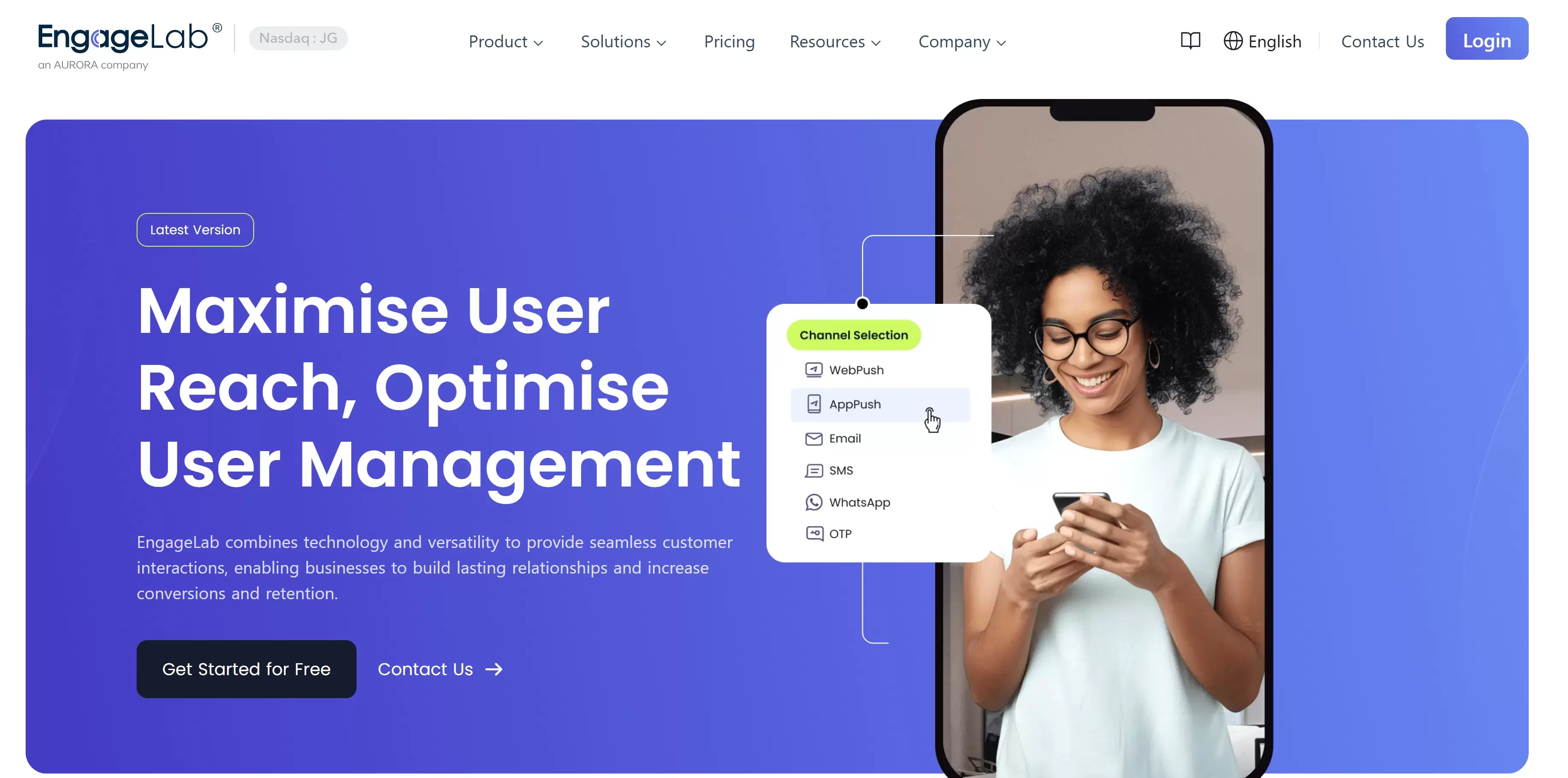
EngageLab combines SMS with WhatsApp, email, AppPush, and WebPush across 200+ countries and regions. Marketing and operations teams can manage sending, tracking, and automated customer journeys from one platform, while developers can use the SMS documentation when a custom integration is needed.
- Best for: International teams that want A2P SMS plus push, email, or WhatsApp in a broader engagement stack.
- Day-to-day use: Business-team friendly for sending and reporting, with developer options for custom workflows.
- Key strengths: Manage SMS and other customer communication channels in one platform, with tools for sending, tracking, and automating messages.
- Limitations to consider: Confirm availability, onboarding, two-way messaging, and support options in every target market.
- Pricing: SMS uses pay-as-you-go billing with country- and route-specific rates shown in the console.
2 Twilio
Twilio stands out for its self-service developer ecosystem. It supports SMS, MMS, RCS, and WhatsApp and provides extensive documentation for businesses that want to build messaging into their own products and workflows.
- Best for: Developer-led businesses that value self-service APIs, documentation, and a broad communications ecosystem.
- Day-to-day use: Primarily developer-led; self-service tools are strong, but business workflows often require configuration.
- Key strengths: Flexible integrations, extensive documentation, broad channel support, and public pricing for many destinations.
- Limitations to consider: Costs and setup can become complex as a business adds countries, channels, phone numbers, and support services.
- Pricing: Pay as you go, with costs varying by destination, channel, sender, direction, carrier fees, and volume.
3 Sinch
Sinch is differentiated by large-scale global messaging and rich-channel reach. It offers SMS, MMS, RCS, WhatsApp, voice, and email products for organizations that need international customer communication and enterprise support.
- Best for: Enterprises that prioritize carrier connectivity, international messaging, and access to SMS and rich messaging channels.
- Day-to-day use: Enterprise and sales-assisted, especially when implementation and account support are part of the purchase.
- Key strengths: Broad international messaging coverage, rich messaging options, verification services, and enterprise support.
- Limitations to consider: Product availability and onboarding vary by market. Complex deployments may require sales-led scoping rather than a purely self-service purchase.
- Pricing: Sinch publishes pay-as-you-go options for SMS and voice, while many enterprise and rich-channel requirements are quote based.
4 Infobip
Infobip offers broad omnichannel orchestration in this shortlist. It combines SMS, WhatsApp, RCS, email, voice, and other channels with campaign tools, customer service conversations, automation, and managed support.
- Best for: Enterprises that need omnichannel messaging, regional onboarding assistance, and optional managed or orchestration products.
- Day-to-day use: Business teams can use campaign and conversation tools, while complex deployments are usually service-assisted.
- Key strengths: Extensive channel choice, campaign and journey tools, customer service capabilities, and regional enterprise support.
- Limitations to consider: Its broad product range may be more than a smaller team needs, and packaging can take time to compare.
- Pricing: SMS is available on a pay-as-you-go basis; custom packages add support, SLAs, APIs, and analytics.
5 Vonage
Vonage is relevant when a business wants messaging, verification, voice, and video services from one provider. Its messaging products cover SMS, MMS, RCS, WhatsApp, Viber, Facebook Messenger, and email.
- Best for: Businesses that want to combine messaging with verification, voice, or video through one API vendor.
- Day-to-day use: Primarily developer-led and best suited to teams that manage communications through APIs.
- Key strengths: Messaging, verification, voice, and video from one provider, with options for switching between channels when needed.
- Limitations to consider: It delivers the clearest value when a business needs several communications products rather than messaging alone.
- Pricing: Usage based, with rates varying by channel, destination, region, and volume.
6 Bird
Bird, formerly known as MessageBird, differentiates itself by combining messaging with customer data and campaign automation. Its current Channels API covers SMS, email, and WhatsApp.
- Best for: Teams that want messaging APIs alongside customer data, campaign, or automation tooling.
- Day-to-day use: Business-team friendly for campaigns and customer data, with APIs for custom workflows.
- Key strengths: Messaging, customer data, and campaign automation in one platform, with support for SMS, email, and WhatsApp.
- Limitations to consider: Confirm which current products and support options are included, especially when migrating from older MessageBird services.
- Pricing: Usage- or bundle-based pricing varies by product, destination, volume, and message category.
7 Tata Communications Kaleyra
Tata Communications Kaleyra focuses on managed enterprise deployments. Its portfolio covers SMS, WhatsApp, RCS, MMS, voice, video, push notifications, and email for organizations planning large, multi-channel deployments.
- Best for: Large organizations seeking global communications infrastructure, enterprise support, and a broad channel mix.
- Day-to-day use: Sales-led enterprise setup with implementation support rather than a lightweight self-service workflow.
- Key strengths: Extensive channel coverage, enterprise implementation support, and services for OTP, notifications, and customer engagement.
- Limitations to consider: It is better suited to large, sales-led deployments than teams looking for a simple self-service messaging tool.
- Pricing: Tailored quotation through sales.
Which A2P Provider Fits Your Business?
Use this table to make a first cut before requesting demos or quotes. It is a shortlist guide based on operating model and product scope, not a ranking of delivery performance.
| If your priority is... | Shortlist first | Why | Less suitable when... |
|---|---|---|---|
| Developer flexibility and self-service setup |
Twilio
|
Strong developer ecosystem, documentation, and flexible APIs | Business teams want a simpler all-in-one workflow |
| Marketing and cross-channel engagement |
EngageLab
Bird
Infobip
|
Campaign, audience, automation, or engagement tools extend beyond basic SMS sending | Only a basic SMS API is required |
| OTP and authentication at scale |
Sinch
Vonage
Tata Communications Kaleyra
|
Verification products or enterprise authentication services are part of their portfolios | Marketing automation is the main requirement |
| Transactional messaging across multiple markets |
EngageLab
Sinch
Infobip
|
Multi-market messaging and delivery reporting support operational notifications | The business operates in only one simple market |
| Messaging combined with voice or video |
Vonage
|
One communications API portfolio extends beyond messaging | Messaging is the only requirement |
| Large, managed multi-region deployment |
Sinch
Infobip
Tata Communications Kaleyra
|
Broad communications portfolios with sales-assisted or managed support | Quick self-service setup is the main priority |
After this first cut, keep two or three candidates and verify target-market availability, total cost, onboarding, and support. Where the table says details require confirmation, that lack of public information should itself be considered during procurement.
Final Procurement Checklist
Once the fit table has reduced the field to two or three providers, use the same business and technical checks for every finalist.
Business Checks
- List the countries, channels, message types, and estimated volume you need.
- Confirm whether the provider supports local setup and compliance requirements.
- Compare the full cost, not only the advertised message rate.
- Check whether marketing and operations teams can manage daily work easily.
- Review reporting, customer support, and service commitments.
- Test the platform with a small but representative pilot.
Technical Checks
Ask your technical team to check:
- Integration: Can the provider connect easily with existing systems?
- Security and scale: Can it protect customer data and handle peak traffic?
- Critical messaging: Are backup delivery, service commitments, and escalation support sufficient?
Which Provider Should You Shortlist?
A useful selection process should end with two or three candidates, not seven broadly capable platforms. Use the fit table for the first cut, then compare each finalist against the same markets, message volumes, operating needs, total costs, support expectations, and technical checks.
EngageLab is worth shortlisting when a business needs international SMS together with WhatsApp, email, and push engagement, plus tools for both business users and developers. Before deciding, confirm that EngageLab supports your target markets, required channels, local setup needs, expected message volume, and support requirements.
Start with a real workflow, or discuss target markets, channels, expected volume, and onboarding needs with the EngageLab team.
![70 Holiday Greeting Messages for Business on Every Occasion [2026]](https://img.engagelab.net/article/happy-holiday-msg-cover.png)


![Best SMS Short Code Providers: 10 Options Compared [2026 Updated]](https://img.engagelab.net/article/sms-short-code-service-provider.png)