Elena Rodriguez
Updated: 2026-03-20
Google slashed reCAPTCHA’s free tier from 1 million assessments per month to just 10,000 in early 2025. Many developers woke up to unexpected charges with no migration path. That moment triggered a wave of searches for the best CAPTCHA alternative.
Cost isn’t the only issue. A Stanford University study found that CAPTCHA challenges can reduce form conversions by up to 40%. Similarly, HUMAN Security research found that 40% of real shoppers have abandoned a purchase specifically because of CAPTCHA friction.
Above all, there is also security irony. According to roundtable.ai (2025), advanced object-detection bots defeat reCAPTCHA v2 with an 83% success rate. That means you are paying more for a tool that frustrates users and doesn’t stop bots.
This guide compares the 8 best CAPTCHA alternatives in 2026. They are scored on UX, bot accuracy, GDPR compliance, and integration ease, so you can drop reCAPTCHA today.

Why reCAPTCHA Is No Longer Enough
Many teams are reconsidering Google reCAPTCHA because it now suffers from three simultaneous failure modes, i.e., cost shock, conversion damage, and a growing security gap.
1 Cost Shock After the 2025 Pricing Shift
The main trigger came in 2025 when Google reduced the free tier out of nowhere. The allowance dropped from 1 million assessments per month to just 10,000.
This means almost any site with high traffic would exceed the limit and incur charges. They had to migrate to the paid Enterprise model through Google Cloud, which introduced a standard $8/month base cost (100,000 assessments/month) plus usage-based pricing ($0.001/assessment over 100,000).
This created an immediate operational cost pressure for any business with high-traffic sites without warning.
2 Conversion Damage and User Friction
Lost conversion is the second problem, less visible but more expensive. The Stanford / Moz CAPTCHA conversion study found that CAPTCHA challenges can reduce form conversions by up to 40%.

Many other industry data also indicate similar patterns:
- HUMAN Security research (2024) found that 40% of real shoppers have abandoned a purchase specifically because of CAPTCHA friction.
- Industry data cited by Responser puts immediate form abandonment upon seeing a CAPTCHA at 1.47%. These are users who leave before even attempting it.
- Text CAPTCHAs carry an average human failure rate of 29.45%. This indicates that real users fail nearly one in three times.
- 67% of users abandon a process permanently after encountering a single complication in the conversion path (Instapage industry data).
These aren’t edge cases. They are your email deliverability numbers, sign-up rates, and revenue.
3 The Security Illusion
CAPTCHA protection is becoming less effective against modern bots, even with these costs and UX penalties.
Roundtable.ai’s hCaptcha vs reCAPTCHA 2025 analysis shows that AI-powered object-detection systems can now defeat reCAPTCHA v2 image challenges with an 83% success rate. Advanced bot frameworks use machine learning to identify objects faster than many humans.
Besides that, reCAPTCHA v3 offers the invisible version, but it relies on behavioral tracking through cookies and interaction data. This raises compliance concerns for organizations subject to GDPR and other regulations.
So, rising costs, declining conversions, and weakening bot resistance are three crucial pressures urging teams to seek a modern CAPTCHA alternative. In fact, in EngageLab’s analysis of form completion patterns across high-traffic client integrations, sites that replaced traditional image CAPTCHA with invisible bot detection saw measurable reductions in sign-up drop-off within the first billing cycle.
How Modern CAPTCHA Alternatives Work
The best CAPTCHA alternatives in 2026 no longer rely on distorted text or image puzzles. They use invisible bot-detection techniques that analyze behavior and interaction patterns behind the scenes.
The four most common mechanisms used by modern CAPTCHA alternatives are:

1 Proof-of-Work (PoW)
Proof-of-Work systems ask the browser to solve a small cryptographic puzzle in the background before a form submission is accepted. User sees nothing or just a simple checkbox. For example, check out the Friendly Captcha reCAPTCHA alternative or ALTCHA.
The trade-off is that PoW can add a slight page load time, and it may be less suitable for extremely low-power devices.
2 Behavioral / Risk-Score Analysis
Behavioral systems rely on real-time interaction signals to determine whether a visitor behaves like a human or a bot. It can analyze mouse movement, keystroke timing, device fingerprint, and IP reputation to generate a risk score in real time.
Users never see a challenge because the decision happens invisibly in milliseconds. For example, Cloudflare Turnstile and EngageLab CAPTCHA rely on this approach.
The trade-off is that these systems require more signal data. It becomes less effective if an attacker replicates human patterns.
3 Honeypot Fields
Honeypot protection inserts a hidden form field that normal users cannot see. Since bots often autofill every available field, filling the hidden input causes an automatic rejection.
This method creates zero friction for legitimate visitors, and it’s commonly built into form frameworks and marketing tools like Klaviyo.
The trade-off is that sophisticated bots can detect and ignore honeypot fields.
4 Time-Based Analysis
Time-based detection measures the speed at which the form is completed. Bots usually fill forms almost instantly, but real users take several seconds to read and type. Many systems combine this signal with Proof-of-Work or Honeypot detection to improve accuracy.
The trade-off is that some bots add artificial delays to simulate human timing.
The best CAPTCHA alternatives in 2026 combine 2–3 of the above mechanisms. They keep the mechanisms invisible to users, adaptive to the sophistication of bots, and compliant with GDPR and WCAG.
The 8 Best CAPTCHA Alternatives in 2026
When Google’s era of free reCAPTCHA has ended, here are the best CAPTCHA alternatives for developers to consider in 2026:
1 EngageLab CAPTCHA — AI-Driven Invisible Bot Detection
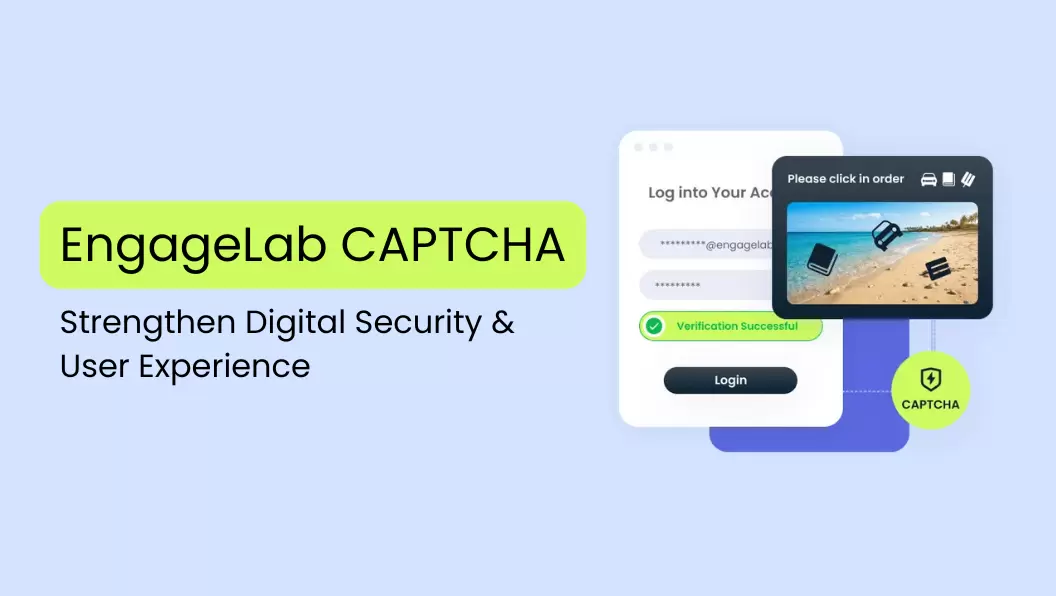
- Best For: Developers & businesses seeking invisible, AI-powered bot protection with zero user friction. Teams already using EngageLab’s multi-channel stack (email, SMS, push, WhatsApp).
- Mechanism: AI-driven behavioral risk scoring, fully invisible. No user interaction, no widget, no puzzle. Runs in the background during form submission.
- Privacy: No invasive tracking, no third-party cookies, no PII collection. GDPR-compliant by design.
- Pricing: Free tier available. Competitive pay-as-you-grow pricing (as of March 2026).
- Integration: Lightweight JavaScript SDK. Easy drop-in for registration forms, checkout flows, OTP verification — no complex setup required. For teams running high-volume user flows on EngageLab, such as OTP verification, registration forms, and checkout, EngageLab CAPTCHA drops in without adding another SDK or vendor relationship. If you have already sent transactional email or SMS verification through EngageLab, the CAPTCHA layer uses the same SDK you already initialized.
Trade-off:
- Best for teams already in the EngageLab ecosystem. Not a standalone competitor to enterprise bot management platforms.
2 Cloudflare Turnstile — Free Invisible Protection for Cloudflare Sites

- Best For: Sites already on Cloudflare, and developers who want free invisible protection with minimal setup.
- Mechanism: Behavioral signals + device reputation analysis. No visual puzzles. No image selection.
- Privacy: No user tracking for advertising purposes. GDPR-safe by design.
- Pricing: Free for up to 10 site keys; Enterprise pricing for additional widgets (as of March 2026).
- Integration: One JavaScript snippet — <script
src="https://challenges.cloudflare.com/turnstile/v0/api.js" async
defer></script>
Trade-off:
- Performs best for sites already behind Cloudflare’s network. Non-Cloudflare deployments require additional setup.
3 Friendly Captcha — EU GDPR-First Proof-of-Work Verification

- Best For: EU-based businesses with strict GDPR or data residency requirements.
- Mechanism: Proof-of-work processed in the browser background. EU-only data centers.
- Privacy: No cookies, no tracking, no PII. GDPR-compliant by design, not by configuration.
- Pricing: From €9/month; free plan available for non-commercial use (as of March 2026).
- Integration: Standard widget + server verification.
Trade-off:
- Slight page load overhead on older or low-end devices due to the PoW computation. Not the fastest option for mobile-first and emerging-market traffic.
4 hCaptcha — GDPR-Safe Image-Challenge Alternative

- Best For: Image-based challenges with GDPR compliance and revenue sharing for sites.
- Mechanism: Image-selection challenges for unknown users, and passive invisible mode for trusted/returning users. Adaptive challenge level based on risk score.
- Privacy: Zero PII collected. GDPR, CCPA, and HIPAA compliant.
- Pricing: Free up to 1 million requests per month; custom enterprise pricing above that (as of March 2026).
- Integration: API compatible with many reCAPTCHA flows. Quick code changes for most sites.
Trade-off:
- Image-selection challenges still appear for new or untrusted users. Not fully invisible in the way Turnstile or EngageLab CAPTCHA are.
5 ALTCHA — Open-Source Self-Hosted Zero-Dependency Solution

- Best For: Open-source advocates, self-hosted deployments, privacy-obsessed developers who want zero third-party dependency.
- Mechanism: Proof-of-work. MIT license. Fully self-hostable (no calls to external servers).
- Privacy: No third-party servers, no cookies, no fingerprinting whatsoever.
- Pricing: Free and open source (as of March 2026).
- Integration: Self-hosted service or lightweight JS library + server verification.
Trade-off:
- Self-hosting requires your own infrastructure maintenance. No managed dashboard or SLA.
6 Honeypot (DIY) — Zero-Cost Invisible Spam Protection

- Best For: Low-traffic sites wanting zero-friction, zero-cost spam protection with no external dependencies.
- Mechanism: Hidden form fields that bots fill and are never shown to humans. Server-side rejection on non-empty honeypot value. Often combined with time-based submission analysis.
- Privacy: Nothing external. No vendor, no SDK, no cookies.
- Pricing: Free (as of March 2026).
- Integration: Built into many frameworks (plugins/packages available).
Trade-off:
- Ineffective against sophisticated bots that scan HTML and skip honeypot fields.
7 MTCaptcha — WCAG-Accessible Text-Challenge Option

- Best For: Teams that need text-based challenges that still meet WCAG 2.1 Level AA accessibility requirements.
- Mechanism: Text decryption challenge with an audio alternative for users with visual impairments.
- Privacy: GDPR, CCPA, and PDPA compliant.
- Pricing: Free tier available. Paid plans for higher volume (as of March 2026).
- Integration: JS widget + server verification. Dashboards for enterprise monitoring.
Trade-off:
- Text-based challenges are still a source of friction. It solves the accessibility gap that many image-based CAPTCHAS fail at, but it’s not invisible.
8 DataDome — Enterprise Bot Management Platform
- Best For: Enterprise e-commerce and high-volume APIs requiring real-time bot mitigation beyond what a drop-in CAPTCHA can handle.
- Mechanism: ML-based behavioral analysis at the network edge. No user-facing challenges for legitimate traffic. Handles credential stuffing, account takeover (ATO), and scraping at scale.
- Pricing: Enterprise pricing. Not a drop-in CAPTCHA replacement but a full bot management layer (as of March 2026).
- Integration: Edge or proxy deployment, SDKs, and server API. A full bot-management platform rather than a simple CAPTCHA.
Trade-off:
- Pricing and integration complexity put this out of reach for most startups and mid-size teams.
Quick Comparison: 8 Best CAPTCHA Alternatives
| Solution | Invisible | GDPR-Safe | Free Tier | Best For |
|---|---|---|---|---|
| EngageLab CAPTCHA | ✔ Yes | ✔ Yes | Yes — included in platform | EngageLab ecosystem users |
| Cloudflare Turnstile | ✔ Yes | ✔ Yes | Yes (up to 10 site keys) | Cloudflare-hosted sites |
| Friendly Captcha | ✔ Yes | ✔ Yes (EU servers) | Yes (free/non-commercial + paid tiers) | EU GDPR-strict deployments |
| hCaptcha | Partial | ✔ Yes | Yes (1M/mo) | reCAPTCHA drop-in swap |
| ALTCHA | ✔ Yes | ✔ Yes | Yes (open-source) | Self-hosted / open source |
| Honeypot (DIY) | ✔ Yes | ✔ Yes | Yes (free) | Low-traffic sites |
| MTCaptcha | ✘ No | ✔ Yes | Yes (trial/free tier) | WCAG accessibility requirements |
| DataDome | ✔ Yes | ✔ Yes | ✘ No (enterprise pricing) | Enterprise bot management |
| Notes: ✔ = supported • Invisible = no user-facing puzzle required | ||||
How to Choose: Decision Framework by Use Case
There isn’t a single best CAPTCHA replacement for every website. The right choice depends on your infrastructure, privacy requirements, traffic volume, and bot threat level. So, don’t compare features to choose the best CAPTCHA alternative. Look for the one that best suits your environment.
Check this decision framework to shortlist the best CAPTCHA alternative for your specific use case:

 If your site is already on Cloudflare: → Cloudflare Turnstile
It’s built into the Cloudflare ecosystem, so it can integrate with a single JavaScript snippet and runs invisibly. It’s the simplest free reCAPTCHA replacement with no extra vendor for sites already using Cloudflare.
If you’re EU-based and need strict GDPR or data residency compliance: →
Friendly Captcha
It uses browser-based proof-of-work and EU infrastructure. There aren’t any cookies or tracking, which makes it GDPR-aligned by design.
If you already use EngageLab for email, SMS, or OTP: → EngageLab CAPTCHA
Teams already using EngageLab can integrate CAPTCHA into the same SDK, with no extra scripts or vendors required. Verified users flow directly into your marketing automation workflows.
If you’re open-source or self-hosted and want zero third-party data handling:
→ ALTCHA
It’s open-source (MIT license) and self-hostable. This gives developers maximum control with no third-party dependencies.
If you need a drop-in reCAPTCHA replacement with a similar API structure: →
hCaptcha
It offers direct API compatibility with reCAPTCHA v2/v3, so switching requires minimal code changes. It is also GDPR-safe and offers a generous free tier.
If you run enterprise e-commerce with complex bot threats — credential stuffing,
ATO, scraping: → DataDome or HUMAN Security
These platforms provide full bot management. They analyze traffic and behavior across APIs and login/checkout systems.
If you want zero cost on a low-traffic site: → Honeypot field + time-based
analysis
Many frameworks support this approach natively. They provide basic bot protection without external SDKs or vendors.
The right choice depends less on which tool has the best feature list and more on where your users drop off, which compliance regime you are in, and which infrastructure you already run.
Step-by-Step: Replace reCAPTCHA in Under 30 Minutes
It is straightforward to migrate from Google’s reCAPTCHA to a modern CAPTCHA alternative. Most developers can complete the switch in under 30 minutes with the right setup.
1 Audit Your Current CAPTCHA Touchpoints
List every form that has reCAPTCHA. Common locations are login pages, registration forms, contact forms, and checkout flows. Each one needs to be migrated separately. Skipping one leaves a gap.
2 Choose Your Replacement
Use the decision framework above to select the best tool for your environment. For developers replacing reCAPTCHA v2 or v3, the fastest drop-in options are Cloudflare Turnstile or hCaptcha because their APIs resemble the original implementation. If you are already on EngageLab, that decision is already made.
3 Remove the Existing reCAPTCHA Script and Site Key
Delete the Google reCAPTCHA JS snippet from your page <head> and remove
every grecaptcha.execute() call from your frontend JavaScript. Remove the hidden
g-recaptcha-response field from your form.
4 Add the Replacement Script
Now, add the replacement script of the CAPTCHA tool you picked.
For Cloudflare Turnstile:
<!-- Load the script -->
<script
    src="https://challenges.cloudflare.com/turnstile/v0/api.js" async
    defer></script>
<!-- Add the widget div where your reCAPTCHA used to sit -->
<div class="cf-turnstile" data-sitekey="YOUR_SITE_KEY"></div>
For EngageLab CAPTCHA:
Behavioral scoring runs in the background via the EngageLab CAPTCHA SDK. There is no visible widget or additional initialization if you are already calling the EngageLab SDK for OTP or push. EngageLab CAPTCHA integrates at this step via the same SDK already used for OTP and push.
5 Validate the Token Server-Side
Send the returned token from your frontend to your backend. Call the provider’s verification endpoint and confirm validity before processing the form. Never trust client-side signals alone because a bot can fabricate a client-side pass.
6 Test with Real Bots and Real Users
Use a staging environment. Confirm legitimate users pass without friction. Run Playwright in headless browser mode to simulate automated submissions and confirm bots are blocked.
7 Monitor Performance for 30 Days
Track three metrics: form completion rate, spam submission rate, and false positive rate (legitimate users blocked). If you are seeing false positives, adjust the risk score threshold in your provider’s dashboard.
For teams already using EngageLab’s messaging stack (OTP, push notifications, or verification flows), EngageLab CAPTCHA integrates at step 4 through the same SDK. This eliminates the need to onboard a new vendor or add extra scripts.
FAQ — 7 Questions
Q1: What is a CAPTCHA alternative?
A CAPTCHA alternative is any bot-detection method that protects forms and login pages from automated attacks without requiring users to complete image-recognition puzzles. Modern alternatives use invisible mechanisms (proof-of-work, behavioral analysis, honeypot fields) that distinguish bots from humans in the background. The result is that users never see a challenge, and form completion rates stop dropping.
Q2: Why are people switching away from reCAPTCHA in 2025?
Many teams are moving away from Google reCAPTCHA due to cost, user friction, and privacy concerns. In 2025, Google reduced reCAPTCHA’s free tier from 1 million to 10,000 assessments per month, triggering charges for any site with real traffic. Research also shows CAPTCHA challenges reduce form conversions by up to 40% (Stanford University study), while reCAPTCHA v3 behavioral tracking raises concerns under the GDPR liability for EU-facing sites.
Q3: What is the best CAPTCHA alternative for GDPR compliance?
Friendly Captcha is designed for strict EU compliance. It uses proof-of-work in the browser with EU-based servers, no cookies, and no personal data collection. ALTCHA (self-hosted) is another strong option for teams with zero tolerance for third-party data handling. Both are GDPR-compliant by design, not by configuration.
Q4: Is Cloudflare Turnstile better than reCAPTCHA?
For most web developers, yes. Cloudflare Turnstile is invisible (no image puzzles), GDPR-safe, free for up to 10 widgets, and drops into any site with a single JavaScript snippet. It doesn’t harvest user data for advertising. The main limitation is that it works best for sites already on Cloudflare’s infrastructure. For non-Cloudflare sites, alternatives like EngageLab CAPTCHA or Friendly Captcha may integrate better.
Q5: What is an invisible CAPTCHA?
An invisible CAPTCHA performs bot verification entirely in the background. It analyzes browser signals, behavioral patterns, or device reputation without displaying any challenge to the user. Users never see a puzzle or a checkbox. Examples include Cloudflare Turnstile (passive mode), EngageLab CAPTCHA, and Friendly Captcha’s proof-of-work widget. They block bots and keep the user experience frictionless for legitimate users.
Q6: Does CAPTCHA hurt conversion rates?
Yes, consistently. A Stanford University study found CAPTCHA challenges can reduce form conversion rates by up to 40%. HUMAN Security research found 40% of real shoppers have abandoned a purchase specifically because of CAPTCHA friction. Even presenting a CAPTCHA, regardless of how easy it is, causes 1.47% of users to abandon immediately (industry data). Invisible alternatives eliminate this drop-off.
Q7: How do I replace reCAPTCHA on my website?
Audit every form that uses Google reCAPTCHA, then remove the Google script and site key. Next, install a replacement such as Cloudflare Turnstile or hCaptcha and add its widget or SDK (see the step-by-step guide above). Always verify the returned token server-side and test the system with automated tools (Playwright) before releasing to production.
Conclusion
The 2025 pricing shift for Google reCAPTCHA forced many developers to reconsider their bot protection strategy. But the deeper reason teams are switching is performance. Modern invisible bot detection protects better and converts better than traditional image puzzles. So, removing CAPTCHA friction means fewer abandoned forms and stronger protection against automated attacks.
The choice of the right CAPTCHA alternative depends on your existing infrastructure, compliance requirements, and traffic scale. It shouldn’t be about which tool advertises the most features. Cloudflare Turnstile, Friendly Captcha, or ALTCHA each solves different operational needs.
For teams already using EngageLab for email, SMS, OTP verification, or push messaging, EngageLab CAPTCHA offers the lowest-friction path. It runs through the same SDK and platform without introducing another vendor.
EngageLab CAPTCHA uses AI-driven behavioral detection to block bots invisibly. No puzzles, no user friction, no extra vendor. Try it free alongside your existing EngageLab stack today.