Elena Rodriguez
Updated: 2026-10-13
Anyone who has sat through a 45-minute discovery call hoping to leave with one number — what Emarsys actually costs — already knows the problem. SAP does not publish a price list. Neither did Emarsys before the acquisition.
Two pieces of background first.
Emarsys was an independent marketing software company until SAP acquired it in 2020. SAP, headquartered in Germany, is one of the world's largest enterprise software companies; it built its business on ERP (the financial and supply-chain management systems most large corporations run on). On February 19, 2026, SAP renamed the product SAP Engagement Cloud. The industry still calls it Emarsys after all these years, and this article does the same — SAP Engagement Cloud appears only where the official name matters. Both names mean the same product.
EngageLab is the customer engagement platform of Aurora Mobile (NASDAQ: JG). Ecommerce companies regularly come to EngageLab holding an Emarsys quote they cannot decode and ask for help reading it. What follows is a practitioner's way of running the numbers: license fees, implementation fees, costs that never appear in the quote, how renewals escalate each year, and which companies should buy versus which are simply wasting money. Credit is given where the product is strong; the expensive parts are called out directly. The figures come from SAP implementation partners' public project data and vendor pricing pages, cited throughout.
Why it costs so much: two platform generations
Emarsys is expensive first because of its architecture. Marketing automation platforms sort into two generations, and most of the cost differences below trace back to them.
Generation one: platforms built around email. The contact list and the email send are the core; SMS and app push were attached later, channel by channel, each with its own database. The classic symptom: the SMS system never knows that someone clicked a link in an email, and the same person can exist several times across systems. Klaviyo and most mid-market email tools sit in this generation.
Generation two: unify the customer data first, then send messages. Whether someone arrives through a storefront, an app, SMS, or a retail location, they are one person with one profile. Every channel sits on a single journey canvas and can genuinely coordinate with the others: if an email is opened, the SMS is suppressed; if a customer adds an item to an app cart and does not check out, an app push goes out two hours later, followed by an email if there is no response. Emarsys, Braze, Salesforce Marketing Cloud, and Adobe Journey Optimizer all belong to this generation.
Two practical consequences matter more than any feature checklist:
First, no second-generation platform works the moment you sign up. Customer data has to be brought in from the storefront, app, and internal systems, cleaned into a unified format, and then journeys are built one by one — typically requiring a few weeks of the buyer's own engineering time. This is how the product category works, not Emarsys making things difficult. A vendor promising zero integration and same-day launch for a comparable platform is usually selling generation one in new language.
Second, the second generation has been built by SAP, Salesforce, and Adobe — and priced for large companies. Six-figure implementation, annual contracts, and renewal increases every year. Mid-market companies that wanted the architecture historically had no alternative but to accept those terms. Second-generation platforms on mid-market commercial terms now exist; the EngageLab section covers this specifically.
Two editions, several multiples apart in price
Alongside the February 2026 rename, SAP split the product into two editions. Always ask which edition a quote covers:
- Emarsys Edition — the original Emarsys with the same engine, sold modularly, and able to run standalone without any other SAP product. This is the edition most mid-market ecommerce companies should evaluate.
- Enterprise Edition — for large organizations needing centralized control across multiple brands, regions, and subsidiaries, sold as a single subscription. Its unique components are Business Areas (multiple brands managed in one tenant), Joule AI for building campaigns in natural language (still at an early stage), real-time order and logistics signals from S/4HANA through SAP Business Data Cloud, and a consumption meter called capacity units, whose conversion rules SAP has not published.
Both editions run the same marketing engine, and both include the SAP Commerce Cloud and SAP CDP connectors out of the box. The Enterprise premium buys multi-brand governance and the SAP data layer — not stronger message-sending capability.
License fees: billed on total contacts
Before the numbers, the cost structure, which the following sections follow:
- License fee — paid every year, based on contact count, and the bulk of the bill;
- Implementation fee — a one-time first-year cost covering integration, journey building, and training;
- First-year total = license + implementation — a rep's "$X a month" usually describes only the license half;
- Renewals and extras — license fees rise from year two, and data cleansing, deliverability setup, and SMS delivery sit outside the base quote.
Starting with the license. Pricing is contact-based with channel add-ons, and every deal is negotiated — volume, contract length, and an existing SAP relationship all move the number. SAP partners publish indicative 2026 market ranges for Emarsys Edition, consistent with what EngageLab hears from customers:
| Contact database | Monthly estimate | Annual license |
|---|---|---|
| Up to 50,000 | $1,500–$2,500 | $18K–$30K |
| 50,000–150,000 | $2,500–$4,000 | $30K–$48K |
| 150,000–500,000 | $4,000–$7,000 | $48K–$84K |
| 500,000–1,000,000 | $7,000–$12,000 | $84K–$144K |
| 1,000,000+ | $12,000+ | $144K+ |
Note the billing base: total contacts. Whether someone receives a single message that month is irrelevant — they count. Many customers acquired during a holiday promotion place one order and never open an email again, yet the license is billed on the full list as long as they sit in the database. This is why companies on these platforms do something awkward before renewal: delete contacts purely to push the bill back down a tier. Contact-based billing has an upside too — predictable costs that are easy to budget. The trade-off is that list growth costs money regardless of whether marketing has caught up with it.
Dormant contacts cost the same as active ones. Under total-contact billing, every person left on the list is a full year of license money — whether they ever receive a message or not.
Enterprise Edition publishes no absolute prices. Only relative gaps are available: at entry scale it costs roughly 2x a fully modular Emarsys Edition; at 500,000–2 million contacts the gap narrows to 5%–12%; and above 5 million contacts it is 20%–35% cheaper (Spadoom edition comparison, August 2026). Enterprise is designed for very large organizations — it is not the more advanced choice simply for being more expensive.
So the repeated line that "Emarsys starts at $100,000 a year" is half right: it describes either Enterprise or the upper end of Emarsys Edition. A 100,000-contact company on Emarsys Edition pays $30K–$48K a year in license alone. The figure that genuinely clears six figures is usually the first-year total, once implementation is included.
Implementation cost and the first-year total
The license buys access; implementation is what makes the platform produce revenue. The 2026 data breaks into three scenarios, consistent with what EngageLab hears from customers:
- Standard implementation: 6–10 weeks, $30K–$80K. Platform setup, contact import and segmentation, 5–10 automations (welcome, browse abandonment, post-purchase, win-back), templates, one or two channels activated, ecommerce integration, dashboards, and training.
- Advanced implementation: 10–16 weeks, $80K–$200K. 15–25 multi-step journeys, behavioral triggers and predictive scoring, email plus SMS plus app push plus web personalization, product catalog and recommendations, loyalty integration, custom attribution, and multi-region configuration. This is the typical range for sophisticated multi-channel ecommerce brands above 200,000 contacts.
- Enterprise implementation: 12–24 weeks, $100K and up, no ceiling. Everything in Advanced, plus Business Areas design and centralized permissions, integration with multiple SAP systems (Commerce Cloud, S/4HANA, SAP CDP), multi-country rollout with local compliance, and cross-team training and handover.
License plus implementation, the first-year totals:
| Scenario | License (year 1) | Implementation | First-year total |
|---|---|---|---|
| Emarsys Edition, Standard | $18K–$30K | $30K–$80K | $48K–$110K |
| Emarsys Edition, Advanced | $30K–$84K | $80K–$200K | $110K–$284K |
| Enterprise Edition | Negotiated case by case | $100K+ | Case by case |
A representative example: an ecommerce brand with around 250,000 contacts running email, SMS, and app push across three regions falls in the Advanced scenario — a first-year cost of roughly $140K–$284K, with a midpoint around $200K. Hold that total against any rep's "$5,000 a month" opener.
How renewal increases work
SAP cloud renewals have recently risen 10% or more per year across the portfolio. Software-asset analyst Licenseware placed SAP cloud renewals in its "10%+ annual increase" category in a February 2026 report (Licenseware: 2025–2026 software price increases); contract-benchmark firm VendorBenchmark puts the Emarsys median increase at 12.3% based on actual contracts (VendorBenchmark: SAP Emarsys pricing). Using a $78,000/year license as the worked example:
| Renewal terms | Year 1 | Year 2 | Year 3 | Three-year total |
|---|---|---|---|---|
| 10% increase, no cap | $78,000 | $85,800 | $94,380 | $258,180 |
| Negotiated 5% cap | $78,000 | $81,900 | $85,995 | $245,895 |
| Negotiated 3% cap | $78,000 | $80,340 | $82,750 | $241,090 |
Three things belong in the contract before signing, not at renewal: a 3%–5% annual cap, contact tiers that move up or down without penalty, and channel add-on rates locked for the term (unlocked SMS pricing is the classic trap). On a license this size, the cap alone is worth more than $12,000 over three years.
Costs that never appear in the quote
- Data cleansing and deduplication: 10%–20% of implementation cost. Duplicates, invalid addresses, missing consent flags, and years-dormant contacts waste sends and damage sender reputation. Not optional.
- Deliverability: $5K–$15K. SPF/DKIM/DMARC setup, 4–8 weeks of IP warm-up, list hygiene, and 90 days of inbox-placement monitoring. No platform guarantees inbox placement.
- Content production: $10K–$30K. A 10-automation deployment needs at least 30–50 assets: templates, subject lines, dynamic blocks, SMS and push copy. Automation amplifies everything it is fed — including weak copy.
- Message delivery on top of license. SMS runs roughly $0.04–$0.08 per message in Europe and $0.01–$0.03 in the US.
- Enterprise capacity units. SAP's public materials state neither how much capacity a contract includes nor how channels convert against it. Get both in writing before signing.
- Wrong usage is the largest hidden cost. Emarsys ships with 60+ pre-built tactics, and most companies activate only five or six — which is not necessarily a bad thing. The correct way to use this category was never switching on every tactic and blasting the full list monthly; it is going deep on a small number of high-value journeys — welcome, cart abandonment, repeat purchase, renewal, silent-customer reactivation — typically 5–10, while controlling how often any one person is contacted and letting channels suppress each other. The additional revenue comes from timing, not volume. The license costs the same whether five tactics or fifty run — the real point is that contacts who never enter a journey still cost a full year of license money.
Who should buy, and who is wasting the money
The ecommerce companies that genuinely need a second-generation platform show concrete signals:
- Fragmented data: the same person exists as three records across the storefront, app, and email tool; browsing behavior, app events, and return history are never used for targeting.
- Uncoordinated channels: three or more channels running with no way to answer "have we already messaged this person today?"; lead channels differ genuinely by market (SMS in Southeast Asia, email in Europe, app push in the US), yet an opened email cannot suppress an SMS.
- Deep journeys: requirements beyond a few linear flows — replenishment, accessory cross-sell, reactivation, renewal, branches on inventory or loyalty tier.
- A team that can keep up: someone owns lifecycle full-time, and a few weeks of engineering capacity exist for integration.
The reverse cases are straightforward waste:
- Under 50,000 contacts, selling mainly on Shopify, needing only welcome and cart emails. Buy Klaviyo — transparent pricing and fast launch. Emarsys is a cannon to swat a fly, and every second-generation platform shares that trait, including EngageLab; EngageLab does not talk these companies into migrating.
- A single-brand, mid-sized company buying Enterprise Edition. SAP partners themselves name this "the most common expensive mistake."
- No SAP systems and no plans for any. Enterprise Edition is indefensible.
- A one-person marketing team, or a business that actually needs a CRM first. Dirty data and unsolved customer management are not fixed by marketing automation.
- A six-figure first-year budget that will not get approved. Emarsys is genuinely expensive — if the budget is not there, look elsewhere rather than forcing it.
EngageLab: the same architecture generation, a different way of doing the math
Position first: EngageLab's architecture shape belongs to the second generation — unified profiles, event data, one journey canvas. It does not claim Emarsys's decades of installed base or partner ecosystem. The differences sit in the arithmetic. There are three.
First, a different billing base: MEP, not total contacts. EngageLab bills on Monthly Engaged Persons — only people who actually enter a journey that month. Dormant contacts generate no charge, and no one has to delete a list to make a budget. Which model works better depends on usage: full-list blasts every month with journeys covering everyone produce similar costs under both models, and contact-based billing is simpler to forecast; run the platform the correct way described above — messaging only the people who should be messaged — and when a large share of the list sits outside any journey in a given month, MEP clearly costs less. EngageLab is not the only vendor billing on active usage (Braze does as well), but within the second generation this is the most fundamental billing difference from Emarsys.
Second, owned routes, global nodes. Many tools procure their messaging routes from third parties; EngageLab builds and operates its own data nodes across 200+ countries and regions, carrying more than 12 billion messages a day. With no middleman layer, costs are lower, and delivery in complex network environments such as APAC has tangible reliability; when something goes wrong, a dedicated team traces it end to end.
Third, API integration without a suite threshold. Implementation follows the same shape as the rest of the generation — integrating the storefront, app, and internal systems — but the scope tracks the journeys actually used, not a half-year multi-cloud program, and there is no requirement to buy an SAP commerce cloud or ERP first.
The boundary is stated as plainly: EngageLab does not take "two email flows" business. It serves companies that have outgrown email tooling but will not replace their entire stack with SAP — typically 100,000–1 million contacts, a native app, customers across multiple regions, and a small marketing team. For these companies, a $110K–$284K first-year Emarsys Advanced deployment is more than a year's marketing budget for most — genuinely unaffordable.
On results, claims stay restrained: in deployments EngageLab has delivered and benchmark data customers have shared, moving cart recovery from email-only to app-push-plus-email typically moves recovery rates from 8%–12% to 12%–16%; multi-journey programs on event data most often show cross-channel repeat-purchase lifts of 20%–35%; renewal messages combining push and email land click rates around 6%–8%. These are observed ranges from anonymized programs, not audited figures or promises — any vendor guaranteeing a fixed percentage before seeing your data is selling.
The architecture is described on EngageLab's customer engagement platform page.
Eight questions to ask before signing anything
- Which edition is this quote for — Emarsys Edition or Enterprise Edition?
- Is there a written implementation estimate — fixed scope or time and materials?
- Which channels are in the base fee, which cost extra, and at what unit rate?
- How much do renewals rise, and can a 3%–5% cap be written in?
- Can contact tiers move both directions without penalty?
- For our storefront and app stack specifically, how large is the integration scope, and how many weeks require our own engineering team?
- Which 10 of the 60+ pre-built tactics will actually run in the first six months, and who runs them?
- If we leave later, how is data exported and do any restrictions extend beyond the contract term?
FAQ
How much does Emarsys cost per year in 2026?
Emarsys Edition runs from roughly $18K a year at 50,000 contacts to $144K+ above a million; the common mid-market band of 150,000–500,000 contacts is $48K–$84K a year. Enterprise Edition publishes no prices. License figures only (Spadoom, April 2026).
What is the first-year total including implementation?
A standard Emarsys Edition deployment runs $48K–$110K in year one; an advanced multi-channel deployment $110K–$284K; Enterprise implementation starts at $100K with license negotiated case by case. Leave separate budget for data cleansing, deliverability setup, and content production when these are not included.
Is Emarsys the same product as SAP Engagement Cloud?
Yes. On February 19, 2026, SAP renamed SAP Emarsys to SAP Engagement Cloud and split it into Emarsys Edition and Enterprise Edition for centrally managed multi-brand organizations. The marketing engine is the same; Enterprise adds Business Areas, Joule AI, SAP Business Data Cloud, and capacity-unit metering.
What is the difference between EngageLab and Emarsys?
Both architectures belong to the same generation — unified profiles, event data, one canvas for app push, web push, SMS, and email. The differences are in the arithmetic, three of them: EngageLab bills on Monthly Engaged Persons (MEP), so contacts in no journey that month are not charged, while Emarsys bills on total contacts; EngageLab runs owned routes and global nodes rather than procuring capacity; and implementation has no six-figure price tag and no SAP prerequisite. Companies with 100,000–1 million contacts, a native app, and customers across multiple regions can contact EngageLab to discuss it.
Is there a cheaper alternative to Emarsys?
It depends on the tier. For simple Shopify email and SMS flows, Klaviyo is cheaper and the right fit — typically $1,750–$2,500 a month at 250,000 contacts. For companies that genuinely need second-generation cross-channel coordination without running SAP, EngageLab offers the same architecture generation, engagement-based billing, and no six-figure implementation. HubSpot is the broad mid-market option; Braze fits mobile-first apps.
Emarsys vs Klaviyo — which is better?
They largely serve different generations. Klaviyo is built for ecommerce email and SMS on Shopify and BigCommerce, with transparent pricing and fast time-to-value. Emarsys is a second-generation omnichannel platform with 60+ pre-built tactics, predictive AI, and multi-brand management, at license-plus-implementation costs an order of magnitude higher. Klaviyo for under 50,000 contacts with email-centric needs; the Emarsys architecture generation when multi-region, multi-channel coordination and a unified profile become requirements — or EngageLab.
Does Emarsys integrate with Shopify?
Yes. Emarsys maintains an official certified Shopify Plus app in the Shopify App Store, bringing customer, product, and sales data into one profile with pre-built commerce tactics (SAP Emarsys on the Shopify App Store). The question was never whether it connects — it is whether a Shopify store is large and complex enough to justify Emarsys-level pricing; most standard-plan Shopify merchants are better served by lighter tools.
How long does Emarsys implementation take?
Standard Emarsys Edition implementation takes 6–10 weeks; advanced multi-channel implementation 10–16 weeks; Enterprise, with multi-brand management, S/4HANA, Commerce Cloud, CDP, and multi-country rollout, 12–24 weeks. Scope, data quality, and the number of automations are the biggest schedule drivers.
Can renewal increases be negotiated?
Yes — before signing, not at renewal. SAP cloud renewals have recently run 10%+ per year, and the median in actual Emarsys contracts is around 12.3%; a 3%–5% cap is generally negotiable, to be written in alongside two-way contact-tier flexibility and locked SMS and add-on rates. On a mid-sized license, the cap alone is worth more than $12K over three years.
Running the final number
Emarsys is a strong product, and nothing here argues otherwise. There is only one question: does your company need this architecture, and is it willing to pay this much for it?
Need plus willingness to pay. That is the entire buying decision — the architecture question and the budget question, answered honestly before signing.
Companies already running SAP heavily, or approaching 5 million contacts, get their money's worth from Enterprise. If the actual need is unified cross-channel journeys, reliable APAC delivery, and bills that track the people actually messaged, the same architecture generation exists without a six-figure first year.
Bring a contact count, channels, and regions. The EngageLab team can model the current or quoted stack against engagement-based billing — with a written first-year and three-year comparison.
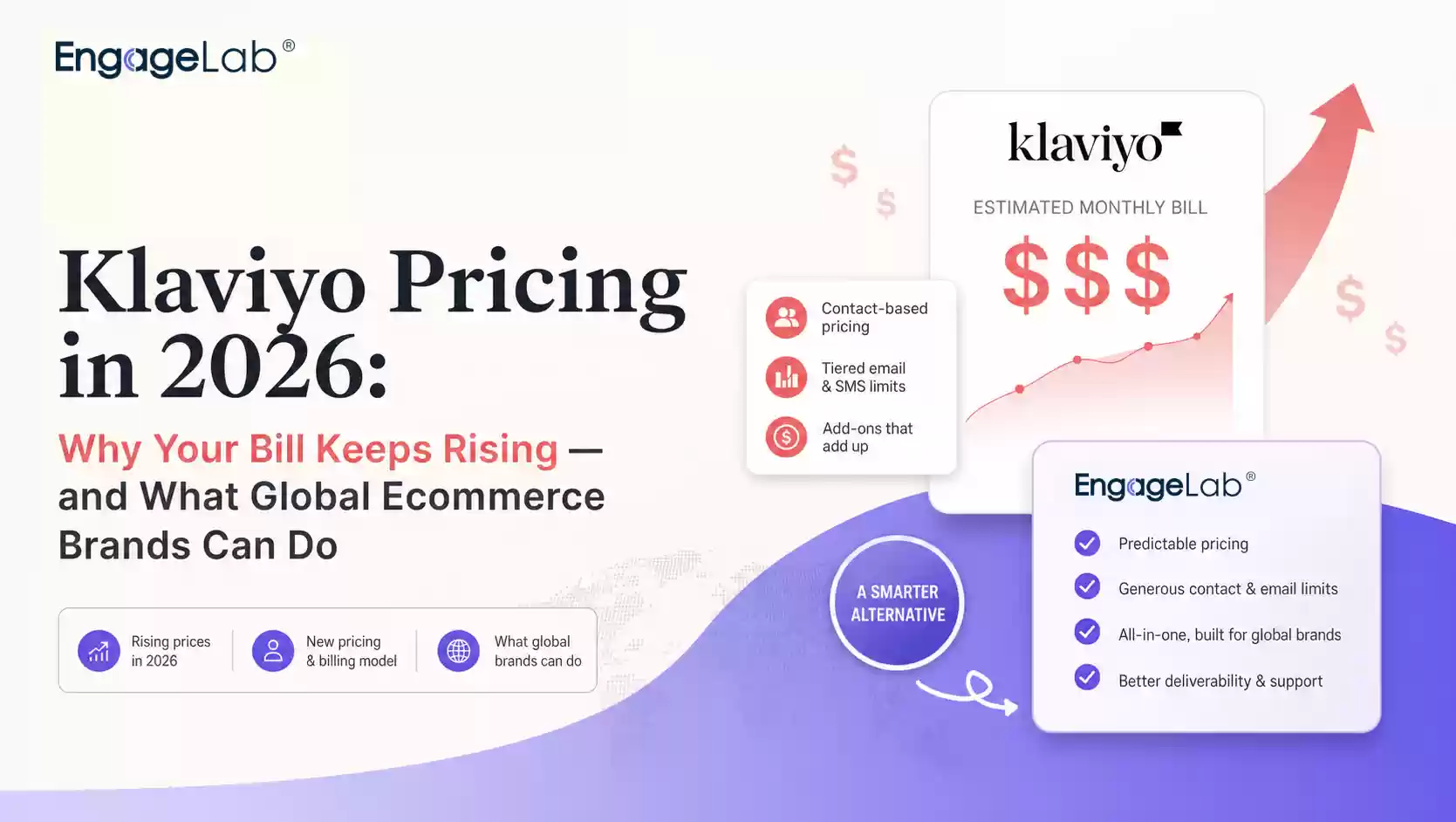
Readers brought here by a Klaviyo bill should start with the companion piece: Klaviyo Pricing in 2026: Why Your Bill Keeps Rising. Or review the customer engagement platform first.
Sources: SAP Engagement Cloud Pricing Cost Guide — Spadoom (April 2026); SAP Emarsys is now SAP Engagement Cloud — Spadoom (April 2026); Emarsys vs Enterprise Edition — Spadoom (August 2026); Certified SAP Emarsys app, Shopify App Store; Licenseware: 2025–2026 software price increases; VendorBenchmark: SAP Emarsys pricing and renewal benchmarks; ITQlick: Salesforce Marketing Cloud vs Emarsys (June 2026); plus official pricing pages for HubSpot, Klaviyo, Salesforce, and Adobe. Competitor figures come from 2026 public and partner sources and do not represent official vendor quotes; performance ranges are anonymized industry observations, not guaranteed outcomes.
Related reading: From Clicks to Stick: Building E-commerce Loyalty Through Intelligent Customer Journeys
![[2026 Update] Top 7 B2B Automation Platforms to Get You Started Today](https://img.engagelab.net/article/b2b-automation-platforms.png)