Jacob Morrow
Updated: 2026-08-21
For a relationship manager at a mid-sized bank, closing a loan may not be the hardest part. The harder part can be the six weeks of silence beforehand, chasing customers who abandoned an application halfway through. That gap between interest and action is where many financial institutions lose customers, and where marketing automation for financial services earns its keep. Banks and insurers must guide prospects through consent and identity checks before promotional outreach begins.
Automation built for this environment does more than schedule emails. It coordinates consent, timing, and channel choice across the financial customer lifecycle, from the first form fill to the moment a dormant account comes back to life.
What Makes Marketing Automation Different for Financial Services

Marketing automation, at its core, means using triggers, rules, and customer data to send the right message at the right moment without a person clicking “send” every time. That definition holds whether you’re running an e-commerce cart-abandonment flow or a mortgage follow-up sequence. What changes in financial services is everything surrounding that core mechanic.
Picture a customer abandoning a personal loan application. Unlike a retail cart reminder, a bank follow-up may require a consent check, approved product language, and the correct channel for that customer’s market. Missing one of those controls can turn a useful reminder into a compliance issue.
Three forces separate financial services marketing automation from its retail counterpart:
- Regulatory oversight. Communications tied to lending, investing, or account opening often fall under consumer-protection and data-protection rules, so every automated touchpoint needs an audit trail.
- Long, high-trust decision cycles. Choosing a mortgage lender or a wealth manager rarely happens on impulse. Automation has to sustain a relationship over weeks or months instead of driving a single-session conversion.
- Consent management. SMS opt-in rules and WhatsApp Business Platform template approval requirements mean marketers cannot treat customer lists like ordinary promotional audiences.
Digital banking makes these dynamics especially visible because it combines frequent transactions with strict security expectations; similar trust and compliance constraints shape insurance and lending. Deloitte’s research links satisfaction to the balance between digital convenience and a human touch, while McKinsey’s banking-experience research highlights onboarding and problem resolution as critical experience moments. Automation supports those moments by delivering relevant messages at the right stage without replacing human judgment.
Financial Services Marketing Automation for Customer Acquisition

Acquisition in banking rarely ends at the form submission. It ends when a verified, consenting lead reaches a human banker or a fully activated account, and that gap is where automated marketing for financial services proves its value.
A typical acquisition workflow starts when a prospect submits an interest form for a savings account or credit card. The system confirms the applicable messaging consent, then syncs the lead to the CRM with product interest and channel preference. A welcome message references the requested product, followed by another automated follow-up if the customer does not complete the application within a set window.
This workflow depends on channel rules that vary by market. Outside an active customer-service window, business-initiated WhatsApp messages generally need an approved template, subject to Meta’s current rules and local regulation. SMS consent requirements also vary by market, so teams should capture and retain the applicable opt-in record before sending promotional messages.
Kept simple, the acquisition stage has one job: turn interest into a verified, consenting lead without losing momentum. Everything after that point is onboarding.
What the automation stack needs. At this stage, the platform needs to connect consent records, CRM data, channel preferences, and journey rules—not simply trigger a follow-up message. If those inputs remain in separate systems, the workflow can contact the wrong lead, use the wrong channel, or delay the sales response.
Automating Customer Onboarding and KYC

Onboarding is a common point of customer drop-off, and it is also a stage where automation can deliver a clear return. A customer who has already submitted an application has done the hard part. What often stalls them is a document upload they forgot, a KYC step they didn’t understand, or simply the fact that nobody reminded them before the session expired.
Consider a mid-tier bank rolling out digital account opening. A customer starts an application but stalls before completing KYC. The workflow waits for a kyc_completed event. If the event occurs within twenty-four hours, the customer exits the journey automatically. If KYC is still pending, the workflow sends a short App Push reminding the customer to finish verification.

After the first reminder, the workflow waits for the same completion event again. Customers who complete KYC during this period exit the journey without another message. If the customer is still pending after the second interval, the workflow sends a final reminder and then ends the journey, preventing the sequence from turning into repeated automated nudges.

These workflows typically integrate with core banking or KYC systems through APIs and webhooks, so a status change in the source system, such as completed verification, can be passed into the automation platform as an event and immediately change what happens next. That integration matters more than the messaging itself. An onboarding flow built purely on marketing-side timing, without visibility into the actual account-opening pipeline, can end up sending irrelevant or duplicate messages that erode trust rather than build it.
Use event conditions, timed waits, App Push steps, and exit rules to stop reminders as soon as verification is complete.
The goal at this stage is activation, not personalization for its own sake. A well-built onboarding sequence measures success in completed account openings and first transactions, not open rates.
What the automation stack needs. The key requirement is current status visibility. The workflow needs to know whether KYC has been completed before deciding whether another reminder should be sent. That requires event reporting, API or webhook synchronization, conditional branching, and clear exit rules when automated follow-up should stop.
Marketing Automation for Customer Engagement and Cross-Sell
Once a customer is active, automation shifts from getting them started to keeping them engaged and helping them discover products that genuinely fit their situation. This is where financial services marketing automation earns the most scrutiny, because cross-sell messaging sits closer to promotional territory than onboarding reminders do.
Take a customer who has held a checking account for eight months and recently received three consecutive salary deposits above a certain threshold. That behavioral pattern, rather than a static demographic profile like age or income bracket, is a stronger signal that they might be ready for a savings product or a starter investment account. A trigger tied to deposit patterns, rather than a blanket monthly newsletter to every account holder, respects both the customer’s time and the compliance boundary around unsolicited product promotion.
Segmentation built on behavior tends to outperform demographic segmentation in financial services specifically because two customers of the same age and income can be in completely different financial positions. One useful practice is separating segments by lifecycle stage, such as new account holder, established customer, or lapsing customer, and layering behavioral triggers on top of that stage rather than relying on either signal alone.
Informational and promotional messages should remain separate because their consent requirements may differ. A payment confirmation or statement notice is operational; a cross-sell offer is promotional. CRM and segmentation tools are useful here when they help enforce that distinction automatically.
What the automation stack needs. Behavioral data and conditional segmentation matter more here than a large campaign-template library. The platform needs to combine lifecycle stage, account activity, product ownership, and consent status, then route customers according to the conditions that currently apply.
Operational Messaging for Financial Services

Operational messages—fraud alerts, payment reminders, and service notices—are not marketing, but they often matter more to customer trust. Meta’s global research indicates that consumers increasingly expect business messaging to feel as immediate and natural as personal messaging, raising expectations for speed and reliability (Meta, 2025).
That makes multichannel delivery practical rather than optional. A bank might send an opted-in payment reminder through WhatsApp, with SMS or voice as alternative paths when that channel is unavailable. The exact routing depends on the messaging infrastructure, but the goal is to avoid relying on one channel and retain delivery status for each attempt.
For time-sensitive verification such as a login or large transaction, OTP delivery can form part of the same reliability chain, while network-based verification may reduce the friction of entering a code.
What the automation stack needs. Operational workflows sit alongside marketing automation rather than functioning as campaigns. The stack needs shared customer data, reliable multichannel delivery, visibility into delivery status, and clear rules for when an alternative communication path should be used.
Marketing Automation to Reactivate Dormant Customers

Every financial institution carries a segment of customers who opened an account, used it briefly, and went quiet. Reactivation automation exists to win a meaningful share of that segment back before they close the account entirely or move their primary relationship elsewhere.
The strongest reactivation triggers in financial services are lifecycle events specific to the industry: an account showing no transactions for ninety days, a debit or credit card approaching its expiry date, or a savings product whose interest rate has changed in the customer’s favor. These triggers carry more weight than a generic “we miss you” message because they give the customer a concrete, relevant reason to log back in.
Here’s a complete workflow for a dormant-account scenario: the system flags an account with no login and no transaction for ninety days. The first message, sent by email, is informational rather than promotional, simply noting that the account is still open and highlighting one relevant update, such as a new savings rate. If there’s no engagement within two weeks, a second message goes out through SMS with a slightly more direct call to action, perhaps prompting the customer to review their account. If the customer still hasn’t engaged after a final interval, the account exits the automated sequence rather than receiving another message.
This stage should stay focused on win-back rather than cross-sell. Introducing a new product pitch into a reactivation sequence can dilute the core message and distract from the single purpose of the win-back flow.
Timing should follow the lifecycle event itself: a card-expiry reminder sent well in advance is more useful than one sent only days before the card stops working.
What the automation stack needs. A workable reactivation flow needs frequency limits and explicit exit conditions. It should stop when the customer re-engages, reaches the contact limit, changes eligibility, or reaches the end of the defined sequence. Without those controls, a useful win-back sequence can quickly become repetitive.
How to Choose a Marketing Automation Platform
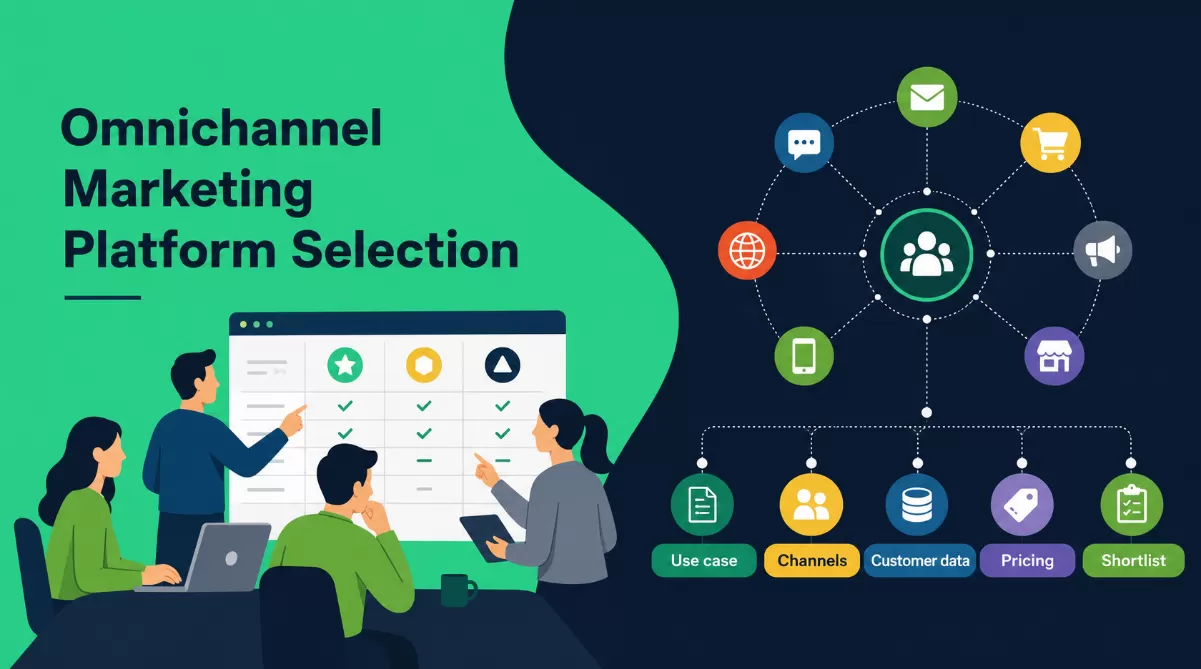
Selecting a platform for marketing automation for financial services comes down to five practical criteria, and each one matters for a different reason.
- Integration capability: Look for solid API and webhook support so workflows can respond to current data from core banking and CRM systems.
- Compliance posture: Confirm support for consent tracking, desensitized data storage, and regional data residency in markets governed by frameworks such as GDPR and PDPA (as of August 2026).
- Scalability: Verify that the platform can handle peak message volumes without compromising delivery speed.
- Analytics depth: Look for insight into journey performance beyond open and click rates.
- Omnichannel capability: Evaluate whether email, SMS, WhatsApp, and push can run in coordinated workflows without fragmenting customer data or delivery visibility. EngageLab, for example, combines these channels with a visual workflow builder and behavior-based analytics in one console.
None of these criteria works in isolation, and no single platform will be the strongest choice for every institution. Weigh them against your specific regulatory footprint, existing tech stack, and channel mix rather than choosing based on any one capability alone.
Test shortlisted platforms with a real workflow, such as a KYC reminder sequence or a time-sensitive multichannel alert. Ask how the platform handles delivery visibility, partial consent records, and sudden volume spikes—not just what appears on its feature list.
Simplify Financial Services Marketing Automation with EngageLab
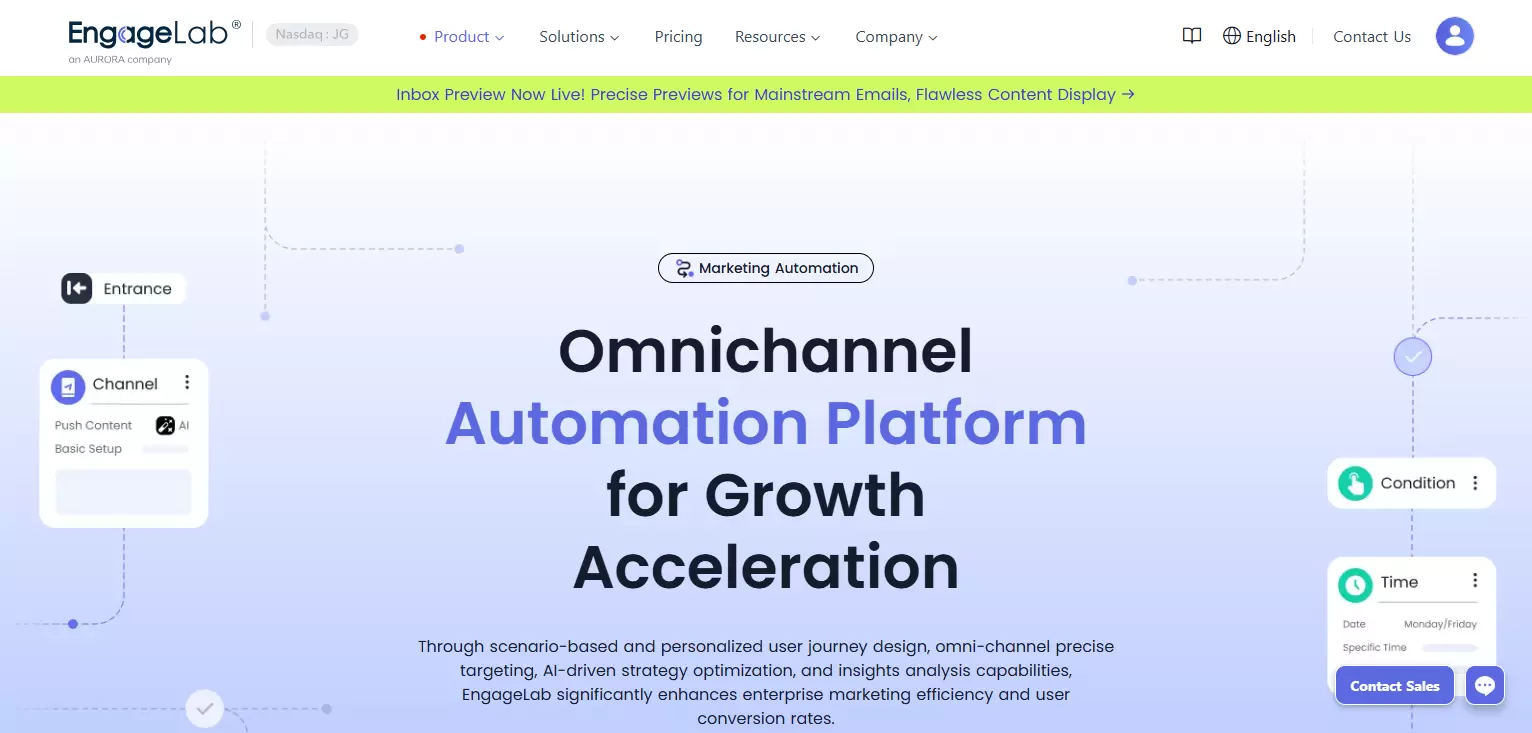
Bringing the lifecycle stages covered above into one operational platform is largely what EngageLab Marketing Automation is built to do, centering on a drag-and-drop journey builder that lets marketing and compliance teams design acquisition, onboarding, engagement, and reactivation flows visually, with entry conditions, timing controls, and multichannel messaging configured in one place.
For a bank or fintech evaluating a consolidated approach, the relevant capabilities include:
- Omnichannel delivery: Reach customers across email, SMS, App Push, Web Push, and the WhatsApp Business API from one platform.
- Visual journey orchestration: Build and adjust onboarding, engagement, and reactivation workflows with less engineering support.
- Message lifecycle monitoring: Track delivery, engagement, and drop-off across channels.
- Revenue and behavior analytics: Evaluate journey performance beyond basic delivery and engagement metrics.
- Built-in verification: Add OTP and Silent Auth to identity-verification steps in onboarding and operational journeys.
Explore omnichannel automation across acquisition, onboarding, engagement, and reactivation.
These capabilities do not replace compliance judgment or journey design. They reduce the manual work involved in coordinating lifecycle stages and channels.
Frequently Asked Questions
What is marketing automation for financial services?
It's the use of triggers, customer data, and pre-approved messaging templates to deliver compliant, timely communications across a bank or insurer's customer lifecycle, from lead capture through onboarding, engagement, and reactivation, without manual intervention for every message.
How is marketing automation for financial services different from retail marketing automation?
It adds consent controls, disclosures, and auditability to trigger-based automation while supporting longer, higher-trust financial decisions.
Is marketing automation compliant with GDPR and PDPA?
Compliance depends on workflow configuration and consent handling, not on the platform alone. Institutions must verify the GDPR, PDPA, and other regional requirements that apply to them (as of August 2026).
Which messaging channels work best for financial services marketing automation?
There's no single best channel. WhatsApp tends to perform well for time-sensitive alerts where customers have opted in, SMS offers broad reach for urgent notices, and email suits longer-form, informational content like statements or investment updates.
How much does marketing automation cost for a bank or fintech?
Pricing varies by platform and typically scales with message volume or active users rather than a flat fee. Most vendors offer tiered or pay-as-you-go models, so it's worth requesting a quote based on your institution's actual channel mix and volume (as of August 2026).
Conclusion
Done well, marketing automation for financial services isn’t about sending more messages. It delivers the right one through the right channel when it helps someone finish an application, complete KYC, or return to a dormant account. Strong workflows coordinate consent, timing, and channel choice without making the customer experience feel procedural.
Every recommendation in this guide should be treated as a starting point rather than a fixed rulebook, since requirements shift by institution, market, and regulation. Platforms like EngageLab Marketing Automation help teams coordinate lifecycle journeys and channels without piecing the workflow together across disconnected tools.
Explore omnichannel automation across acquisition, onboarding, engagement, and reactivation.