Elena Rodriguez
Updated: 2026-07-15
When a one-time password does not arrive, the user cannot log in, finish checkout, or recover an account, and that failure lands straight in your support queue and drop-off rate. Keeping that flow reliable under real traffic is the job of an OTP API provider , the developer-facing layer that generates, delivers, and verifies codes across channels.
This is a technical selection guide, not a provider ranking. It walks through how an OTP API works, how SMS OTP, WebOTP, and multi-channel verification differ, what to check in the documentation, and a step-by-step integration checklist.
 Quick answer
Choose an OTP API provider when your team needs more than sending a text message. The checklist should cover code generation, SMS or multi-channel delivery, server-side verification, expiration, retry limits, webhook events, delivery reports, fraud controls, and production logs. A basic SMS API delivers a message; a dedicated OTP verification API manages the whole authentication workflow around that message.
What Is an OTP API Provider?
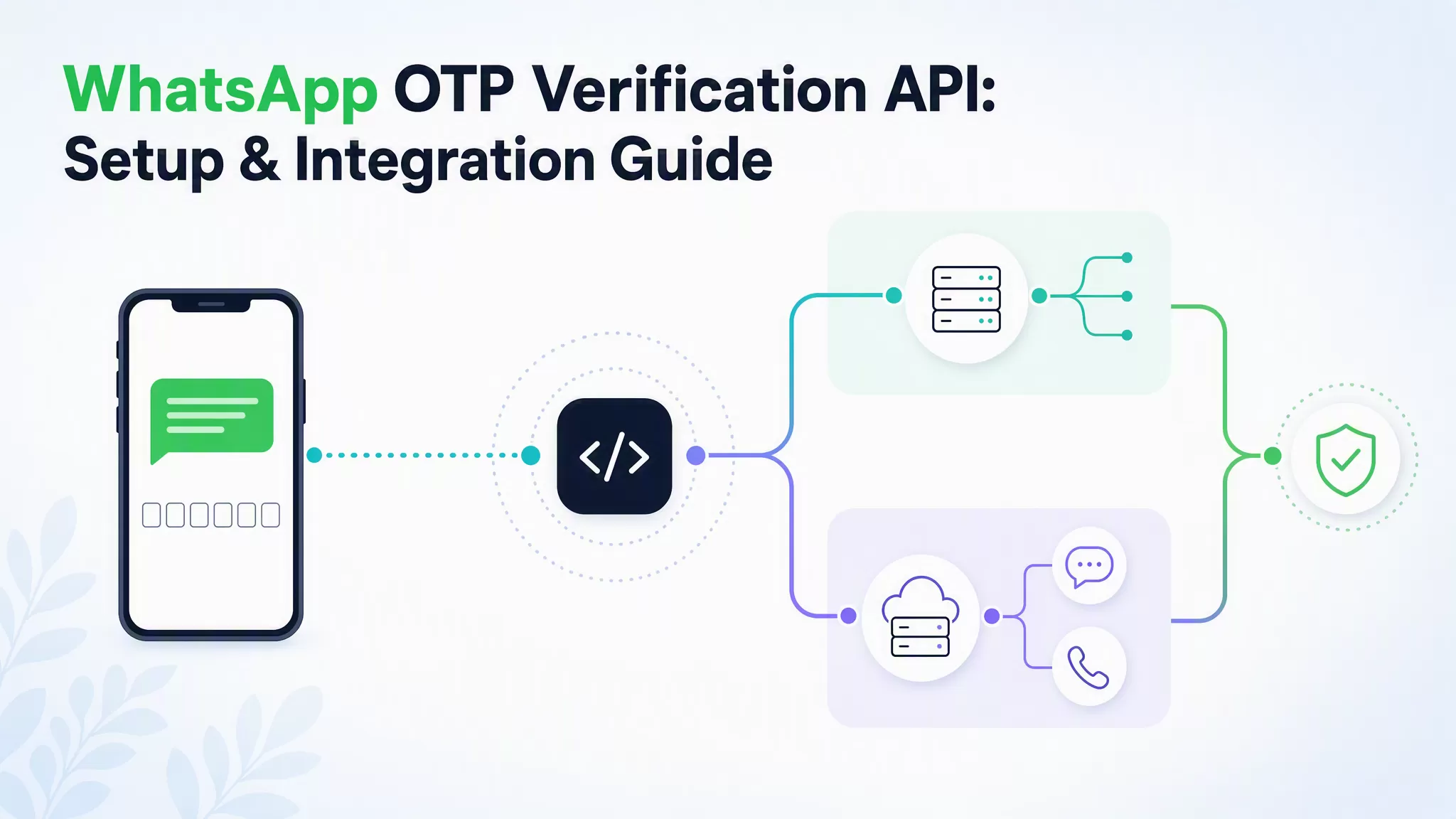
An OTP API provider gives your backend programmable endpoints and tools for one-time password verification. In a typical flow, your application asks the provider to create and deliver a temporary code, the user enters the code, and your server calls a verification endpoint before allowing the next action.
It sits between a general OTP service provider comparison, which is about vendor coverage and pricing, and a basic one-time password definition, which explains the concept. The API-provider question is narrower and more technical: how solid is the integration your team lives with after launch, from endpoint design to error handling and observability.
| Search intent | What the buyer is really asking | What this guide answers |
|---|---|---|
| OTP service provider | Which vendor has the right coverage, pricing, support, and verification product? | Compare service scope and commercial fit. |
| OTP API provider | Can developers integrate OTP generation, delivery, verification, callbacks, and logs safely? | Evaluate API design, docs, SDKs, errors, retry logic, and monitoring. |
| SMS OTP API | Can I send verification codes by SMS at scale? | Check delivery routes, sender rules, message status, fallback, and verification. |
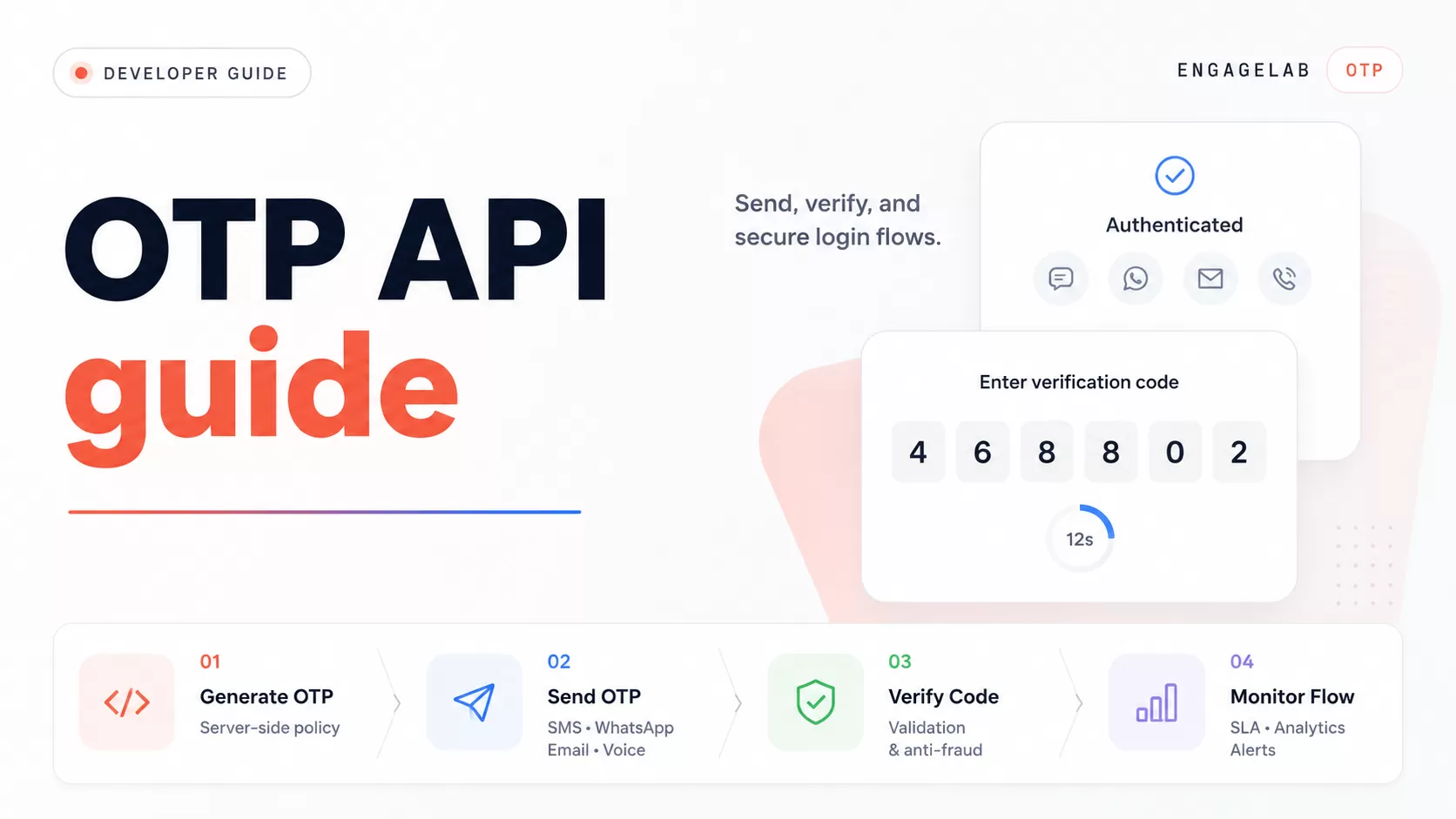
How an OTP Verification API Works
A good OTP verification API makes the authentication flow explicit. The provider should not just send a message; it should control the code lifecycle and return a reliable, server-side verification result your backend can trust.
| Stage | What happens |
|---|---|
| 1. Request | The user tries to sign in, register, recover an account, confirm a payment, or perform a sensitive action. |
| 2. Generate | The provider creates a short-lived code tied to a destination, template, channel, TTL, and attempt count. |
| 3. Deliver | The code is sent through SMS, WhatsApp, email, voice, or another configured route. |
| 4. Verify | Your backend submits the user-entered code to a verification endpoint and waits for a trusted server-side result. |
| 5. Observe | Callbacks, status queries, and reports expose delivery status, latency, verification result, failures, and abuse patterns. |
For example, the Send OTP API generates a code and sends it according to the selected template and channel strategy:
- Send: POST https://otp.api.engagelab.cc/v1/messages
Then the Verify OTP API checks the submitted code and returns whether verification succeeded:
- Verify: POST https://otp.api.engagelab.cc/v1/verifications

SMS OTP API vs WebOTP API vs Multi-Channel OTP API
These three tools are often confused because they all touch OTP, but they solve different layers of the problem. Mixing them up is a common reason an integration stalls halfway.
| Option | What it does | What it does not do | Best use |
|---|---|---|---|
| SMS OTP API | Sends OTP messages by SMS, often with verification templates, TTL, and message status. | May not cover WhatsApp, voice, email, fallback, or fraud controls unless built into the OTP product. | Products where SMS is the primary possession factor. |
| WebOTP API | A browser capability that lets a web page read an OTP from a specially formatted SMS and autofill it. MDN describes it as a way to streamline phone-number verification UX. | It does not deliver messages, create or verify codes, manage templates, or provide provider-grade logs. | Improving mobile web UX once an SMS OTP backend already exists. |
| Multi-channel OTP API | Handles OTP across SMS, WhatsApp, email, and voice with fallback logic from one workflow. | Still needs product decisions on risk, policy, sender setup, and user experience. | Global products where SMS alone is not reliable in every market. |
In short: WebOTP reduces typing friction but is not a delivery provider, a basic SMS API can send a code but may not verify it, and a multi-channel OTP verification API covers the full authentication workflow.
What to Look for in an OTP API Provider
Evaluate the documentation the way an on-call engineer would, imagining the day login breaks in production. Before you look at pricing, confirm the provider gives you the logs, callbacks, retries, and fraud controls you will need when a code fails. A ranked list cannot answer that; a checklist can.
| Checklist item | What to confirm |
|---|---|
| API documentation | Clear endpoints, parameters, response examples, error codes, authentication, SDK links, and production notes. |
| SDK and sample code | Official Node.js, Python, or language-specific examples that cover both send and verify. |
| Global routing | Country coverage, sender ID rules, routing quality, latency, and registration requirements before launch. |
| Fallback channels | WhatsApp, voice, email, auto-retry, and fallback sequencing for markets where SMS fails or delays. |
| Rate limiting and fraud control | TTL, resend limits, attempt limits, destination throttling, device or IP checks, and fraud monitoring. |
| Delivery reports and webhooks | Message IDs, delivery status, verification status, callback retries, and searchable logs for support. |
| SLA and compliance | Uptime commitments, data handling, regional restrictions, sender registration, and template approval. |
| Cost predictability | Failed-message handling, successful-verification pricing, fallback costs, and channel-specific fees. |
One caveat for security teams: phone-based OTP is useful but not phishing-resistant. According to NIST SP 800-63B (2024) , PSTN out-of-band authentication is restricted because of SIM swap and number-porting risk. For high-risk accounts, pair OTP with additional risk checks or stronger authenticators.
OTP API Integration Checklist
Start with one real test, not a production rollout. Validate the application, sender, template, destination country, and callback path before you wire OTP into signup or payment. First pick the entry point that matches how your team wants to integrate.
| Entry point | When to use it |
|---|---|
| Console quickstart | First validation. Create an OTP application, template, and API key, then send and verify one code. Start with the OTP quickstart . |
| REST API | When the backend is ready to call Send OTP and Verify OTP directly. |
| SDK | When your team wants official Node.js or Python examples and callback handling. See the OTP SDK guide . |
| Agent Skill | When an AI coding assistant should scaffold the integration from your workspace. Start with the OTP Agent Skill . |

1 Create the OTP Application and API Key
Create a dedicated OTP application for the product, environment, and use case. Keep staging and production credentials separate, restrict API key access, and never place secrets in client-side code.

2 Configure Templates, Sender IDs, and Fallback Channels
Define the message template, language, sender identity, and country-specific registration needs. If the product serves multiple markets, decide whether the first channel is SMS, WhatsApp, email, or voice, and which fallback triggers when delivery is delayed or blocked.
3 Set OTP Policy Before Coding
Choose code length, TTL, resend delay, maximum attempts, destination throttles, and lockout behavior. A good OTP API lets you enforce these rules centrally rather than scattering them across product code.
4 Add the Send OTP Endpoint Server-Side
Your backend should validate the user action, normalize the destination, check abuse signals, and call the Send OTP endpoint. Return a neutral response to the client so attackers cannot enumerate valid accounts or phone numbers.
5 Add the Verify OTP Endpoint Server-Side
Submit the message ID and user-entered code from your backend, never from a client-only path. Treat a successful verification as a server-side state change tied to the specific user action.
6 Log Message IDs, Callback Events, and Failure Reasons
Store the provider message ID, request ID, destination hash, status, verification result, and final outcome. Your support team should be able to answer one question fast: was the code sent, delivered, expired, retried, verified, or blocked?
7 Monitor Verified Completion, Not Just Delivery
SMS delivery rate matters, but OTP performance is measured by verified completion. Track delivery, latency, resend rate, fallback use, verification success, expirations, wrong-code attempts, and drop-off by country and channel.

When a Basic SMS API Is Not Enough for OTP
A basic SMS API is fine when your team already owns OTP generation, storage, verification, throttling, and logging. Twilio Programmable Messaging and Amazon SNS SMS both send SMS programmatically, but that alone does not make them a complete OTP verification workflow.
A basic SMS API is enough when
Your engineering team already owns secure OTP generation and storage, SMS is the only channel you need in the near term, and you can build and maintain retry, rate-limit, and support tooling yourselves.
An OTP API provider fits better when
You need code generation, verification, expiry, and attempt limits in one workflow, you want SMS, voice, and WhatsApp OTP behind one API or fallback strategy, and support, fraud, and engineering teams need searchable delivery and verification logs.
The upgrade point usually shows up when failed delivery starts hurting activation, revenue, or trust. If users repeatedly request codes, switch devices, contact support, or abandon signup, the problem is no longer message sending. It is authentication reliability.
OTP API for Global Verification
EngageLab OTP is built for teams that want code generation, delivery, verification, and monitoring inside one API workflow. The OTP documentation covers SMS, WhatsApp, email, and voice with multi-channel fallback, analytics, security controls, and integration paths for REST API, SDK, and Agent Skill.

This is the fit to evaluate when your team wants SMS, voice, and WhatsApp OTP behind one API, rather than maintaining separate sending logic and verification rules for each channel.
Developer next step:
- Run the quickstart and send one test code.
- Inspect the send and verify API responses end to end.
- Decide whether production needs SMS-only delivery or multi-channel fallback.
OTP API FAQ
What is an OTP API?
An OTP API is a backend interface for creating, sending, and verifying one-time passwords. In production, it should also support expiration, retry limits, verification attempts, message status, callbacks, and logs.
What is an SMS OTP verification API?
An SMS OTP verification API sends a one-time code by SMS and lets your backend verify it before allowing the user action. Stronger versions add templates, sender rules, TTL, resend limits, callbacks, and fraud controls.
Is the WebOTP API a replacement for an OTP provider?
No. WebOTP improves mobile web UX by helping the browser read a code from a properly formatted SMS. It does not send messages, route SMS, verify codes, manage templates, or provide delivery reports.
What should good OTP API documentation include?
Send and verify endpoints, authentication setup, required parameters, response examples, error codes, SDK examples, callback behavior, rate limits, and production setup notes.
How do I choose between an SMS OTP API and a multi-channel OTP API?
Choose an SMS OTP API when SMS is reliable enough for your markets and risk level. Choose a multi-channel OTP API when you need fallback through WhatsApp, voice, or email, or when delivery issues affect signup, checkout, or account recovery.
Final Takeaway
The right OTP API provider makes verification reliable for users and debuggable for developers. Do not judge on SMS price alone. Compare documentation, SDKs, verification flow, fallback, rate limiting, fraud controls, delivery reports, webhooks, and production monitoring. That is the difference between a message-sending API and an authentication-ready OTP integration.