Elena Rodriguez
Updated: 2026-09-12
A checkout team rarely replaces a verification provider because a comparison table shows one more channel. The trigger is almost always a production symptom: codes land two minutes late in one country, fraud traffic outgrows real sign-ups, or finance cannot reconcile the invoice against completed verifications. Those are the reasons worth acting on when you compare messagebird alternatives . A rebrand, on its own, is not one of them.
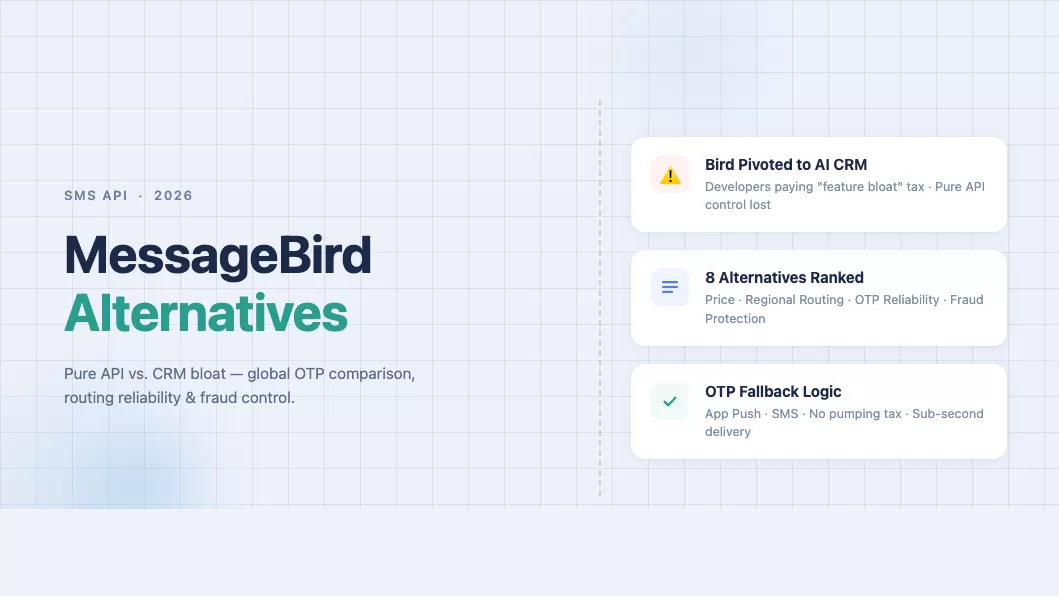
Bird, the company formerly called MessageBird, still runs a Verify API. What changed underneath is the commercial surface. Its pricing page now presents tiered monthly plans instead of a public per-message SMS rate, and the platform has grown outward into marketing, sales, payments and service software. So this guide keeps Bird as the baseline and answers the three questions a migration business case actually turns on: what each provider charges per completed verification, who submits your sender ID registration, and which methods will still be legal in your markets next quarter.
The short answer
Stay on Bird if its Verify API, support terms and per-country delivery already work. Move for a named reason. EngageLab fits teams that want SMS, WhatsApp and voice chained into one fallback order and priced as they go. Twilio has the widest method set at $0.05 per successful verification . Telnyx has the lowest published fee at $0.03 . Vonage gives configurable workflows and silent authentication. Sinch and Telesign compete on mobile-native and multi-channel routing. Infobip covers managed enterprise 2FA on three channels. Plivo charges nothing for the verification itself but gates the product behind a $1,000 monthly minimum .
See what a multi-channel verification stack looks like
SMS, WhatsApp, voice and email verification, plus the analytics you need to compare one provider against another.
MessageBird Alternatives at a Glance
Every row below comes from the provider's own pricing page or developer documentation for this 2026 update, not from a third-party review. Two columns exist because almost no comparison publishes them: the fee charged for a completed verification, and which party actually submits your sender ID registration. Both change your launch date and your invoice more than the channel count does.
| Tool | Verification fee | Documented channels | Who registers your sender ID | Watch-out |
|---|---|---|---|---|
|
|
Pay as you go, no published unit price | SMS, WhatsApp, voice, email | Vendor side for WhatsApp: a built-in number pool removes the separate Business Account registration | No public rate, so contact sales for a quote on your top five destinations. Security controls for WhatsApp, voice and email are still marked coming soon |
|
|
$0.05 per successful verification | SMS, voice, WhatsApp, email, TOTP, push, silent device approval, passkeys, silent network auth | You do, including 10DLC brand and campaign registration in the US | Channel fees stack on top: US SMS adds $0.0083, US WhatsApp adds $0.0034 per authentication template message |
|
|
$0.03 per successful verification | SMS, voice, flash call, WhatsApp | You do | Flash call on Android is affected by the 2026 Google Play permission change |
|
|
€0.052 / $0.06084 per successful verification on the Conversion plan | SMS, RCS, voice, WhatsApp, email, silent authentication | Vendor side: delivery runs on a pre-approved short code, so there are no virtual numbers to buy | The cheaper Success plan drops workflows, channel failover and every channel except SMS |
|
|
Not published, quoted by contract | SMS, phone call, flash call, data verification | You do | Two of its four methods lean on Android permissions Google Play now restricts for account verification |
|
|
Not published, contracted platform terms | SMS, voice, email | Mixed, and set per country in the contract | Three channels only. No WhatsApp, RCS or silent option inside the 2FA service |
|
|
Not published, set by method and country | SMS, silent, push, email, WhatsApp, RCS, Viber | Confirm per market during procurement | Phone-number risk scoring sits in a separate Verify Plus product |
|
|
$0 , you pay only the delivery channel | SMS and voice in the docs, WhatsApp on the product page | Vendor side: OTPs go out on Plivo's own registered sender IDs | Direct brands only, and a USD 1,000 per month minimum commitment before you send anything |
|
|
Tiered monthly plans, no public per-message SMS rate | Email, WhatsApp, SMS | You do | Failover only crosses to a different platform, so an SMS retry after an SMS failure does not help |
Part 1: What Bird Costs You Now, and What the Alternatives Charge
Bird no longer publishes a per-message SMS rate
This is the first thing to establish, because it decides whether you can even build a comparison. Bird's pricing page now presents tiered monthly plans, described as a flat monthly rate that falls per message as volume grows, rather than a destination price list you can model against. Any figure you find quoted for Bird SMS in a third-party comparison is therefore either historical or inferred. To baseline your own spend you need an invoice, not a web page.
The Verify product itself is well documented and worth measuring against. According to Bird (2026) , its Verify API covers email, WhatsApp and SMS, with a verification timeout that defaults to 600 seconds and is configurable between 30 and 3,600, a maximum attempt count that defaults to 3 and ranges to 10, and a code length that defaults to 6 characters and ranges to 12. One design detail matters more than any of those numbers: failover moves to the next step only when that step sits on a different platform, because if one type of SMS fails, all SMS will fail on the same infrastructure. A fallback chain that stays inside one channel buys you nothing.

The verification fee is not the invoice
Managed verification products charge on two layers: a platform fee for the verification itself, and the cost of every message or call used to deliver it. Vendors publish the first layer prominently and the second layer somewhere else. Comparing only the first layer is how teams end up surprised.
| Provider | Platform fee | Charged on | What still gets added |
|---|---|---|---|
| Twilio Verify | $0.05 | Successful verification | US SMS $0.0083 per message, US WhatsApp $0.0034 per authentication template message, plus carrier surcharges. Push and TOTP are inside the $0.05 |
| Telnyx Verify | $0.03 | Successful verification, same fee on every channel | A separate charge per request based on destination and channel |
| Vonage Verify (Conversion) | €0.052 / $0.06084 | Successful verification | Messaging and voice rates apply to attempted and successful verifications, so failures are not free |
| Plivo Verify | $0 | Nothing. Only the channel is billed | A USD 1,000 per month minimum commitment for the US, Canada, UK, Australia and India, rising to USD 10,000 to add pre-registration countries |
| Sinch, Infobip, Telesign and the pay-as-you-go option in row one above | Not published | Quoted by method, country or contract | Treat the quote as the price. A number you cannot find on the vendor's own page should not go into your model |
Every figure above is a list price in the vendor's own currency for its standard plan, and the Twilio channel rates are US destinations. Volume discounts, regional rates and negotiated terms move all of them, so treat these as the starting point of a quote rather than the quote itself.
Run it against a real month. Take 100,000 verification attempts with a 90% completion rate and a 15% resend rate, all US SMS. The platform fee alone is $4,500 on Twilio, $2,700 on Telnyx and about $5,476 on Vonage Conversion, before a single message is priced. That is a spread of roughly $2,776 a month on the same traffic. Then add the delivery layer: 115,000 US SMS at $0.0083 is another $955 on Twilio, and US carrier surcharges of roughly $0.0035 to $0.005 per segment are passed through identically by every provider, so they never separate the shortlist.
Plivo looks free on this table and is the most expensive option in the room for a team sending 20,000 verifications a month, because the $1,000 minimum lands whether you use it or not. The arithmetic flips somewhere above roughly 100,000 US verifications a month. Work out where your own volume sits before you shortlist on fee alone.
What "pay only for successful verifications" leaves out
Success-based billing is the most quoted line in this category and the least examined. Vonage publishes two plans side by side, and the difference between them is the clearest illustration in the market of what that phrase can cost you.
| Capability | Verify Conversion (€0.052 / $0.06084) | Verify Success (quoted, no charge on failures) |
|---|---|---|
| One-time passcode generation | Yes | No, bring your own code |
| Sender ID and voice CLI management | Yes | No |
| Workflows and pre-built 2FA templates | Yes | No |
| Channel failover | Yes | No |
| RCS, voice, WhatsApp, email, silent authentication | Yes | No, SMS only |
| Fraud Defender Advanced | Yes, at no additional cost | No |
Read across that table and the trade becomes visible. According to Vonage (2026) , the plan that never charges for a failed attempt is also the plan without code generation, without fallback and without any channel other than SMS. You are not buying cheaper verification, you are buying a transport API and moving the orchestration back into your own codebase. That may be exactly right if you already run your own retry logic. It is the wrong purchase if you picked a managed Verify product to avoid writing that logic.
The same reading test applies everywhere. Ask two questions of any success-based quote: which specific events are billed when a code is never delivered , and which features are removed from the plan that carries the promise . Twilio and Telnyx both charge the platform fee on success and the channel cost regardless, which is honest but still means failed traffic appears on your invoice.
Before shortlisting, price one real month of your own volume, with your destination mix and your resend rate, and put it next to your current Bird invoice.
Part 2: How We Compared These Verification APIs
"MessageBird alternative" describes four different projects, and mixing them produces a shortlist that reads well and cannot be implemented. Decide which one you are running before the first demo call.
- Messaging transport: your application generates and validates codes, the vendor moves SMS or voice traffic.
- Managed verification: the vendor generates codes, applies expiry and retry rules, delivers them and returns a result.
- Multi-channel authentication: the flow can move across SMS, WhatsApp, voice, email, silent authentication, push or TOTP.
- Customer communications platform: verification is one workload inside a wider CRM, support or engagement stack.
The candidates split along that line. Plivo and Infobip 2FA sit closest to managed verification on a narrow channel set. Twilio , Vonage , Telesign and Sinch sell multi-channel authentication, and you pay for method breadth whether or not you use it. EngageLab and Bird sit inside wider engagement platforms, which means verification shares a workspace with other messaging workloads. Those are three different migrations, and quoting them against one another as though the implementation effort were equivalent is the most common mistake in this category.
The further right you sit on that list, the less a raw SMS rate tells you. A team buying managed verification is really buying code lifecycle, fallback logic and fraud controls it would otherwise build. If your requirement is closer to a plain phone verification service than to an engagement platform, a managed Verify product can be overhead you pay for twice. Six criteria decided the ordering above, and each one has a way to check it yourself rather than take it on trust.
| Criterion | Why it separates providers | How to verify it yourself |
|---|---|---|
| 1. Published price | Four of the nine providers here publish a number. Five do not | Open the vendor's own pricing page. If there is no figure for a completed verification, model the quote as the price and expect it to move |
| 2. Channels you can switch on | Documented channels and channels available on your account in your markets are different lists | Ask for a country by channel matrix, then send one live test into each launch market during the trial |
| 3. Registration ownership | It decides whether launch takes days or a quarter, and it is almost never on the comparison table | Ask whose legal entity appears on the registration form. See Part 4 |
| 4. Controls that fire before billing | A control that blocks after the message leaves does not protect the invoice | Ask for the event log of one blocked request, not a feature list |
| 5. Eligibility and minimums | Some products exclude resellers, ISVs and multi-tenant platforms outright | Read the eligibility clause and the minimum monthly commitment before you book engineering time |
| 6. Migration surface | The cost of leaving is set by how many vendor-specific fields your codebase already stores | Count the provider IDs, template references and callback shapes in your own schema today |
One judgment is editorial and worth stating plainly. "Best fit" below reflects what each provider documents and prices, not a ranking of engineering quality. Where a claim could not be traced to a vendor's own page, it is described as unpublished rather than estimated.
Part 3: The 8 Best MessageBird Alternatives
These are the eight providers worth putting in front of a procurement committee as alternatives to MessageBird for verification traffic. Each entry gives the positioning, the facts you can check on the vendor's own pages, and a pros and cons read that includes the thing the sales deck leaves out.
1. EngageLab

The OTP service handles code generation, delivery, verification and lifecycle callbacks across SMS, WhatsApp, email and voice. The mechanic that separates it from a transport API is that the fallback order is a property of the template, not something your application orchestrates at call time.
- Template channel strategy:
send_channel_strategy
takes whatsapp , sms , email or voice ; multiple channels are separated by | and fall back in the order written;
email cannot be combined with the others.
That parameter is the whole design in one line. The three phone channels can be chained into any order you want and the platform walks the chain, while email stays a separate strategy rather than the last hop of a phone chain. It is a small distinction in a feature table and a large one when you are deciding what happens to a user in Jakarta whose SMS never arrives.
Two facts are worth checking for yourself because they change the integration shape. WhatsApp delivery runs on a built-in number pool, which the documentation describes as removing the need for an additional business account registration, so the usual WhatsApp Business Account approval step disappears from the launch plan. And a separate SIM Swap API exposes two endpoints, one that returns the date of a number's most recent SIM change and one that checks whether a swap happened within the last N hours. The honest limit: SIM swap checking currently covers Brazil and Indonesia only , so treat it as a market-specific control rather than a global fraud layer.
- SDK and callbacks: the official Node.js SDK supports Node.js 14+, ships TypeScript declarations and has zero dependencies. Callbacks are signed with
X-CALLBACK-ID (HMAC-SHA256), and each event carries an is_terminal flag so retries stay idempotent.
On controls, the Security Center documents per-number and per-IP frequency limits, a two-level volume threshold that warns at one value and stops sending at another, country allow and block lists, and a one-click emergency stop for the SMS channel. The IP limit only takes effect if you pass the end-user IP on the send call, and the threshold alerts need a webhook configured first. The equivalent controls for WhatsApp, voice and email are still marked coming soon, so test what exists today rather than buying against the roadmap.
Pros:
-
 Fallback order is configured once on the template, not re-implemented in your application
- Built-in WhatsApp number pool removes the separate Business Account registration step
-
SIM swap detection available as an API, which most Verify products leave to a third party
-
Pay as you go with account top-up instead of a monthly platform fee, plus REST, SMPP and official Node.js and Python SDKs
Cons:
-
 No public per-verification list price, so you need to contact sales for a quote on your top five
destination countries before you can compare
No public per-verification list price, so you need to contact sales for a quote on your top five
destination countries before you can compare
-
Channel-specific security controls for WhatsApp, voice and email are documented as coming soon
- SIM swap coverage is limited to Brazil and Indonesia today
- No TOTP, passkey or push method, so a passwordless roadmap needs a second vendor
2. Twilio Verify
Twilio's argument is optionality. According to Twilio (2026) , the Verify API documents SMS, passkeys, silent network auth, automatic channel selection, voice, WhatsApp, email, TOTP, push and silent device approval. A team can start on SMS OTP and add passkeys or a network check two years later without a second procurement cycle. Nothing else in this shortlist covers that range.
The pricing is legible and the layering is where teams misjudge it. The platform fee is $0.05 per successful verification . Push and TOTP sit inside that fee. SMS adds $0.0083 per message in the US, WhatsApp adds $0.0034 per authentication template message, and silent network auth adds per-country channel fees. At 90,000 completed verifications a month the platform layer alone is $4,500, so the question to answer before signing is whether you will use enough of the method set to justify it. If you have detailed cost modelling to do across Twilio's other product lines too, our dedicated Twilio alternatives comparison breaks the messaging side down separately.

Pros:
- Widest documented method set here, including passkeys and silent network authentication
- Published per-verification and per-channel prices you can model without a sales call
- Automatic channel selection removes fallback logic from your application
- Documentation depth and community answers for integrations nobody else has written up
Cons:
- Highest published platform fee of the four providers that publish one
- You own 10DLC brand and campaign registration in the US, with the lead time that implies
-
Method availability varies by country, so the homepage list overstates what you can turn on
3. Telnyx Verify
Telnyx supports SMS, voice, flash call and WhatsApp verification, and its Verify pricing page lists $0.03 per successful verification across all of them, with the destination and channel billed separately per request. That is the lowest published platform fee in this comparison and the formula is easy to defend in a finance review: one flat number, plus the traffic you actually sent.
Two cautions. Telnyx advertises messaging from $0.004, and that figure is not the all-in cost of a Verify transaction, so build the model from the success fee plus destination price plus carrier surcharge plus fallback attempts. More importantly, flash call is one of its four methods, and flash call on Android now sits on the wrong side of a Google Play policy change described under Sinch below. If flash call was the reason Telnyx made your shortlist, re-check that assumption before you build against it.

Pros:
- Lowest published platform fee at $0.03, identical on every channel
- Billing formula is simple enough to model without a spreadsheet workshop
-
Runs on its own network, which gives it more control over routing than a pure aggregator
Cons:
-
Per-channel destination rates live on four separate pricing pages, so the all-in cost takes work to assemble
-
Flash call viability on Android is narrowing under the 2026 Google Play permission change
- No email, TOTP or push method inside the Verify product
4. Vonage Verify
Vonage Verify covers SMS, RCS, voice, WhatsApp, email and silent authentication behind a configurable workflow, and it is the only provider here that removes number procurement from your side of the project: delivery uses a pre-approved short code or long code depending on carrier requirements, so there are no virtual numbers to buy. Fraud Defender Advanced is included with the Conversion plan at no additional cost.
Silent authentication is the method worth testing. On supported mobile networks the carrier confirms possession of the SIM without the user copying a code, which removes the entire delivery step and the fraud surface attached to it. Coverage depends on operator support and network conditions, so a visible fallback stays mandatory. If you are evaluating this method across vendors rather than just here, we cover how silent network authentication works and where it fails separately. The plan trap is covered in Part 1 and it is the single most important thing to read before you sign.

Pros:
- No virtual numbers to purchase, because delivery uses a pre-approved short code
- Six channels including RCS and silent authentication under one configurable workflow
- Fraud Defender Advanced bundled with the Conversion plan rather than sold separately
Cons:
-
Highest published per-verification fee here, and messaging rates apply to attempted as well as successful verifications
-
The success-only plan strips code generation, failover, workflows and every channel except SMS
- Vonage's own security guidance puts rate limiting on your application, not the API
5. Sinch Verification
Sinch documents four methods in its Verification API : SMS, phone call, flash call and data verification. The mobile-native pair is the reason to test it, because flash call and data-based checks remove code entry from a native sign-in flow entirely, which measurably lifts completion on mobile.
There is a policy change that reshapes this section and does not appear in any other comparison of MessageBird competitors. According to Google Play (2026) , the SMS and Call Log Permissions policy will no longer permit account verification via phone call as a use case for the READ_CALL_LOG permission , and developers have at least 30 days from 15 July 2026 to comply. Flash call on Android 9 and newer relies on exactly that permission. Google's stated alternatives are the Digital Credentials API and the SMS Retriever API.
Decision rule: If your Android app ships through Google Play, treat flash call as a method with a compliance expiry date rather than a permanent part of the fallback chain. This affects Sinch and Telnyx equally.

Pros:
- Data verification removes code entry without depending on the call log permission
- Mature mobile SDKs built for native sign-in rather than web forms
- Strong carrier position in Europe and emerging markets
Cons:
- No published verification pricing, so every comparison starts with a sales call
- Flash call, one of its four methods, faces a Google Play compliance deadline on Android
- No WhatsApp, email or TOTP inside the Verification API
6. Infobip 2FA
Infobip's 2FA Service generates PINs and delivers them over SMS, voice or email. That is a deliberate middle ground for teams that want more than transport but do not need nine authentication methods, and it is backed by one of the larger direct carrier networks in the category.
Channel scope is easy to read from the documentation; commercial fit is not. There is no published per-PIN price, so the platform subscription, the per-interaction processing charge and the carrier pass-through all arrive together in a quote. Before treating Infobip as the enterprise default, get four things in writing: who owns sender registration in each launch country, what the contractual support response time is, how templates move between environments, and whether the quoted rate already contains every carrier and platform charge. A large network only helps on the routes your own users sit on.

Pros:
-
Managed PIN generation and validation on the three channels most enterprises already accept
-
Large direct carrier network with EU headquarters, which shortens some data residency conversations
Cons:
-
Narrowest channel set in this shortlist: no WhatsApp, RCS, silent, push or TOTP in the 2FA service
- No published per-PIN price, and platform fees are layered on top of message costs
- Enterprise contracting adds weeks that a self-serve competitor does not
7. Telesign Verify
Telesign's Verify API has the widest single-API channel set here: SMS, silent verification, push, email, WhatsApp, RCS and Viber, with custom routing rules and multichannel fallback across all of them. If your user base spans markets where Viber or RCS carry better than SMS, this is the shortlist entry that covers it without a second integration.
Two things to pin down in procurement. Phone-number risk scoring, which assesses a number before an SMS is sent, sits in a separate product called Verify Plus, so establish in writing what the base Verify API includes and what is an add-on. And while Telesign states that pricing is based on the verification method and country with no contracts or monthly fees, it publishes no rates, so the free trial credits are the only way to get a real number before a sales conversation. Security-first positioning is not a substitute for a written scope and a false-positive review.

Pros:
- Seven channels under one API, including Viber and RCS that nobody else here covers
- Custom routing rules per channel and market, with always-on multichannel failover
-
No contracts, time-based commitments or monthly fees, and a free trial with test credits
Cons:
- Number risk scoring is a separate Verify Plus purchase, not part of the base API
- No published rates at all, so budgeting depends entirely on the quote
- Seven channels means seven sets of registration and template rules to operate
8. Plivo Verify
Plivo is the easiest product here to reason about and the hardest to qualify for. The Verify API documentation states plainly that it supports two delivery channels, SMS and voice, with SMS as the default and voice for users without SMS capability, accessibility needs or as a fallback. The product page adds WhatsApp and lists RCS and email as coming soon. The verification itself carries no fee: you pay for the SMS.
Then come the constraints, and they are decisive. Verify is offered to direct brands only and requires a minimum monthly commitment: USD 1,000 per month covers the US, Canada, UK, Australia and India, and USD 10,000 per month is needed to add pre-registration countries. That single clause removes resellers, ISVs, aggregators, multi-tenant platforms and most early-stage products before any technical evaluation starts. What you get in exchange is genuinely valuable and covered in Part 4: Plivo delivers OTPs through its own registered sender IDs, so there is no sender registration or KYC on your side.

Pros:
-
No verification fee at all, so above the commitment threshold the unit economics are the best here
-
No sender registration or KYC on your side, because delivery uses Plivo's registered sender IDs
- Narrow, well-documented scope that is quick to integrate and easy to reason about
Cons:
-
USD 1,000 per month minimum commitment, rising to USD 10,000 for pre-registration countries
- Direct brands only: resellers, ISVs, aggregators and multi-tenant platforms are excluded
- India traffic routes internationally rather than over domestic DLT routes
Part 4: Who Registers Your Sender ID and Brand
This is the question that decides whether verification goes live in three days or three months, and it is missing from almost every comparison of A2P messaging providers . Two vendors with identical channel lists can differ by a full quarter on launch date purely because one submits the registration paperwork and the other hands you a form.
There are only three ownership models, and every provider in this comparison sits in one of them.
| Model | Who it applies to here | What you gain | What you give up |
|---|---|---|---|
| Vendor registers, you ride their identity | Plivo (own registered sender IDs), Vonage (pre-approved short code), and the built-in WhatsApp number pool in row one of the table above | Days instead of weeks to first production send, and no KYC packet to assemble | The sender is not branded as you, and the identity is not portable if you leave |
| You register under your own brand | Twilio, Telnyx, Sinch, Bird | Your brand appears on the message, which lifts trust and completion rates | You own 10DLC brand and campaign approval, DLT registration in India and alphanumeric sender ID applications per country |
| Mixed, set per country | Infobip, Telesign, and most enterprise contracts | The vendor absorbs the hard markets while you keep your brand in the easy ones | Nothing is knowable from the website. It has to be written into the contract country by country |
The trade is real in both directions, and the right answer depends on which cost hurts more. A fintech that needs its own name on the message will accept a longer registration path. A marketplace running a launch deadline will take the vendor's identity and revisit branding later. Before you decide, it is worth understanding what an SMS sender ID actually is in each regime, because "sender ID" means an alphanumeric string in Europe, a registered 10-digit long code in the US and a DLT-approved header in India.

WhatsApp is where the difference shows up most sharply, because the default path requires a WhatsApp Business Account, a verified business profile and template approval before the first message moves. A built-in number pool removes that entire sequence for OTP traffic. Ask every vendor on your shortlist which of the three models above applies, per country, in writing.
Part 5: Verification APIs by Region and Compliance
A shortlist that works in Ohio can fail in Rotterdam and be illegal in Mumbai. Region is not a footnote to the channel comparison, it is the constraint that determines which channels exist for you at all. Three regimes cover most of what a global product runs into.
United States: 10DLC, toll-free and short codes
US application-to-person SMS runs on registered routes. A 10-digit long code needs brand and campaign registration before carriers will accept it, toll-free numbers need verification, and short codes are expensive and slow to provision but carry best. Twilio, Telnyx, Sinch and Bird all put that registration on you. Vonage removes it by delivering Verify traffic on a pre-approved short code. Plivo removes it by sending on its own registered sender IDs, if you clear the commitment.
Carrier surcharges of roughly $0.0035 to $0.005 per segment are passed through identically by every provider, so they never separate a US shortlist. The variables that do are the platform fee from Part 1, who registers, and how long approval takes. Budget registration time before the contract, not after.
Europe: GDPR, EU data hosting and SOC 2 evidence
In the EU the questions move from routing to data. Where are message bodies and recipient numbers processed, where are they retained, which subprocessors touch them, and can the vendor produce a current SOC 2 report and ISO 27001 certificate without a three-week wait. Alphanumeric sender IDs are widely supported across European carriers, which makes branding easier here than in the US, but registration rules still vary country by country.
Two structural facts help. Infobip is headquartered in the EU, which shortens some data residency conversations by default. The OTP service reviewed first in Part 3 states SOC 2 and ISO 27001 compliance on its own product page, alongside data residency options in Singapore, the US, Germany, Japan, Brazil and Hong Kong, which makes a German hosting requirement a configuration question rather than an escalation. Ask for the current report rather than taking the badge. For every other vendor, ask for the residency option in writing rather than inferring it from a head office address.
Asia-Pacific, India and the Middle East
India is the sharpest example of why region belongs in the comparison. Domestic A2P traffic runs over DLT-registered headers and templates, and a provider that routes your India traffic internationally instead is technically delivering but commercially exposed to filtering and higher cost. Plivo states that Verify traffic to India uses international routes rather than domestic DLT routes, which is a clean disclosure and a real limitation.
Across South-East Asia, Hong Kong and the Middle East the pattern is different again: SMS route quality varies by carrier far more than it does in the US or EU, WhatsApp often carries better than SMS, and voice is a genuine fallback rather than an accessibility feature. This is where a template-level fallback chain earns its cost, because the right order in Indonesia is rarely the right order in Germany. If more than a quarter of your verification volume is outside the US and EU, weight fallback configurability above headline price.
Part 6: The Fraud Controls You Still Have to Build
SMS pumping, also called artificially inflated traffic, starts when an attacker can trigger paid verification traffic without completing a real user journey. Every vendor here sells some protection against it. None of them can see what your application sees: the account being created, device history, session behaviour, checkout state, and whether the user ever submits a code at all.
Minimum production guardrails
- Rate-limit on five identifiers: phone number, IP, account, device and session, not one of them alone.
- Allow only the countries you serve, with an explicit review path for exceptions rather than a permanent open list.
- Set a spend threshold that stops traffic, not one that only sends an alert at 3am.
- Bind each attempt to the initiating transaction and expire it quickly, so a code cannot be harvested and replayed elsewhere.
- Track request-to-delivery and delivery-to-success ratios by country, carrier and traffic source, because pumping shows up as a ratio change before it shows up on the invoice.
Two vendor-side layers are worth asking about specifically. The first is whether a control fires before a paid message leaves the platform or after it has already been billed, which is the difference between a fraud control and a fraud report. The second is SIM swap detection, which addresses a different attack: the number is legitimate, the SIM behind it is not. Telesign covers number risk in its separate Verify Plus product, Vonage bundles Fraud Defender Advanced with the Conversion plan, and the OTP service reviewed first in Part 3 exposes SIM swap checks as an API limited to Brazil and Indonesia. Everyone else expects you to source it.
Read this in every quote: "Pay only for successful verifications" almost never means failures are free. Ask which specific events are billed when a code is never delivered, and who absorbs the cost when the fraud model misses.
Part 7: How to Migrate Off Bird Without Verification Downtime
Verification is the one workload where a bad cutover locks real customers out of their accounts. There is no universal two-week or four-week window either: sender approvals, country count, fallback depth and your own release process set the schedule. Four steps, each with a test that tells you it worked.
Method 1: Freeze the baseline before you ask for a quote
Export at least two representative weeks of Bird data broken out by country, channel, carrier where available and use case. Record request acceptance, delivery, verification completion, median and p95 time-to-code, resend rate, support incidents and total invoiced cost. Without this you are negotiating against a number the vendor supplies.
Done when: you can state completion rate and p95 time-to-code for your top five destination countries from your own data, and reconcile them to a specific invoice line.
Method 2: Put an adapter between your app and the vendor
Keep vendor-specific request and callback formats behind one internal interface before you migrate anything. Store the provider message ID, channel, country, template, timestamps, final state and failure reason in your own schema. This small layer is what makes rollback possible and what turns a future routing change into a config edit rather than a project.
Done when: grepping your codebase for vendor-specific identifiers returns nothing outside the adapter and your credential store, and callbacks are idempotent under replay.
Method 3: Run a reversible split by country
Start with one low-risk country or a small traffic share. Hold template, expiry, resend rules and user segment constant across both providers, because comparing one vendor on new users against another on returning users produces a difference that has nothing to do with routing. Review failures rather than averages: a two-second median hides a painful long tail, so inspect p95 latency, non-delivery reasons, duplicate sends, callback delay and false-positive fraud blocks. If completion drops on the new path, work out why SMS delivery fails before you blame the vendor, because route, sender registration and template wording all produce the same symptom.
Done when: per-country completion rate on the new provider is within one percentage point of your frozen baseline for two consecutive weeks, and you have raised one real support ticket and timed the response.
Method 4: Gate the cutover on written thresholds
Move more traffic only when the candidate clears numbers you wrote down before the pilot started: completion rate, p95 latency, cost per completed verification, fraud loss and operational workload. Agreeing the thresholds afterwards is how a migration gets justified rather than judged. Keep Bird live and the rollback switch armed until the last country is moved and stable.
Done when: every threshold is met in writing, the rollback path has been exercised at least once in production, and finance has reconciled one full invoice on the new provider.
12 Questions to Put in Your Verification API RFP
A question list is only useful if you know what a passing answer looks like. The third column is the part most RFP templates leave blank.
| Area | Question | What a passing answer looks like |
|---|---|---|
| Coverage | Which verification methods work in each launch country? | A country by channel matrix with sender requirements, not a global feature list |
| Registration | Whose legal entity appears on the sender ID registration? | A named party per country, plus the typical approval time for each |
| Routing | What triggers fallback, and can we control order and timeout? | A config screenshot and an API example, plus confirmation that fallback crosses channel types |
| Pricing | What is charged on a failed or blocked attempt? | A sample invoice with carrier fees itemised, not a statement that you pay only for success |
| Minimums | Is there a minimum monthly commitment or eligibility restriction? | A figure and the country list it covers, plus whether ISVs and multi-tenant platforms qualify |
| Fraud | Which checks happen before a paid message is sent? | An event log from one blocked request and a documented false-positive process |
| Limits | Can we cap volume and spend by app, country and channel? | A console demo showing a cap that stops sending, not one that only alerts |
| Data | Where are message and recipient data processed and retained? | A DPA, a current subprocessor list, a named residency region and a retention setting you control |
| Callbacks | How are webhook signatures, retries, ordering and replay handled? | A signing scheme you can verify, and a terminal-state flag so retries stay idempotent |
| Support | What response and restoration targets are contractual? | SLA wording in the agreement, plus a real ticket you raised during the trial and its timestamp |
| Portability | Which sender IDs, numbers and templates can move with us? | An asset-by-asset migration plan from both the outgoing and incoming provider |
| Change control | How are pricing, route and deprecation changes communicated? | A notice period in the contract and a public changelog you can subscribe to |
Which MessageBird Alternative Fits Your Team
Most of this decision comes down to two things: how much of the verification lifecycle you want to own, and how much of your volume sits outside the US and EU. Here is the honest split for the two most common outcomes.
Choose EngageLab if you...
- Want the fallback order set once on the template , chaining SMS, WhatsApp and voice, instead of orchestrating retries in your own application code
- Send meaningful volume into South-East Asia, India, LATAM or MENA , where route quality varies most and WhatsApp often outperforms SMS
- Need WhatsApp OTP live quickly without standing up a WhatsApp Business Account and waiting on profile verification
- Have a data residency requirement and would rather pick a region than escalate it, or need SIM swap checks in Brazil or Indonesia
Stay on Bird if you...
- Already have a negotiated rate and a working support relationship , and your per-country completion numbers are not the problem
- Use Bird as a CRM and engagement platform , not only for verification, so leaving is a replatform rather than an API swap
- Need email and phone verification from one endpoint with configurable timeout, attempt count and code length, which its Verify API does well
- Have registered sender IDs and approved templates under your own brand that would take a quarter to rebuild elsewhere
The honest test is a dual-send week on your top five destination countries, holding template and segment constant and comparing delivery receipts side by side. Pricing was checked against each vendor's own pricing pages for this 2026 update, but a quote for your destination mix will always beat a published list rate as a planning input.
MessageBird Alternatives: FAQs
-
1
Is MessageBird now called Bird?
Yes. MessageBird rebranded to Bird and expanded from communications infrastructure into marketing, sales, payments and service software. The developer products did not disappear: Bird still runs a Verify API covering email, WhatsApp and SMS. What did change is pricing transparency, since the pricing page now shows tiered monthly plans rather than a public per-message SMS rate. -
2
What is the best alternative to MessageBird for SMS OTP?
There is no single winner, because the answer depends on who registers your sender IDs and where your users are. Twilio has the widest method set at $0.05 per successful verification. Telnyx has the lowest published fee at $0.03. For phone-channel fallback configured on the template and strong coverage outside the US and EU, the OTP service ranked first in this comparison is the closest fit. Run two candidates with materially different strengths through the same traffic rather than picking on features. -
3
Which MessageBird alternative is cheapest?
On published platform fees, Plivo charges nothing for the verification itself and Telnyx charges $0.03, against $0.05 for Twilio and $0.06084 for Vonage Conversion. Plivo's zero fee comes with a USD 1,000 monthly minimum, so it is the most expensive option below roughly 100,000 US verifications a month. Add destination rates, carrier surcharges, registration and resend attempts before ranking anything. -
4
Which provider has the fastest SMS delivery for 2FA?
No provider is fastest everywhere, because time-to-code is set by the route into a specific carrier, not by the platform. Compare p95 rather than median, per country, on your own traffic. The structural way to cut the tail is a fallback chain that crosses channel types, since retrying SMS after an SMS failure uses the same infrastructure that just failed. -
5
Is MessageBird the same as Sendbird?
No, and they are not competitors. Bird, formerly MessageBird, is a CPaaS that delivers SMS, WhatsApp, email and verification traffic. Sendbird sells in-app chat and messaging SDKs that live inside your own product. If you are comparing phone number verification APIs, Sendbird is not on the list. -
6
Which MessageBird alternatives work for a CRM or ERP integration?
For verification inside a CRM or ERP, the deciding factor is usually the callback contract rather than the channel list, because your record system needs a reliable terminal state. Look for signed webhooks and an explicit terminal-state flag so retries stay idempotent. Twilio and Telnyx have the deepest integration ecosystems; the OTP service reviewed first here signs callbacks with HMAC-SHA256 and marks terminal events directly in the payload. -
7
Can I move my existing numbers and sender IDs off Bird?
Sometimes, but never as one transfer. Long codes, toll-free numbers, short codes, alphanumeric sender IDs, WhatsApp senders and approved templates each follow different ownership and country rules. Inventory every asset, then get written portability guidance from both providers before you announce a cutover date. Note that identities you ride on the vendor's registration are not portable at all. -
8
How do I migrate without verification downtime?
Keep Bird live while the candidate is registered, tested and taking a limited traffic share. Put an adapter between your application and the vendor, make callbacks idempotent, keep a rollback switch armed, and move traffic country by country only after the new path clears written thresholds for completion, latency, fraud and cost.
The Best Alternative Is the One That Survives Your Pilot
Bird is a reasonable baseline, and staying is a legitimate outcome when its API and commercial terms already work. Switch on evidence of a specific mismatch: a channel you cannot get, controls that do not match your fraud pattern, weak performance in a priority country, a support model that failed a real incident, or a higher total cost per completed verification once registration and resends are counted.
Keep the shortlist to two candidates with genuinely different strengths, run identical traffic through both for a week, and keep the one that improves the user outcome without leaving you a harder system to operate. If phone-channel fallback and coverage outside the US and EU are what your data points at, start with EngageLab's multi-channel OTP verification API and price it against your own destination mix.
Set SMS, WhatsApp and voice order on one template, send live codes into your top five countries, and compare completion against your current invoice.