Elena Rodriguez
Updated: 2026-08-14
Your verification bill has two numbers in it, and the small one is the text message. Twilio Verify pricing starts at $0.05 per successful verification, charged on top of whatever the channel costs to deliver. In the United States, a Verify SMS costs $0.0083 to send. The platform fee sitting on top of it is six times larger.
That ratio is the whole story of this pricing model, and it decides whether Verify is a bargain or a line item your CFO asks about. This guide breaks down the official rate structure channel by channel, models 100,000 monthly US verifications, checks the same workload across the United Kingdom, Singapore, and Brazil, shows the four places the bill grows faster than your user base, and walks through migrating a live verification flow without downtime.
How Twilio Verify Pricing Works: Two Fees, Not One
Verify is a managed verification layer, not a message channel. You pay for the orchestration, and then you pay again for the delivery. According to Twilio's Verify pricing page (checked August 2026), the base rate is $0.05 per successful verification plus standard channel fees.
| Channel | Verification fee | Channel fee (US) | Billing trigger |
|---|---|---|---|
| SMS | $0.05 | $0.0083 per SMS | Successful verification |
| $0.05 | $0.0034 per authentication template message | Successful verification | |
| Voice | $0.05 | Per Voice pricing | Successful verification |
| $0.05 | Per Email pricing | Successful verification | |
| Push | $0.05 (channel fee included) | Included | Request approved or denied |
| TOTP | $0.05 (channel fee included) | Included | Request approved |
| Silent Network Auth | $0.05 | Per country channel fee | Successful verification |
Two details in that table matter more than the headline number. The verification fee is identical across every channel, so switching from SMS to WhatsApp changes the cheaper half of the bill and leaves the expensive half untouched. And Push is the one channel billed on denial as well as approval, which means a user who rejects a prompt still costs you the full fee.
Volume discounts exist and are negotiated rather than published, so treat $0.05 as the list price for planning and the starting point for a procurement conversation.
What 100,000 Verifications Actually Cost
Run the arithmetic on a mid-sized consumer product sending US SMS codes, one message per verification, with every code entered correctly.
Twilio Verify at 100,000 successful US SMS verifications per month
- Verification fee: 100,000 × $0.05 = $5,000
- SMS channel fee: 100,000 × $0.0083 = $830
- Monthly total: $5,830 | Annualized: $69,960

The platform fee is 86% of that bill. The messages your users actually receive account for 14%. Now switch the whole flow to WhatsApp, where the channel fee drops to $0.0034: the total falls to $5,340 and the platform share climbs to 94%. Channel optimization, the lever most teams reach for first, can only ever touch the smaller slice.
Reality is also messier than one message per verification. Users mistype codes, abandon signup, and request resends. Because the $0.05 fee applies only to successful verifications on most channels, failed attempts do not trigger it, but every resent message still incurs its channel fee. At a 30% resend rate, 130,000 messages against 100,000 successes lands at $6,079 per month rather than $5,830.
Model your own number this way rather than from a per-message rate card: count successful verifications for the platform fee, count messages sent for the channel fee, and keep the two separate. Teams that forecast verification cost as "SMS volume times SMS price" understate the bill by roughly a factor of six.
How the Same OTP Workload Changes by Region
EngageLab's public pricing page describes OTP as pay-as-you-go and asks buyers to contact sales for actual rates. That is the boundary used here: Twilio's public list prices can be modeled openly, while the alternative's country-level prices remain quote-only. The comparison below uses 100,000 successful verifications and one SMS segment per success in four representative markets.
| Destination market | Twilio public SMS input | Twilio total at 100,000 successes | What can change the final quote |
|---|---|---|---|
| United States | $0.0083 per SMS | $5,830 before carrier fees | Long code, toll-free, short code, carrier mix, and registration |
| United Kingdom | $0.056 per SMS via mobile number or alphanumeric sender | $10,600 | Sender type, local rules, message segments, and volume tier |
| Singapore | $0.0591 per SMS via international number or alphanumeric sender | $10,910 | Sender support, route, message segments, and destination mix |
| Brazil | $0.0599 per SMS via international number | $10,990 | Sender availability, registration, route, and local carrier rules |

The conclusion survived the geography change. For the same workload, internal reference scenarios put the alternative's modeled total substantially below Twilio's public list-price total in all four markets . The size of the difference was not uniform, so publishing one global saving percentage would be misleading. Country mix, sender requirements, routing, and retry behavior decide the real gap.
Here is the number to remember. In the historical US reference model, the same 100,000-success workload came out more than 60% below Twilio's $5,830 list-price total . The exact alternative dollar amount is deliberately omitted because current pricing is quote-only. Use the percentage as a directional benchmark and ask sales to reprice your actual traffic.

Pricing note: These figures are planning references, not offers. Twilio totals use public list prices checked August 14, 2026 and exclude negotiated discounts, taxes, sender rental, multi-segment or retry traffic, and any carrier fees not shown. The alternative's current rates are confidential and quote-only. Final pricing varies by country, volume, sender type, route, carrier surcharge, tax, committed use, and support scope. Contact sales for current pricing and available discounts.
Price is not the only difference. Twilio's premium includes a managed number pool, global optimization, localization and compliance support, rate limiting, and built-in security. The current OTP template documentation covers SMS, WhatsApp, voice, and email; phone channels can be arranged as a primary route with up to two fallbacks. Its Security Center also provides number- and IP-based frequency limits, country controls, volume alerts and quotas, and an emergency stop for SMS. The lower estimate matters only if that operating model covers the controls your team actually uses.
Get current OTP rates and discounts for your destination mix.
Four Places the Verify Bill Grows Faster Than Your User Base
Cost per verification is stable. Verifications per user is not, and that is where forecasts break.

Retry loops on weak routes. When delivery is slow in a given country, users tap resend two or three times before the first code arrives. Each tap is another channel fee, and only one of them can ever become a successful verification. Poor deliverability shows up on the invoice before it shows up in your support queue.
Push denials. Approved or denied, a Push verification request bills the same $0.05. An account-takeover attempt that a user correctly rejects is a charge, not a saving.
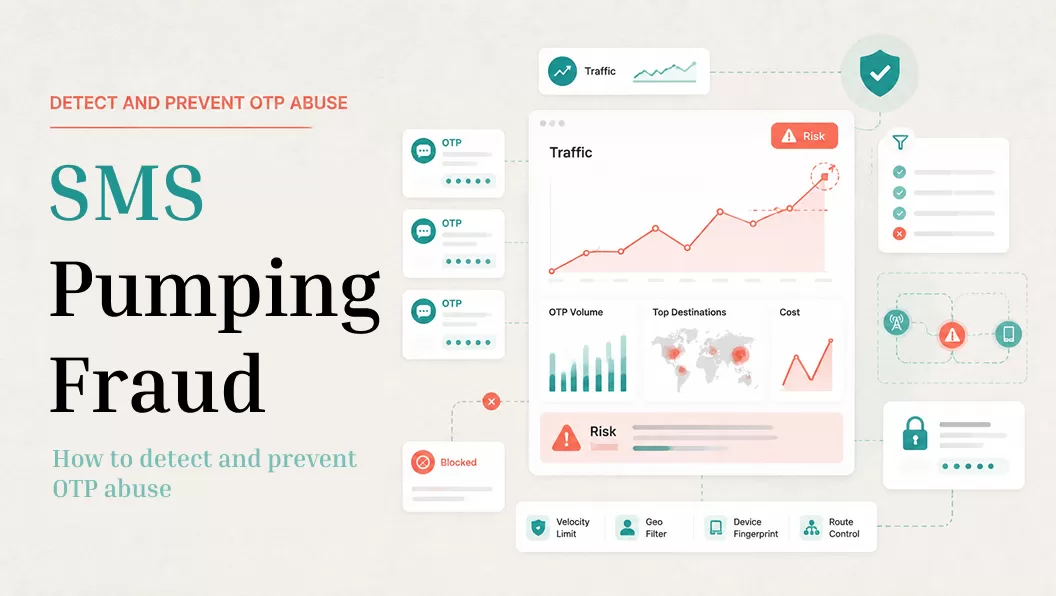
Fraud-driven volume. Automated abuse of an unprotected signup endpoint generates verification requests that no real user ever completes. The channel fees land immediately even when the verification fee does not. This is the mechanism behind SMS pumping fraud , and rate limiting the endpoint matters more to the bill than any per-unit negotiation.
Country-level channel spread. The $0.05 is flat worldwide, but channel fees are not. A user base shifting toward high-cost SMS destinations changes the cheaper half of the bill significantly, and Silent Network Auth adds a per-country channel fee on top of the same flat rate.
When Twilio Verify Is Worth the Premium
The fee buys real things, and a fair comparison says so. Verify handles channel orchestration, fallback logic, fraud signals, rate limiting, and compliance across a very wide country footprint, all behind one API. For a team without messaging expertise that needs verification working in a sprint, $0.05 per verification is cheaper than the engineering time to build the equivalent.
The premium stops making sense at three specific points. When monthly volume moves into six figures, the flat fee compounds into real money against infrastructure you now understand well. When most of your traffic concentrates in a handful of markets, the global footprint you are paying for is largely unused. And when verification is already business-critical, the value shifts from convenience toward delivery rates and per-country routing, which is a different purchase.
At that point the question is not which vendor is cheapest per message. Compare the full stack: verification fee, channel fee, sender cost, carrier charges, fraud controls, and the engineering work that remains with your team.
For teams at that decision point, EngageLab OTP is a pricing-model alternative rather than a like-for-like replacement for every Verify channel. Its public pricing is quote-led, and the internal reference scenarios above indicate a substantially lower modeled cost than Twilio's public list-price structure across the selected markets. Verify that direction against your own numbers: request current rates for your top five destination countries and compare them with the blended cost per successful verification from your Verify audit.

EngageLab OTP product snapshot
EngageLab OTP combines code generation and verification with delivery by SMS, WhatsApp, voice, and email. Phone-number templates can use one primary channel and up to two fallbacks, while the Security Center applies number and IP frequency limits, country rules, quotas, and an SMS emergency stop. Pricing is quote-led, so teams should test these controls against their own traffic mix.
Build one template, compare completion and cost, then migrate only if the new route wins.
It is not the right move for every team. If the expected annual saving does not cover integration, testing, and a controlled dual run, keeping the existing service is the lower-risk choice. And the channel coverage is SMS, WhatsApp, email, and voice, so a flow that depends on Verify's TOTP or push channels does not have a like-for-like replacement here and needs a separate decision. For evaluation criteria beyond price, our OTP API provider guide and the enterprise OTP solutions overview cover the delivery models behind these options.
How to Migrate a Verification Flow Without Downtime
Verification sits on the signup and login path, so migration has to be reversible at every step. The sequence below assumes you already have a working Verify integration and want to run a real cost and delivery comparison before committing. Nothing here requires switching off Twilio until the final step.
1 Audit What Your Verify Service Actually Does
Pull 30 days from the Twilio console before configuring anything: verification attempts by channel, by destination country, completion rate, and resend rate. Separate successful verifications from messages sent , because those two numbers drive the two halves of your bill and they are rarely equal. This audit is also the only honest baseline for judging whether a migration improved anything. You are done with this step when you can state cost per successful verification per country, which is the single number the rest of the migration is measured against.
2 Recreate the Template With an Explicit Channel Strategy
In the EngageLab Console , open OTP , then Template Management , and click Create Template . Fill in Template Name , Template ID , Signature , and Sending Strategy . Where Verify abstracts channel selection behind its service configuration, this template makes the routing decision explicit and version-controlled.
A saved template appears in the Template Management list with a pending review status. If the save fails, the usual causes are a duplicate Template ID or a signature that has not been registered for the destination country yet, both of which are fixed before submission rather than after.

Naming rule: Mirror your Verify service names so the comparison stays readable, for example login_otp_sms_primary against the Verify service it replaces.
3 Map Primary and Fallback Channels to the Audit
In the Phone number channel section, set SMS Primary send for markets where your audit showed healthy delivery, and add WhatsApp Failover send or Voice Failover send for the countries where your resend rate was highest. Those resend-heavy countries are exactly where Verify's channel fees were compounding without producing successful verifications.

Fallback rule: Cap retries per destination before the fallback fires, so a bad route cannot turn into a paid resend loop.
4 Clear Approval Before Any Real Traffic
Click Create and Submit Audit , then return to Template Management and confirm the template shows as approved. Keep the approved Template ID with your backend configuration. Template review is a gate that does not exist in the same form on Verify, so build it into the migration timeline rather than discovering it on cutover day.

5 Dual-Run, Compare, Then Cut Over
Create a server-side API key and point a traffic slice at the new path while Verify keeps serving the rest. Your backend calls the send endpoint when a user triggers signup, login, or a password reset, and the check endpoint before the protected action proceeds. Implementation details are in the OTP Send and OTP Check docs.
Run both paths for at least one full billing cycle and compare on the metrics your audit established: delivery rate by country, completion rate, time to first code, resend rate, and total cost per successful verification. Route a larger share across only when the new path wins on your own numbers, and keep the Verify integration in place until it does.
Migration checklist
- 30-day Verify baseline: successes, sends, completion and resend rate by country.
- Approved template with a stable template ID.
- Server-side API key, staging and production separated.
- Retry caps, expiry window, and failed-attempt limits configured.
- Dual-run over one billing cycle with cost per successful verification tracked on both.
Twilio Verify Pricing FAQ
How much does Twilio Verify cost per verification?
Twilio Verify lists $0.05 per successful verification plus the channel fee for delivery, checked August 2026. A US SMS verification therefore costs about $0.0583 in total: $0.05 for the platform and $0.0083 for the message. Volume discounts are available through Twilio's sales team and are not published, so the list rate is a planning figure rather than a final price.
Does Twilio Verify charge for failed verifications?
On most channels the $0.05 fee applies only when a verification succeeds, so an abandoned or mistyped code does not trigger it. The channel fee still applies to every message sent, including resends. Push is the exception: Twilio bills the fee whether the request is approved or denied, so rejected prompts are chargeable events.
Is Twilio Verify cheaper than building on a raw SMS API?
It can be, especially when your team would otherwise have to build orchestration, fallback, fraud controls, and compliance handling around a raw SMS API. There is no universal volume crossover. Compare the annual $0.05 verification layer with the engineering and operating cost you would actually take on, then include delivery and completion rates rather than deciding from the message price alone.
Is EngageLab cheaper than Twilio Verify across different regions?
The internal reference scenarios reviewed for the United States, United Kingdom, Singapore, and Brazil produced substantially lower modeled totals than Twilio's public list-price structure for the same workload. In the historical US example, the modeled difference exceeded 60%. Exact EngageLab rates are not public, and the percentage is directional rather than guaranteed. Request a country-by-country quote using the same destination mix, resend rate, sender type, security controls, carrier charges, taxes, and support scope.
How do I reduce verification costs without hurting signup conversion?
Attack volume before unit price. Rate-limit the request endpoint to stop automated abuse, cap resends per user and destination, validate number format and line type before sending, and route resend-heavy countries to a channel that actually lands. Cutting wasted sends reduces the channel half of the bill and lifts completion, which is the only change that improves cost and conversion at the same time.
Model Your Own Cost Before You Renew
Twilio Verify pricing is simple to read and easy to underestimate. The flat $0.05 is channel-independent and indifferent to how efficiently your flow runs, which means a cheaper channel does not move the larger half of the bill. Pull your last 30 days, split successful verifications from messages sent, and multiply both. If the platform fee is most of the total and your traffic sits in a few markets, the number is worth a second look before the next renewal.
A lower verification fee can change the economics, but only a production test can tell you whether the route is genuinely cheaper. Build one template, dual-run a controlled traffic slice, and compare completion, latency, resends, and total cost per successful verification. The lower quote wins only if the codes arrive.
Compare country-level pricing, fallback routes, and security controls for your verification mix.