Elena Rodriguez
Updated: 2026-05-18
Credential theft surged 160% in 2025, according to Check Point’s analysis via IT Pro. In B2B environments, a single compromised admin account can expose every downstream customer, triggering breach notifications, contract reviews, and churn. Static passwords flag nothing on their own — that’s where the best anomaly detection tools for B2B login security earn their keep.
This article will guide you about, for anomaly detection, what features actually matter and how you can choose the perfect solution for defending against potential attacks.
What B2B Login Anomalies Actually Look Like (And How Systems Flag Them)
Not all suspicious logins get caught immediately. Threats hide inside patterns that look like legitimate access. Without behavioral context, they’re nearly impossible to spot.
In high-volume authentication systems, unknown users rarely trigger anomaly detection. What gets flagged is a known user behaving abnormally: logging in from a new device, an unusual location, or at an odd time. User behavior analytics (UBA/UEBA) and machine learning have become the backbone of modern authentication security because of this.
The 2025 Verizon Data Breach Investigations Report found that stolen credentials were the initial access vector in 22% of confirmed breaches. The access becomes a common entry point for attackers.
Here’s how the most common login anomalies look in practice, and how modern systems catch them:
| Anomaly type | Business scenario | How it’s detected |
|---|---|---|
| Impossible travel login | An accounts manager logs in from Germany, then 30 minutes later from Singapore. | Geolocation + velocity rules. UEBA models calculate travel feasibility and flag logins that aren’t physically plausible. |
| After-hours access | A payment is released at 3 AM from a finance account. | UEBA establishes a temporal baseline and flags significant deviation from normal time patterns. |
| Brute-force attempts | Repeated password combinations tried against an admin account. | Login rate limiting + anomaly thresholds detect repeated failures and trigger CAPTCHA, MFA, or temporary lockout. |
| New device or browser | A procurement manager logs in from an unrecognized device. | Device fingerprinting compares OS, browser, IP. Unknown devices trigger OTP or step-up authentication. |
| High-risk IP or proxy | Login attempt from a known VPN, Tor exit node, or flagged IP range. | Threat intelligence feeds and IP reputation scoring flag the source. Step-up authentication is applied. |
| Privilege escalation | A standard-access account attempts to reach admin-level resources after login. | Behavioral analytics detect changes in role-based access patterns and either block the request or trigger an alert. |
These anomalies rarely appear in isolation. A login from a high-risk IP, on a new device, outside business hours combines multiple signals at once.

That’s why anomaly detection tools use risk scoring rather than single triggers. When risk thresholds are crossed, adaptive authentication kicks in: Silent network authentication, bot detection, MFA or secure OTP delivery. Not every unusual activity gets blocked, because blocking everything also breaks the experience for real users.
The goal is catching malicious logins in real time while keeping legitimate users moving without friction.
3 Login Security Approaches: From Anomaly Detection to Real-Time Verification
In B2B environments, detecting suspicious logins is about more than stopping attacks. It’s about maintaining compliance, keeping operations running, and protecting revenue. One compromised account in a system connected to customer data or payments can be very expensive.
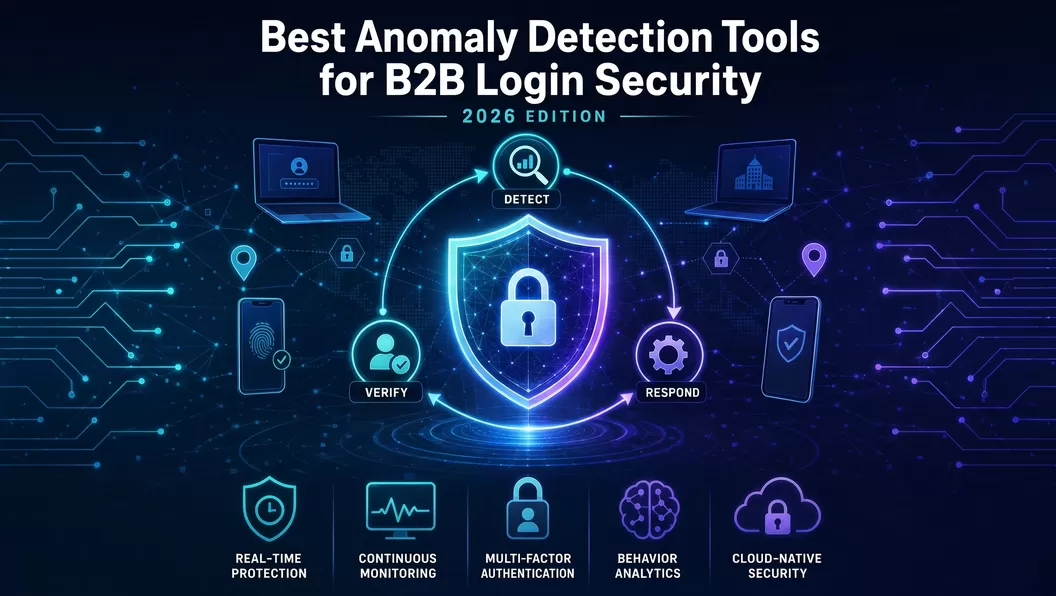
Modern login security has evolved into a full cycle: detect, respond, verify. Detection tools identify anomalies. Response systems evaluate risk. The verification layer confirms whether the user is who they say they are.
Relying on just one layer creates gaps. Behavioral detection combined with adaptive verification cuts unauthorized access incidents significantly.
Three primary strategies have emerged for detecting and managing anomalies:

1 Traditional software (SIEM and WAF)
Security Information and Event Management (SIEM) systems and Web Application Firewalls (WAF) monitor login attempts, network traffic, and access patterns. They rely on predefined rules and threat intelligence feeds.
Triggering mechanism: they trigger on blacklisted IP addresses, abnormal traffic spikes (DDoS patterns), and rule-based anomalies like repeated failed logins.
Use cases: they’re good at blocking large-scale DDoS attacks, preventing access from flagged IP ranges, and monitoring infrastructure-level threats. Examples include Splunk, Darktrace, and FraudNet.
The blind spot: if an attacker logs in from a legitimate IP with correct credentials, these systems won’t catch it. That’s common in B2B, where compromised accounts look identical to real ones.
2 AI-powered bot detection
These tools analyze behavioral patterns, device fingerprints, and interaction signals to determine whether a user is human or an automated script. They’re designed to catch sophisticated bot attacks that slip past traditional filters.
Triggering mechanism: they flag inconsistencies in device and browser fingerprints, unusual typing patterns and mouse movements, and behavior that matches known bot profiles. Examples include Cloudflare, HUMAN Security, and Imperva.
The blind spot: attackers now use CAPTCHA-solving services and human-like simulators that closely mimic real user behavior. Even sophisticated detection models can be fooled, making it hard to distinguish a real user from a skilled attacker.
3 Lightweight validation layer: OTP
OTP (One-time passwords) sit on top of detection systems for login scenarios as a verification layer. Rather than analyzing signals, they confirm whether the person trying to log in actually controls the account by requiring a temporary code sent via email, SMS, or WhatsApp.
Triggering mechanism: OTP triggers on risk signals (unusual location, new device, high-value action), upstream behavioral anomalies, or carrier-grade insights such as SIM swap alerts and network-level risk flags.
Use cases: requiring authentication for suspicious logins and securing high-risk actions like payments or password resets.
The blind spot: for traditional OTP, three limitations are worth knowing: additional steps slow login slightly; without integration, it has no inherent knowledge of user behavior; and in some regions, SMS delivery is unreliable.
👉 How smart OTP improves detection
OTP has evolved beyond a simple verification step. Smart OTP systems generate signals from SIM and carrier-level data, delivery success and failure patterns, and abnormal retry behavior. These signals surface fraud patterns that SIEM and bot detection miss: coordinated OTP abuse attempts, SIM swap risks.
In B2B, OTP closes the loop: detect, respond, verify. It catches suspicious activity without blocking real users, which keeps the experience intact and reduces false positives. Combined with multi-channel delivery and adaptive authentication, the limitations of traditional OTP shrink considerably.
Why OTP is the foundation of modern login security
The three approaches each evaluate something different:
- SIEM & WAF: analyze known threat signals (e.g., IP reputation).
- Bot Detection: analyzes behavioral anomalies (e.g., interaction patterns).
- OTP: prevents and verifies the ownership of the account.

That distinction matters. It marks the shift from probabilistic detection to deterministic verification. Detection-only systems generate a lot of alerts, which creates alert fatigue and friction. Adaptive OTP doesn’t guess whether a login is risky — it confirms identity directly, using additional signals like delivery behavior and carrier data.
For organizations balancing compliance, security, and user experience, OTP is the most practical entry point. It cuts false positives and creates a stronger barrier against unauthorized access.
10 Best Anomaly Detection Tools for B2B Login Security: Features, Pricing & Best Fit
💡 Quick comparison
| Provider | Verification logic | Channels | Global reach | Integration effort | Pricing (May 2026) | Best for |
|---|---|---|---|---|---|---|
| EngageLab | Adaptive (closed-loop) | SMS, Email, WhatsApp, Voice | 200+ countries | 🟢 Low (2 API calls) | Usage-based, no platform fee | Global SaaS |
| Twilio | Adaptive (closed-loop) | SMS, Email, WhatsApp, Voice, Push, TOTP | 180+ countries | 🟡 Medium | $0.05/successful verification + channel fees | Enterprise platforms |
| Telesign | Adaptive (closed-loop) | SMS, WhatsApp, Viber, RCS, Email | 230+ countries | 🟡 Medium-High | $0.009/SMS (US); identity intelligence priced separately | Fintech and high-risk B2B |
| Vonage | Adaptive (closed-loop) | SMS, Voice, Email, WhatsApp | 190+ countries | 🟡 Medium | Pay-per-success; contact sales for rates | Large-scale apps |
| Authkey | Static (open-loop) | SMS, Voice, Email, WhatsApp, RCS | India + select global | 🟢 Low | ~$41/10,000 SMS | SMEs (India-market) |
| Exotel | Static (open-loop) | SMS, Voice | India, SEA, MEA | 🟢 Low | From ~$115/quarter | Regional B2B (India-first) |
| Bird | Static (open-loop) | SMS, WhatsApp, Email, Voice, RCS, Social | 220+ countries | 🟡 Medium | Pay-as-you-go + carrier pass-through | Omnichannel teams |
| Infobip | Static (open-loop) | SMS, WhatsApp, RCS, Viber, Voice, Email | 190+ countries | 🟡 Medium-High | Custom enterprise pricing | Large enterprises |
| Plivo | Static (open-loop) | SMS, Voice, WhatsApp | 190+ countries | 🟢 Low-Medium | Channel costs only | Developers (cost-first) |
| Sinch | Static (open-loop) | SMS, Voice (Flash Call + Phone), Data Verification | 150+ countries | 🟡 Medium | Pay-as-you-go per attempt | Telecom-scale B2B |
⚠️ “Aware” or “Actionable”?
Adaptive OTP (smart): risk-based authentication that only challenges high-risk logins. Reduces mean time to response and lowers friction for clean sessions. Best for most modern B2B use cases.
Static OTP (traditional): sends a code on every login regardless of context. Cost-efficient and predictable, but limited in anomaly response. Best for low-risk environments or tight budgets.
Not sure which tier fits your volume? Talk to our team →
1 EngageLab
Trusted by over 800,000 teams, EngageLab is built for adaptive verification, not just delivery. It functions as a detection and verification hybrid.

Key features
- Adaptive verification engine: OTP only triggers when risk signals cross a defined threshold (new device, unusual location, high-risk IP). Clean logins go through untouched.
- Pre-delivery fraud screening: flags suspicious numbers and known fraud patterns before an OTP is sent, cutting wasted sends and exposure to SMS pumping.
- Multi-channel delivery with automatic routing: sends via SMS, email, WhatsApp, or Voice, with intelligent fallback if the primary channel fails.
- Real-time delivery dashboard: tracks latency, delivery rates, and failure reasons by region.
- Fast integration: OTP delivery and verification can be set up in two API calls. The full Verify API adds Silent Network Authentication and CAPTCHA to the same stack.
- Compliance-ready routing: meets data residency requirements across 200+ countries, with GDPR-aligned infrastructure.
Pricing (May 2026): usage-based, no platform fee. Customizable.
😃 Pros:
· Adaptive triggers mean high-risk logins get verified and low-risk ones don’t, cutting both fraud
exposure and user friction.
· Internal data shows the full Verify API stack blocks up to 90% of attacks and cuts
verification churn by 60%.
· Most teams go live within two days.
😟 Cons:
· Teams that only need basic single-channel SMS OTP may not need the full platform.
· The UI is optimized for API-first teams.
Best for: high-growth B2B SaaS teams that want adaptive, risk-based verification without building the detection logic themselves.
2 Twilio
As CPaaS infrastructure scales, Twilio’s verification API keeps pace, providing the high-volume reliability and global reach necessary for enterprises to secure their authentication workflows at any magnitude.

Key features
- Multi-channel verification via a single API: SMS, Voice, Email, WhatsApp, TOTP, Push, and Silent Network Authentication, which verifies users in the background without requiring them to enter a code.
- Built-in retry logic and fraud monitoring: automatically retries failed deliveries. Fraud Guard adds rule-based traffic monitoring to flag suspicious verification patterns.
- Extensive SDK and integration ecosystem: client libraries across major languages and deep documentation.
Pricing (May 2026): $0.05 per successful verification, plus channel fees (US SMS: $0.0083; WhatsApp authentication template: $0.0147). Volume discounts available.
😃 Pros:
· Widest channel selection in the category, with mature documentation and developer tooling.
· A large ecosystem means most identity platforms already have native Twilio integrations.
😟 Cons:
· Costs scale quickly at high verification volumes.
· Detection logic is primarily rule-based, not AI-driven.
Best for: enterprise platforms with large engineering teams that prioritize ecosystem depth, channel breadth, and delivery reliability over cost efficiency.
3 Telesign
Telesign leans into fraud detection and identity intelligence, which makes it one of the strongest options in high-risk environments.

Key features
- Global reach: across 230+ countries and 80+ languages, with direct-to-carrier routing for reliable delivery in complex regions.
- SIM swap detection: identifies SIM swap activity before OTP delivery, blocking one of the most common account takeover vectors in fintech and crypto.
- AI-driven identity risk scoring: analyzes 2,200+ digital attributes including phone reputation, IP signals, and behavioral data to generate a real-time risk score per login attempt.
- Multi-channel verification: via SMS, Voice, WhatsApp, Viber, and RCS, with built-in fallback logic.
Pricing (May 2026): $0.009 per SMS (US), pay-as-you-go. Premium identity intelligence features (phone ID, score, SIM swap) are priced separately.
😃 Pros:
· One of the strongest fraud signal sets in the category, with 2,200+ attributes per identity check.
· SIM swap detection is built in.
· Strong compliance framework for regulated industries.
😟 Cons:
· Premium detection features cost extra on top of base SMS rates, making total cost harder to predict.
· Setup is more involved than simpler OTP APIs.
· Not the right fit for teams that also need bulk marketing messaging.
Best for: fintech, crypto, and high-risk B2B platforms where account takeover is a material threat and fraud intelligence is worth paying for.
4 Vonage
Vonage offers a balanced OTP and communication suite with silent authentication options and strong routing, backed by Ericsson’s carrier-grade network following its acquisition.

Key features
- Predefined multi-channel delivery workflows: the Verify API sequences delivery automatically — SMS first then voice fallback — without requiring custom retry logic.
- Silent Network Authentication (SNA): verifies users in the background by confirming SIM-to-number binding at the carrier level. No user input required.
- Vonage Fraud Defender: applies real-time automatic blocking at the network level for suspicious traffic patterns.
- 190+ country coverage with carrier-grade routing reliability across major markets.
Pricing (May 2026): pay-per-success, starting at $0.0572 per success. Contact Vonage for current rates.
😃 Pros:
· SMS-to-voice failover is built into the API by default.
· Fraud Defender operates at the network level, blocking suspicious traffic before it generates
charges.
· SNA keeps friction near zero for low-risk sessions.
😟 Cons:
· Less flexible for teams needing custom verification flows.
· Out of the box, detection is not adaptive.
· Pricing requires a sales conversation for accurate forecasting.
Best for: teams that want intelligent channel failover without building it themselves, operating at a scale where carrier-grade routing matters.
5 Authkey
Authkey is a lightweight, cost-first OTP provider with minimal overhead. It’s built for speed and simplicity, not fraud intelligence.

Key features
- Multi-channel OTP delivery: SMS, Voice, Email, WhatsApp, and RCS through a single API, with automated re-routing to standby channels on primary delivery failure.
- Pre-built OTP templates: ready-to-use templates for login, signup, and password reset, reducing setup time.
- Delivery analytics panel: tracks OTP delivery status, failure reasons, and latency in real time.
- Simple REST API: minimal configuration, free sandbox account for testing.
Pricing (May 2026): pay-as-you-go, starting at approximately $41 per 10,000 SMS. Primarily India-structured; international rates require contacting sales.
😃 Pros:
· Low entry cost with a free trial.
· Fast to implement.
· Supports more channels than its positionin suggests, including WhatsApp and RCS.
😟 Cons:
· No adaptive or risk-based verification.
· OTP is sent on every trigger regardless of context.
· Primarily India-focused, with limited international routing transparency.
· Smaller ecosystem with fewer third-party integrations.
Best for: small teams and India-market startups that need basic OTP authentication quickly and at low cost, without requiring fraud intelligence.
6 Exotel
Exotel is a regional provider with deep carrier integrations in India and Southeast Asia. Its nOTP feature is a genuine differentiator for teams where login friction is a concern.

Key features
- SMS and Voice OTP with automatic fallback routing: built-in channel switching on primary delivery failure, targeting under-3-second delivery across supported networks.
- nOTP, zero-touch authentication: Exotel’s patented mode verifies users silently in the background without requiring them to enter a code.
- Deep telecom integrations across India, Southeast Asia, and MEA: direct carrier connections deliver strong regional routing reliability.
Pricing (May 2026): credit-based model starting at approximately 9,999 INR (~$115 USD) per quarter. International rates require contacting sales.
😃 Pros:
· Strong carrier-level reliability in India, SEA, and MEA.
· nOTP offers genuinely frictionless authentication for supported flows.
· Serves 7,000+ businesses including Uber India, Gojek, and Lazada.
😟 Cons:
· No adaptive or risk-based OTP triggering.
· Pricing transparency for international markets is low.
· Customer support response times have been flagged as slow in verified reviews, a risk for security-critical
workflows.
Best for: B2B teams operating primarily in India, Southeast Asia, or MEA who need reliable regional OTP delivery.
7 Bird (formerly MessageBird)
Bird is an omnichannel CPaaS platform. OTP is one feature among many, which is worth keeping in mind when evaluating it for a security-critical workflow.

Key features
- Omnichannel messaging across 220+ countries: SMS, WhatsApp, Email, RCS, Voice, and social channels including Messenger, Instagram, and LINE, all through one API.
- Flow Builder for custom delivery workflows: a visual tool for configuring multi-step messaging sequences, including OTP delivery logic, without writing custom code per channel.
- Competitive SMS pricing: Bird cut SMS pricing by up to 90% following its 2024 rebrand.
- Unified agent workspace: consolidates inbound and outbound communication across all channels into one dashboard.
Pricing (May 2026): pay-as-you-go per message, varying by channel and destination. Carrier fees passed through separately. API platform fees typically start in the low five figures annually; enterprise contracts average around $139,000/year.
😃 Pros:
· Widest channel selection in this list, including social messaging platforms most OTP providers
don’t touch.
· Competitive SMS pricing.
· Flow Builder reduces engineering overhead for multi-channel workflows.
😟 Cons:
· OTP is not Bird’s core product — its strategic focus is AI-driven CRM and marketing
automation, so verification features receive less development priority than at dedicated OTP providers.
· No adaptive or risk-based triggering.
· Support response times for non-enterprise tiers have been widely flagged on G2 and Reddit as slow (48+ hours).
· Carrier pass-through fees make cost forecasting harder than with per-success providers.
Best for: teams already using Bird for customer messaging that want to add basic OTP verification without onboarding a second vendor.
8 Infobip
Infobip is an enterprise-grade global messaging platform with deeper carrier integrations and outstanding OTP delivery.

Key features
- 800+ direct carrier connections: reduces aggregator hops that increase latency and lower delivery reliability, particularly in EMEA and Africa.
- Omnichannel OTP with intelligent routing: SMS, WhatsApp, RCS, Viber, Voice, and Email, with automated routing to the best-performing channel per user and region.
- Always-on failover: if a primary channel fails, Infobip automatically switches to an alternative mid-session.
- Infobip Signals: detects and blocks SMS pumping fraud using machine learning across number ranges, traffic velocity, and error rates. Enabled at the account level with configurable per-country thresholds. Blocked traffic is not charged.
- Compliance-ready infrastructure: certified under GDPR, ISO 27001, and SOC 2, with local sender ID support and regional data routing.
Pricing (May 2026): custom pricing based on volume, channel mix, and geography. Contact sales for enterprise quotes.
😃 Pros:
· Strong delivery rates in markets including EMEA and Africa where other providers struggle.
· Infobip Signals blocks SMS pumping with no integration effort.
· Full compliance stack out of the box.
😟 Cons:
· Custom-only pricing makes cost forecasting difficult before a sales conversation.
· Integration complexity increases when combining verification flows with fraud controls and multi-region routing
rules.
Best for: large enterprises operating across multiple regions where carrier-grade delivery, built-in fraud protection, and compliance certification all need to come from one vendor.
9 Plivo
Plivo is a cost-effective choice. It offers 95% conversion across multiple authentication channels including SMS, WhatsApp, and Voice.

Key features
- $0 verification fee and $0 Fraud Shield: only SMS, Voice, or WhatsApp channel costs apply.
- AI-driven Fraud Shield, built in: detects and blocks SMS pumping fraud using real-time traffic monitoring, geo permissions, and configurable fraud thresholds per country and per hour.
- 95% conversion across SMS, Voice, and WhatsApp: multi-channel delivery with per-session fallback logic. If SMS fails, the same session retries via Voice without charging an additional verification fee.
- Pre-registered sender IDs and templates: bypasses carrier registration and template whitelisting, reducing compliance overhead.
- 99.99% uptime SLA across 190+ countries: with 90-day delivery log retention and webhook callbacks for session status updates.
Pricing (May 2026): $0 OTP verification fee. $0 Fraud Shield. Channel costs only. Check Plivo’s pricing page for current SMS rates by sender type and carrier.
😃 Pros:
· Most cost-transparent pricing model in the category.
· Fraud Shield is AI-driven and included at no extra cost.
😟 Cons:
· Smaller global ecosystem and fewer third-party integrations compared to larger platforms.
· No adaptive or risk-based OTP triggering.
Best for: cost-conscious B2B development teams that want transparent, channel-only pricing with built-in SMS pumping protection.
10 Sinch
Sinch is a carrier-grade communication provider with 350+ direct mobile operator connections across 150+ countries. Its Flash Call feature is a meaningful cost-reduction option for high-volume Android verification.

Key features
- Four verification methods via a single API: SMS OTP, Flash Call, Voice Call, and Data Verification, with SDKs for iOS, Android, and web.
- Intelligent fallback across methods: if Flash Call or SMS fails to convert, the session automatically falls back to Voice Call, optimizing for both delivery rate and cost.
- 350+ mobile operator connections: direct carrier relationships rather than aggregator routing, improving delivery speed at high volumes.
- Real-time dashboard with per-method analytics: tracks delivery rate and conversion rate separately for each verification method and region.
Pricing (May 2026): pay-as-you-go, billed per verification attempt. Flash Call is charged at a fixed rate per attempt. Full rate card available in the Sinch dashboard after account creation. Volume discounts available.
😃 Pros:
· Flash Call is up to 25% cheaper per verification than SMS, with faster completion on
Android.
· Carrier-grade infrastructure backed by 350+ direct operator connections and a 99.9% uptime SLA.
· Recognized as a 2026 IDC MarketScape Leader for Worldwide Communications Engagement Platforms.
😟 Cons:
· No adaptive or risk-based OTP triggering.
· Pricing requires account creation to access the rate card, making upfront comparison harder than with Plivo or
Twilio.
Best for: high-volume B2B platforms that want to reduce per-verification costs through Flash Call and need carrier-grade delivery reliability across multiple regions.
FAQs: Anomaly Detection and OTP Verification for B2B Login Security
What are signs of account takeover in B2B?
Account takeover in B2B is harder to catch than in consumer apps because attackers work hard to look normal once they’re in.
At login, the obvious tells: new device, unfamiliar geography, impossible travel, or a string of failed attempts that suddenly resolves clean. That last one gets dismissed as a forgotten password more often than it should.
Once inside, behavior shifts. Compromised accounts drift toward things the user doesn’t usually touch: admin panels, bulk exports, payment details. High-value actions outside business hours are worth flagging, especially vendor changes or large transfers.
At the infrastructure layer: API call spikes from a single session, tokens reused across different IPs, OTP retry loops. The retry loops usually mean someone’s intercepting codes or brute-forcing them.
The B2B wrinkle is that one account rarely stays one account. From there, attackers pivot into customer accounts, vendor portals, and connected integrations. It compounds quickly.
Will adding a verification layer slow down B2B onboarding?
It shouldn’t, if you choose a decent provider. Good ones run silent authentication in the background: no friction unless the login looks suspicious. Adaptive OTP only triggers on risky sessions. Clean logins go through without any extra steps.
Is bot detection enough, or is OTP still needed?
They serve different purposes. Bot detection filters out automated scripts (the « how »). OTP confirms user identity (the « who »). Even if a login attempt isn’t from a bot, it could still be a manual account takeover. OTP provides proof of possession that behavioral analysis alone can’t offer.
How does smart OTP support regional data privacy laws like GDPR?
Through minimal data processing and independent regional data nodes. Platforms can localize data handling in line with EU Commission GDPR guidelines.
Summary
B2B login security is no longer just about detecting anomalies. It’s about how quickly you can detect, respond, and verify before compromised access turns into a breach.
Traditional detection tools like SIEM and bot protection identify risk signals, but they often stop at alerting rather than resolving the threat. OTP verification closes that gap. It’s a low-friction response layer that sits between anomaly detection and real-time protection.