


Agent Email Use Cases
Scenario 1: Zero-Friction Global Cold Start
Business Context: No Independent Domain and Cold Start Delivery Bottlenecks In the early stages of overseas business, teams often face the pain points of lacking independent brand domains and complex DNS (SPF, DKIM, DMARC) configuration experience. Using traditional one-way mass sending not only easily triggers anti-spam mechanisms of major overseas email service providers (e.g., Gmail, Outlook), leading to IP reputation damage or low inbox rates, but also lacks efficient lead screening and structured accumulation channels.
Full-Cycle Technical Practice
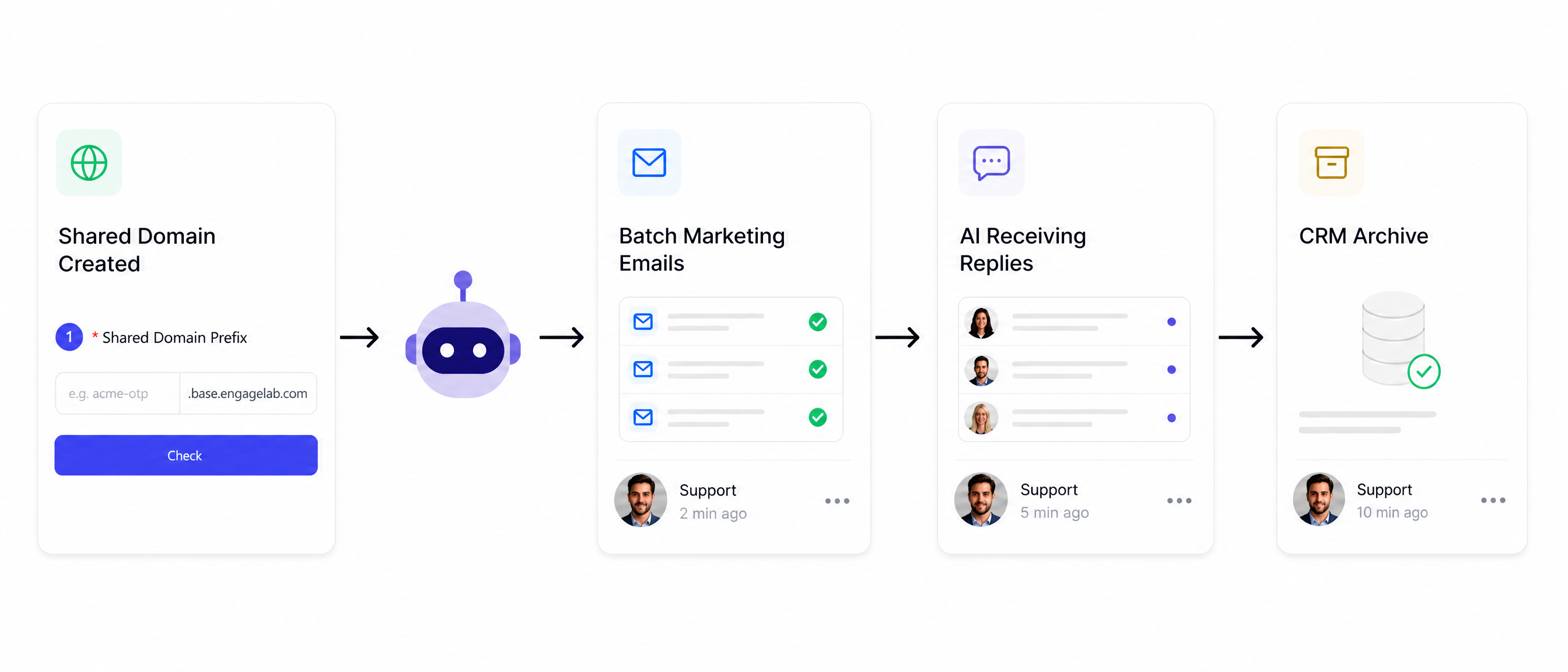
- Step 1: One-Click Shared Domain Creation – Bypass complex DNS configurations by directly calling the official high-reputation shared sending domain provided by the system to quickly build an overseas communication channel.
- Step 2: Agent Batch Outreach and Generation – Relying on AI Agent's deep analysis of product semantics, automatically generate high-relevance outbound marketing emails and execute batch delivery.
- Step 3: Inbound Capture and Intent Analysis – Real-time capture of reply events from overseas target customers. The system converts complex MIME entities into structured text for multi-turn semantic analysis by AI.
- Step 4: Structured CRM System Entry – For identified high-value intentions, automatically call APIs to write customer main information and session summaries into the corporate CRM system.
Solution Value and Results
- Agile Deployment:Eliminate infrastructure setup cycles and achieve minute-level global sending capability initialization.
- Reputation Protection:Rely on high-reputation shared infrastructure and two-way interaction mechanisms to ensure channel delivery rates.
- Data Closed Loop:Automatic synchronization of intention data, achieving seamless transition from outreach to follow-up.
Scenario 2: 24/7 Global Cross-Timezone Technical Support
Business Context: Cross-Timezone Service Blind Spots and Knowledge Retrieval Efficiency When operating globally, cross-timezone service delay is a core factor leading to customer churn. When overseas end-users submit urgent technical support requests during their local working hours (i.e., domestic non-working hours), manual teams cannot respond in real-time; meanwhile, faced with massive and complex product technical documents, manual retrieval and response efficiency cannot support large-scale operations.
Full-Cycle Technical Practice
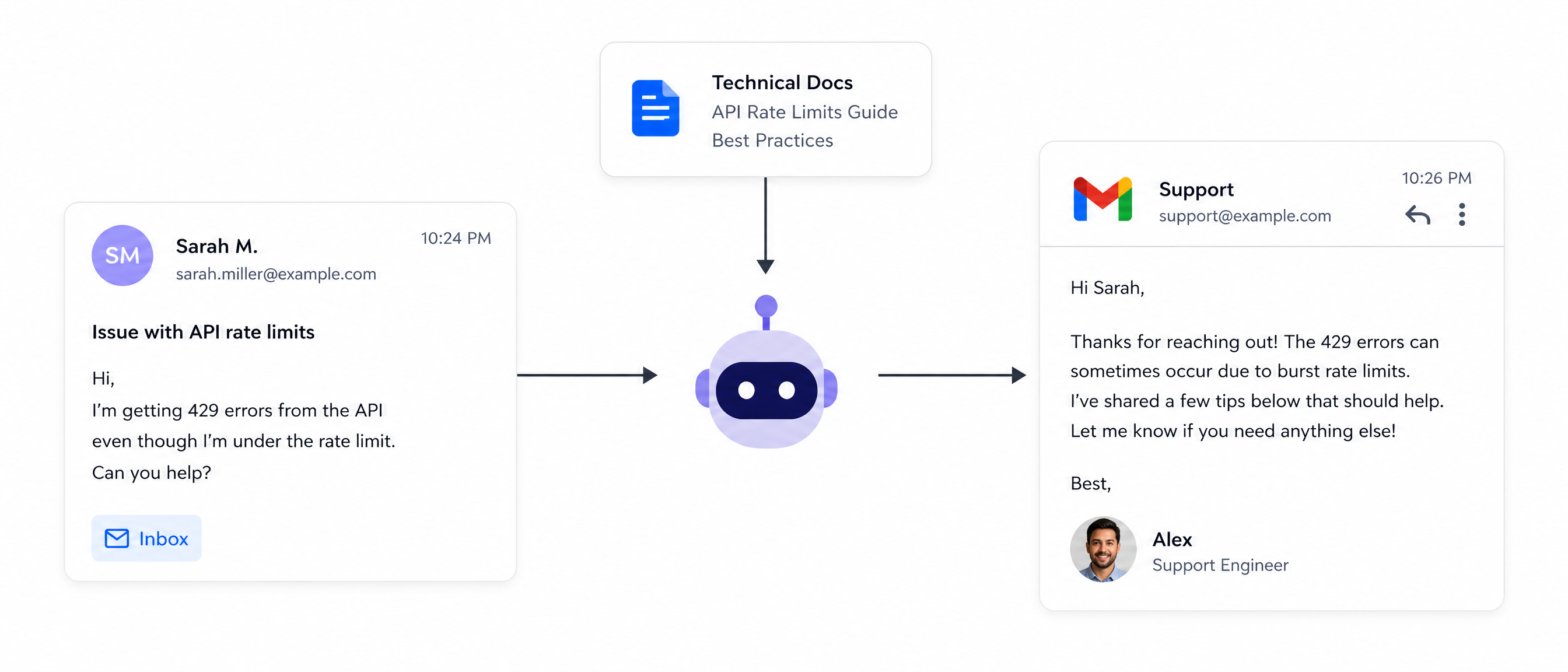
- Step 1: Cross-Timezone Event Capture – During domestic non-working hours, the system automatically captures asynchronous inbound requests from overseas users (e.g., Alex) regarding product technical parameters (e.g., Model X-Pro performance).
- Step 2: Precise RAG Knowledge Base Retrieval – AI Agent triggers the internal Retrieval-Augmented Generation (RAG) mechanism to call the corporate private knowledge base (PDF manuals, structured tables) in real-time, accurately matching technical parameters.
- Step 3: Context-Aware Protocol Response – Inject session header identifiers based on standard RFC specifications and output high-accuracy Thread responses as a professional "Support" persona, breaking timezone barriers.
Solution Value and Results
- Round-the-Clock Response:Eliminate response delays caused by time differences and maintain 7x24 hour continuity of global business.
- Knowledge Empowerment:Eliminate manual guessing; all responses are strictly traceable to official knowledge base sources.
- Efficiency Multiplier:Achieve automated processing of high-concurrency technical consultations without increasing night shift labor costs.
Scenario 3: Intelligent User Lifecycle Management
Business Context: Email Fragmentation and Contextual Disconnection under Multi-Turn Interaction In long-cycle customer journeys (e.g., registration activation, expiration reminders, feature follow-ups), users often have multiple back-and-forth, multi-turn continuous conversations with the system or customer service. If traditional ordinary sending interfaces are used, each turn of interaction generates an isolated email entity, leading to severe fragmentation of historical communication context and increasing cognitive costs for manual handovers or subsequent AI reasoning.
Full-Cycle Technical Practice
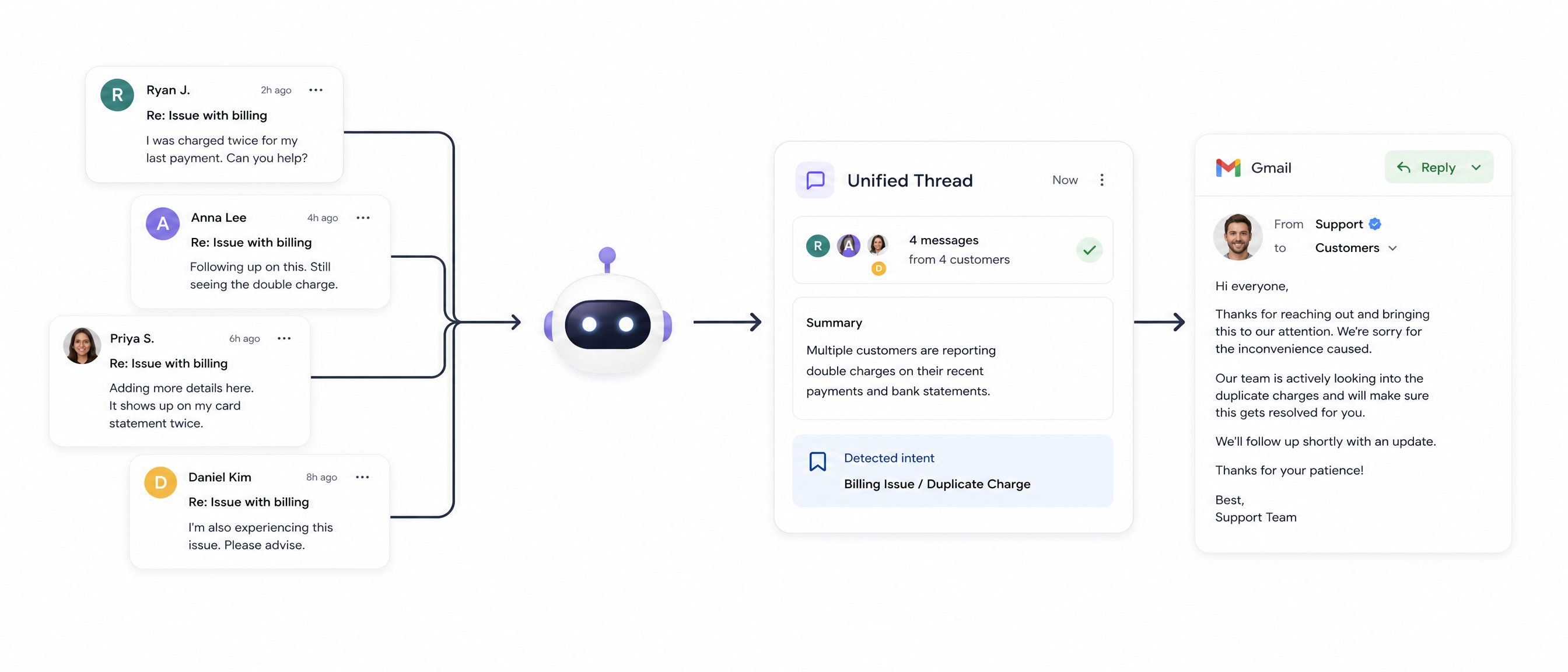
- Step 1: Multi-Turn Event Triggering and Replies – Following automated notifications triggered by lifecycle nodes, users engage in multiple back-and-forth continuous replies regarding renewal, migration, or configuration issues.
- Step 2: Global Thread Engine Aggregation – The inbound gateway automatically converges fragmented emails from multiple turns and back-and-forth exchanges into a single global Thread session stream based on unique identifiers (Message-ID, In-Reply-To, References).
- Step 3: Panoramic Context Output – AI Agent reads the entire historical timeline of the Thread and provides continuous responses with global context awareness as a "Support" persona.
Solution Value and Results
- Conversation Aggregation:Completely eliminate email disconnection caused by multi-turn dialogues and form a complete business interaction timeline.
- Contextual Transparency:Zero-threshold mastery of full historical context whether for manual takeover or continuous AI follow-up.
- Asset Security:Encrypted hosting of sensitive identity information ensures compliance and security of corporate digital assets during lifecycle flow.
