Elena Rodriguez
Updated: 2026-11-27
A retailer with 100,000 stored contacts can bring a much smaller marketable audience to an Emarsys renewal. SAP quotes on stored contacts. Klaviyo’s Email plan is $1,380 USD per month at 100,000 active profiles in 2026, and the number can be much lower if only a portion of the database is marketable. A large WhatsApp program changes the calculation. Browser push can add another vendor to the bill.
When comparing Emarsys competitors , decide which part of the stack has to move . SAP renamed Emarsys to SAP Engagement Cloud in February 2026. Spadoom’s 2026 partner benchmarks put standard through advanced implementation at a one-time $30K–$200K USD on top of the annual license. An email team on Shopify may need a storefront connector and a few flows. A regional retail group may need to keep its customer data platform (CDP) and replace only the messaging layer.
The short answer? For a Shopify-first email and SMS stack with transparent active-profile tiers, start with Klaviyo (or Omnisend for lighter budgets). For mobile-app-heavy enterprise engagement, evaluate Braze. For a global messaging stack running Email, SMS, WhatsApp (with Coexistence), AppPush, and WebPush from one builder, evaluate EngageLab Marketing Automation alongside per-channel usage pricing .
Shortlist rule Keep only the platforms that can run your required workflows, then price them using the audience or usage each one actually bills.
Part 1: SAP Engagement Cloud Rebrand, Editions, and 2026 Benchmark Pricing
The SAP announcement introduced the Engagement Cloud name in February 2026. Emarsys Edition keeps the modular engagement offering. Enterprise Edition adds Business Areas for managing separate operations, Joule AI and SAP Business Data Cloud integration. It also introduces capacity units. Get the edition on the first page of the quote before comparing prices across vendors.
SAP’s public pricing page displayed a technical error during the late-2026 check. The following USD figures use Spadoom’s 2026 guide for SAP and the vendors’ public plan figures where available. Treat the SAP figures as a partner market estimate, not an SAP list quote .
| Platform | Billing unit | 2026 USD pricing benchmarks |
|---|---|---|
| SAP Engagement Cloud, Emarsys Edition | Total contacts under an annual agreement | $18K–$30K/yr up to 50K contacts. $30K–$48K/yr in the 50K–150K band. $48K–$84K/yr in the 150K–500K band. Confirm exact boundaries in the quote. |
| SAP implementation | One-time project cost | Standard $30K–$80K (6–10 weeks). Advanced $80K–$200K (10–16 weeks). Scope determines which benchmark applies. |
| Klaviyo | Active profiles. Email / Marketing below. | 20K: $375 / $470.85 per month. 50K: $720 / $885 per month. 100K: $1,380 / $1,610 per month. 150K: $1,955 / $2,200.85 per month. Above 150K, including 500K: Custom. |
| EngageLab | Marketing Automation: monthly engaged persons (MEP). Standalone products use their own units. | Marketing Automation: Contact Sales. Email: 50 free per day, packs from $5.98 per 2,000 sends. AppPush: $299 per 10K peak DAU plus $199 monthly platform fee. WebPush: $199 per 10K peak DAU plus $199 monthly platform fee. LiveDesk: $99, $299 or $399 per month by conversation tier. |
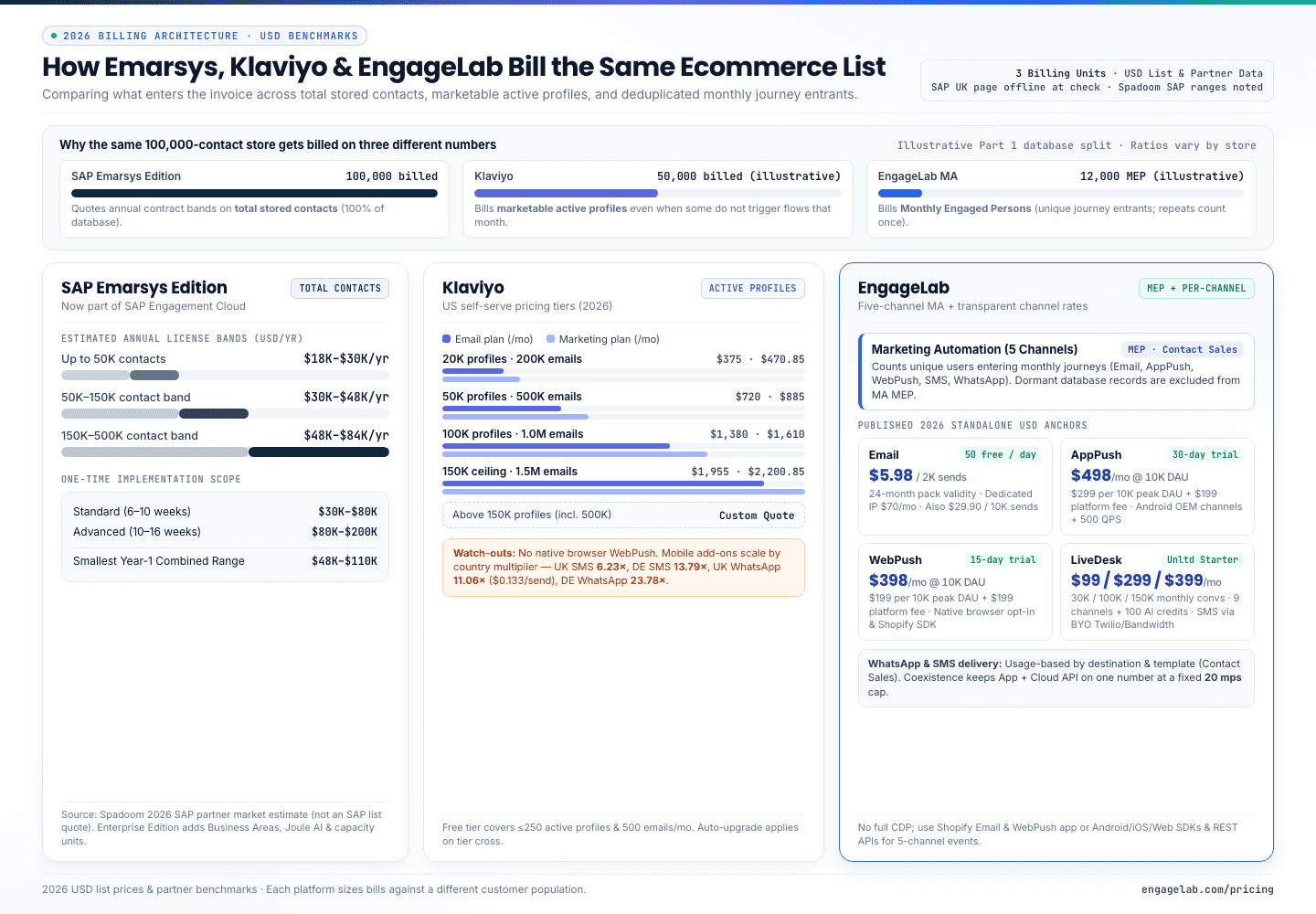
Open the full-size billing comparison
-
1
Count the stored base for SAP
Model the quoted total-contact band and keep implementation separate. A Standard rollout against the smallest benchmark band comes to $48K–$110K in year one before items outside those estimates. Ask which records the contract includes and how the band changes at renewal. -
2
Count marketable profiles for Klaviyo
An active profile is a contact you can market to. The free tier covers up to 250 active profiles and 500 emails per month. Paid tiers can auto-upgrade when you cross a billing boundary. If your database has 100K records and 50K active profiles, the 2026 Email benchmark is $720/month, or $8,640 over 12 months at a constant tier. -
3
Deduplicate journey entrants for MEP
Count unique people who enter any journey during the month. Count repeat entries once. If 12,000 people enter and 3,000 of them enter again, the input for the Marketing Automation quote is 12,000 MEP. Estimate standalone channel or inbox usage on separate lines.
The public pricing page gives useful standalone budgets. In 2026 USD, Email packs are valid for 24 months, and a dedicated IP is $70/month. At 10K monthly peak daily active users (DAU), AppPush is $498/month after its 30-day trial. Standalone WebPush is $398/month at the same peak after its 15-day trial. The calculator badges the WebPush platform fee as temporarily free alongside AppPush, while the displayed total still includes the fee. Use the undiscounted amount in your model until the order confirms the waiver.
Read the Emarsys pricing and renewal breakdown if the SAP contract is the main decision. Use the first-year benchmark to size the switch, then bring renewal terms and implementation scope into procurement.
Part 2: Klaviyo vs Emarsys vs Unified Omnichannel Messaging Platforms
2A. Klaviyo vs Emarsys for ecommerce
Start with Klaviyo if Shopify supplies the events behind most of your automations and email drives the program. Put one existing cart flow through the connector. Check that a purchase stops the reminder , including when the shopper checks out on a different device. That test tells you whether the storefront integration saves real work or leaves an identity gap to fix.
Keep SAP on the shortlist if multiple storefronts depend on unified profiles or your retail team uses SAP data in its campaigns. Emarsys offers 60+ prebuilt tactics. Ask which tactics work with your existing event payloads and who maintains the mappings when the storefront changes. Spadoom’s scoped implementation benchmarks span 6–24 weeks across Standard through Enterprise projects. Estimate your schedule from the required work and approvals.
Alium Research’s 2026 buyer interviews describe moves toward Klaviyo among Shopify and self-service buyers. Interviewees also raised Emarsys setup and usability friction alongside Klaviyo’s cost and channel limits at scale. Treat those accounts as prompts for the demo. Your own marketable-profile count and campaign mix will determine the budget.
Klaviyo’s monthly Email allowance grows from 200K sends at 20K profiles to 1.5M at 150K. The Email and Marketing prices in Part 1 are Klaviyo’s 2026 US calculator figures . Estimate mobile messaging separately by destination and message type. The calculator shows 6.226× for UK SMS and 13.788× for German SMS. WhatsApp marketing shows 11.063× in the UK ($0.133 per send) and 23.78× in Germany. US toll-free SMS is $0.011 per send plus applicable carrier fees. These multipliers are calculator ratios, so use the vendor’s local rate for a dollar forecast.
For example, 10,000 UK WhatsApp marketing sends at that listed rate come to $1,330 USD. A 50K-profile Email plan starts from $720/month at the verified tier. If that base and mobile usage are quoted separately, the two lines add to $2,050/month before other fees . Confirm the eligible plan and credit package in the calculator. Keep the SMS budget separate. The Klaviyo invoice breakdown covers the suppression window and Klaviyo One surcharge when those affect your quote.
Where Klaviyo simplifies the move
 Shopify supplies the events and catalog for the pilot flows.
- The 2026 US calculator gives a self-serve baseline up to 150K active profiles.
Where to budget extra work
-
 Native browser push is missing. Price the separate service and the consent migration if you depend on it.
-
International mobile credits vary by market. Model your busiest promotion using its actual destination mix.
2B. Emarsys vs Klaviyo vs EngageLab
| Decision | SAP Engagement Cloud | Klaviyo | EngageLab |
|---|---|---|---|
| Best fit | SAP-centric or multi-store retail | Shopify-led ecommerce | Cross-region messaging with an existing data owner |
| 2026 USD model | Annual contact-band quote plus implementation | Active profiles. 100K: $1,380 Email / $1,610 Marketing per month. Above 150K: Custom. | Marketing Automation: MEP, Contact Sales. Standalone products priced by channel usage or inbox conversations. |
| Email, SMS and App Push | Email and mobile engagement. Confirm SMS coverage and delivery partners in the quote. | Email and mobile app push included. SMS uses the mobile messaging add-on. | Email and SMS in journeys. AppPush supports APNs, FCM and Android OEM channels. |
| Browser push | Confirm Web Push inclusion and migration with SAP. | No native Web Push. | Native WebPush. Separate peak-DAU pricing and 15-day standalone trial. |
| Verify sender onboarding and regional availability in the proposed edition. | Mobile messaging add-on with destination and template pricing. | Business App Coexistence can keep the existing number. Optional sync covers up to 180 days. Fixed 20 messages per second (mps), with no upgrade. | |
| Customer service | Scope the service inbox separately in the SAP stack. | Scope Helpdesk separately from the email plan. | LiveDesk covers nine channels including WhatsApp and SMS. SMS requires your own Twilio or Bandwidth credentials. Paid tiers start at $99/month. |
| Path to launch | Scope connector mapping and implementation. Standard partner benchmark: 6–10 weeks. | Connect Shopify and validate key flows before cutover. | Shopify app covers Email and Web Push. Schedule SDK or API event work for five-channel Marketing Automation. |
A browser push and WhatsApp pilot can keep orchestration in a single journey builder while your current data stack stays in place. Price WhatsApp and SMS usage by destination and ask sales to quote the journey audience separately . If the launch needs a unified profile store, scope the data work separately. Confirm connector coverage before setting a date.
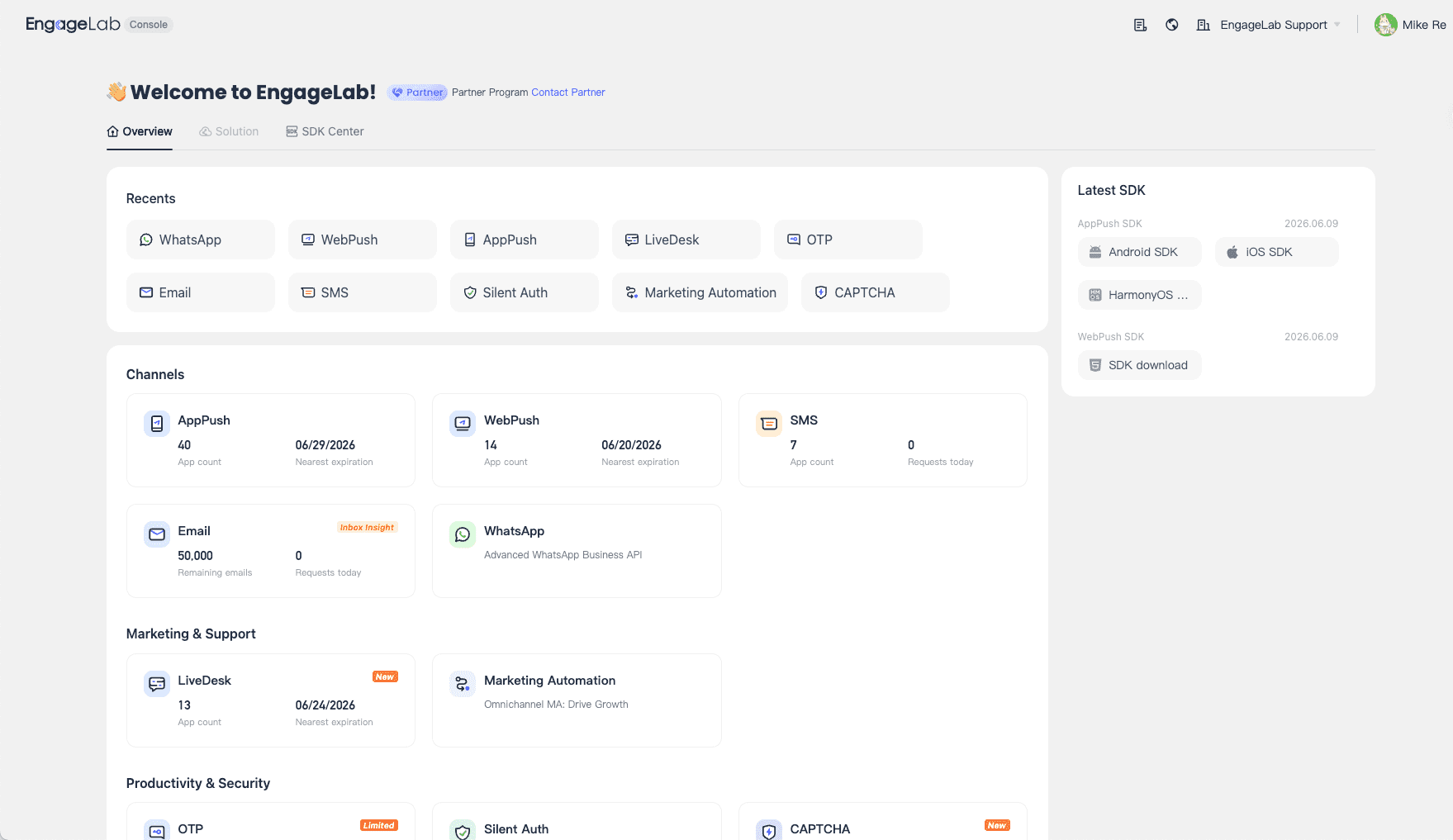
Use the console to check the standalone Email or Web Push setup against one workflow.
Part 3: The 8 Best Emarsys Alternatives Compared by Replacement Scope
Some SAP Emarsys competitors take over the engagement layer and leave the customer record in place. Others ask your team to move segmentation, commerce data or site personalization as well. Use the replacement scope to narrow the list before requesting demos. Sales-led entries need a quote for your usage and integration scope.
| Platform | Replacement scope | Channels | Pricing model | Best fit |
|---|---|---|---|---|
| EngageLab | Messaging and billing-model replacement | Email, SMS, WhatsApp, App Push, Web Push | MEP quote plus standalone channel usage | Cross-region teams with an existing data layer |
| Klaviyo | Storefront lifecycle replacement | Email and app push, plus mobile messaging add-on | Active profiles, Custom above 150K | Shopify teams with email-led flows |
| Braze | Enterprise engagement replacement | In-app, push, email, SMS | Sales-led | App-first businesses |
| Iterable | Enterprise journey replacement | Email, SMS, push, in-app | Sales-led | Teams with a defined event model |
| Insider One | Personalization and engagement | Web and app personalization plus messaging | Sales-led | Retail teams coordinating site and app experiences |
| Bloomreach | Wider commerce and data stack | Marketing journeys plus on-site discovery | Sales-led by scope | Teams also moving search or profiles |
| Salesforce Marketing Cloud | Wider CRM-centered architecture | Email, mobile messaging and journeys by edition | Edition and configuration quote | Teams centered on Salesforce CRM |
| Omnisend | Partial storefront replacement | Email, SMS, Web Push | Free and paid plans by list size | Shopify teams with a narrower channel mix |
1 EngageLab: Best for Global Omnichannel Messaging & Usage-Based Billing
Start here when your data layer can pass customer events into a journey and the reason for switching is channel coverage or billing. For a pilot, send a cart event into the builder and check whether the flow can branch on a purchase. Keep profile resolution and audience governance in your own stack. LiveDesk’s 2026 USD tiers cover up to 30K, 100K, or 150K monthly conversations at $99, $299, or $399 per month (Starter includes unlimited agent seats and 100 Free AI Credits per tier; Enterprise capacity is expandable).
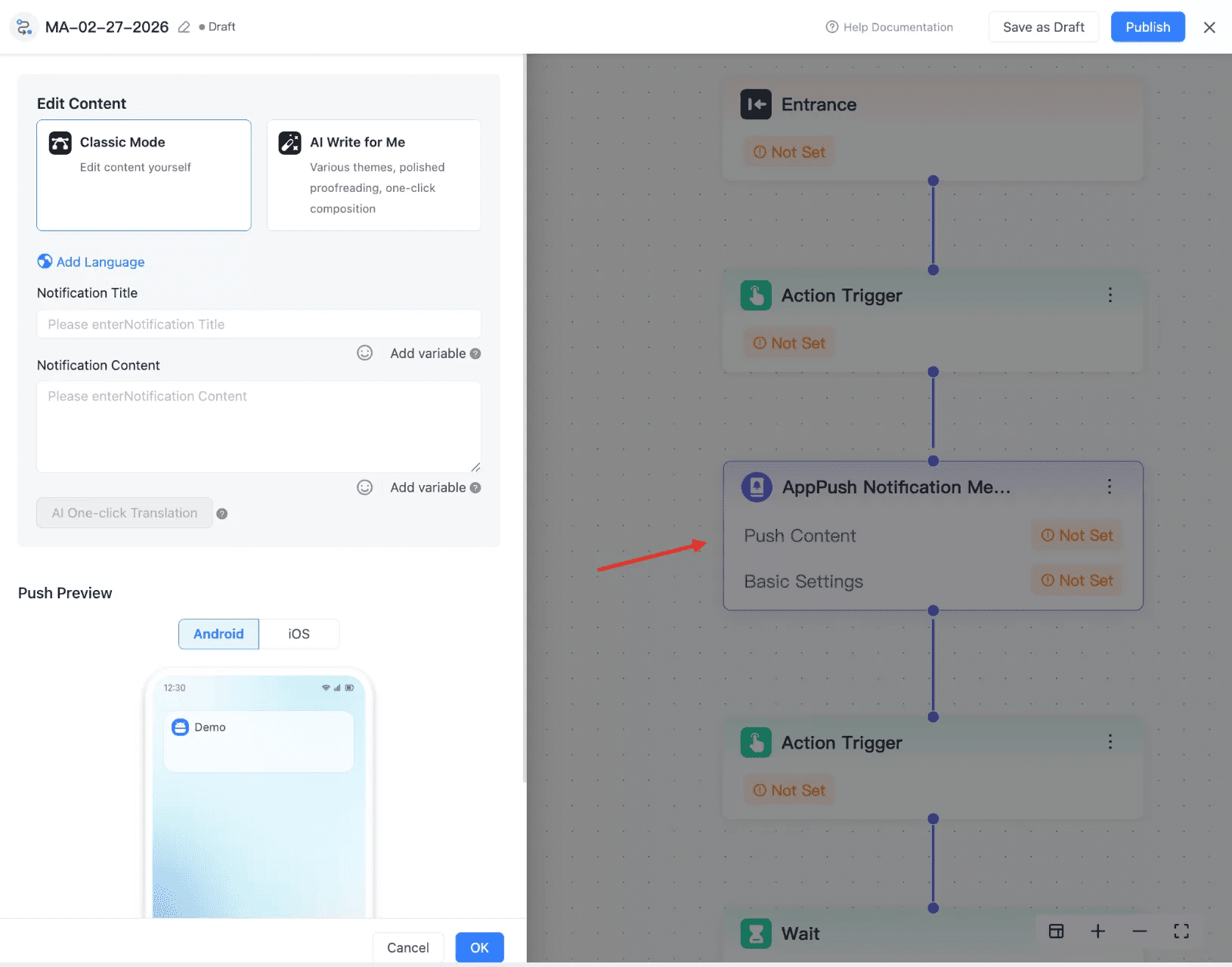
Choose it if: you need AppPush (including Android OEM channels), native WebPush, Email, SMS, and WhatsApp in one builder while keeping your stored database separate from Marketing Automation MEP billing.
Choose Klaviyo or SAP instead if: you need a full enterprise CDP, prebuilt SAP Business Data Cloud connectors, or turnkey Shopify analytics without SDK or API event work.
Pros:
-
One journey builder orchestrates Email, SMS, WhatsApp, AppPush, and WebPush from Android, iOS, Web SDK, or REST API events.
-
Published standalone 2026 USD anchors: Email 50 free/day and packs from $5.98/2K; AppPush $498/mo (30-day trial); WebPush $398/mo (15-day trial) at 10K peak DAU.
-
WhatsApp Business App Coexistence supports 180-day chat sync on the same number, while LiveDesk handles nine support channels from $99/month.
Cons:
-
No full CDP; the Shopify app covers Email and WebPush, while five-channel MA requires SDK or API instrumentation.
-
Coexistence caps throughput at a fixed 20 mps, and LiveDesk SMS requires your own Twilio or Bandwidth credentials.
 Check sender capacity before migrating
WhatsApp Coexistence keeps the Business App and Cloud API on one number at a fixed 20 mps ceiling that cannot be upgraded . The Business App has a 5 mps cap, and existing companion devices unlink on activation. Confirm both sender capacity and LiveDesk BYO SMS credentials before moving frontline workflows.
Key takeaways for omnichannel messaging teams include:
- Marketing Automation bills on deduplicated monthly engaged persons (MEP) via custom quote, keeping dormant stored records separate from journey billing.
- Standalone channels publish transparent USD entry paths: 50 free emails/day, 30-day AppPush trial, 15-day WebPush trial, and $99/month LiveDesk Starter with unlimited seats.
- Android, iOS, Web SDKs, and REST APIs pass custom commerce events without replacing your existing warehouse or CDP.
2 Klaviyo: Best for Shopify-Led Ecommerce Teams
For a Shopify team running welcome flows and post-purchase email, the connector can cut engineering work enough to justify active-profile pricing. Pull your suppressed and marketable counts first: in 2026, Email runs $375/month at 20K active profiles and $1,955/month at 150K in USD, switching to custom quotes above 150K. For a narrower storefront list, see these Klaviyo alternatives for ecommerce .
Pros:
-
Fast self-serve Shopify connector with mature catalog sync and prebuilt storefront triggers.
-
Transparent 2026 US calculator up to 150K active profiles and broad ecommerce partner ecosystem.
Cons:
-
No native browser WebPush; UK/DE SMS (6.226×–13.788×) and WhatsApp (11.063×–23.78×) multipliers raise multi-region costs.
-
Accounts above 150K active profiles lose self-serve calculator visibility and require custom pricing.
3 Braze: Best for Mobile-First Enterprise Brands
Braze fits enterprise teams whose retention hinges on mobile app events and real-time in-app messaging. Take an onboarding flow with push opt-out logic to the demo and test cross-device identity. Quote SDK work and event volume alongside the license , since sample demos rarely show real integration cost.
Pros:
-
Deep mobile SDK, in-app Canvas orchestration, and real-time behavioral triggers for app-led brands.
- Strong enterprise fit when native mobile engagement outranks email newsletters.
Cons:
- Sales-led enterprise contract with no public rate card for early self-serve budgeting.
- Requires sustained engineering investment to instrument mobile SDKs and event streams.
4 Iterable: Best for Flexible Cross-Channel Lifecycle Journeys
Iterable suits growth teams with a well-defined event schema that want granular control across email, SMS, push, and in-app triggers. In evaluation, pass two out-of-order purchase events to verify how a running journey adjusts after a late order , and scope data-mapping effort in writing.
Pros:
- Flexible cross-channel Studio branching built around custom behavioral events.
-
Avoids SAP-specific suite lock-in when your team already maintains an external warehouse.
Cons:
- Custom enterprise pricing only; heavy event-schema cleanup can delay initial launch.
- Less plug-and-play for small Shopify teams without dedicated lifecycle engineering.
5 Insider One: Best for Onsite & App Personalization
Insider One (formerly Insider) fits retail teams coordinating onsite banners, app personalization, and inbox campaigns together. Activate one test segment across both web and messaging during your trial and verify which modules own the audience and carry separate add-on fees.
Pros:
-
Unifies onsite/in-app merchandising personalization with email, push, and WhatsApp delivery.
-
Helpful when conversion optimization on storefront pages sits under the same team as CRM.
Cons:
-
Sales-led modular packaging can stack costs quickly across personalization and messaging tiers.
-
Over-scoped if your team only needs reliable campaign delivery without onsite web overlays.
6 Bloomreach: Best for Commerce Search & Discovery
Shortlist Bloomreach when the project replaces product discovery and customer profiles alongside messaging. Test an out-of-stock SKU during the demo to measure how quickly inventory changes update campaign audiences , and confirm separate module pricing if your storefront already owns site search.
Pros:
-
Combines commerce search, merchandising, and real-time CDP segmentation in one enterprise suite.
-
Strong match for large catalog retailers syncing inventory across site discovery and email.
Cons:
-
Custom enterprise pricing and heavier deployment when your goal is simpler campaign automation.
- Paying for full commerce-data modules duplicates tools if search stays elsewhere.
7 Salesforce Marketing Cloud: Best for Salesforce CRM Stacks
Salesforce Marketing Cloud fits organizations where Salesforce CRM already governs customer records. Bring a customer profile spanning multiple storefronts into the demo to verify how opt-out states sync into marketing , and price partner contact-key integration alongside the edition quote.
Pros:
-
Native alignment with Salesforce CRM objects, sales workflows, and enterprise governance.
- Scales across multi-brand conglomerates standardized on the Salesforce ecosystem.
Cons:
-
Edition complexity, partner implementation fees, and administration effort rival Emarsys.
-
Contact-key and consent synchronization across business units require careful technical maintenance.
8 Omnisend: Best for Lighter Shopify Email, SMS & Web Push
Omnisend fits Shopify brands swapping out enterprise complexity for turnkey email, SMS, and browser push. Its 2026 USD tiers list Free at $0, Standard at $11.20/month promotional ($16/month standard), and Pro at $41.30/month promotional ($59/month standard). Model renewals on standard rates and projected list size .
Pros:
- Fast Shopify setup with prebuilt cart, welcome, and browse flows plus native Web Push.
- Low entry cost with transparent self-serve plans starting at $16/month regular rate.
Cons:
-
Lighter multi-region messaging, AppPush, and custom data-model depth compared with enterprise suites.
- Promotional starter discounts step up to regular list-tiered pricing at renewal.
Part 4: Prebuilt Commerce Connectors vs. SDK and API Integrations
Start an Emarsys integrations review with one order event. Trace it from the storefront to the audience record, then check which system records consent. If a connector covers both paths, the pilot can focus on rebuilding flows. If engineering owns either path, put its tasks on the rollout calendar before committing to a migration date.
| Integration path | Prebuilt coverage | What to prove before cutover |
|---|---|---|
| SAP Engagement Cloud | SAP Commerce Cloud, Adobe Commerce, Salesforce B2C Commerce and certified Shopify Plus app. | Validate customer keys across stores. Test how opt-outs reach each business unit. |
| Klaviyo | Shopify storefront integration and ecommerce app ecosystem. | Check catalog availability and purchase-event timing in a real flow. Map any custom fields the connector leaves out. |
| Messaging with custom events | EngageLab: Email & Web Push is free to install. A separate Shopify theme SDK path is available for Web Push. | Use Android, iOS or Web SDKs and REST APIs as appropriate for five-channel Marketing Automation. Assign an owner for event schemas and identity matching. |
Include a guest checkout and a return in the integration test. Compare how the old and new systems join each event to a customer and whether the return updates the intended segment. A storefront connector can shorten setup, but the test still needs a realistic event payload and an owner who can resolve a mismatch.
Part 5: How to Choose and Pilot an Emarsys Competitor Without Recreating the Same Bottleneck
Keep the enterprise platform on the shortlist if…
- SAP customer data drives audience logic across storefronts.
- Marketing needs shared profiles or controls across brands.
- The certified connector cuts engineering work for critical flows.
- The partner can scope implementation and parallel operation in writing.
Pilot a smaller replacement if…
- Most live flows depend on Shopify events or an existing data layer.
- Your team can name the channels the replacement must own.
- Marketable profiles or journey entrants are easier to forecast than stored contacts.
- Engineering can commit to any custom events required for launch.
-
Step 1 — Model a quiet month and a peak month
Export stored contacts, then count marketable profiles and unique journey entrants for each month. Divide entrants by stored contacts to see how much of the database is actually entering journeys. Use separate estimates for peak DAU and conversations. Give each vendor the worksheet and ask it to identify the billable rows .
-
Step 2 — Test the channel that can change the decision
Run a browser push opt-in through the pilot storefront if that channel matters. For WhatsApp, use actual destination countries and measure the busiest minute you expect to send . Check whether the existing number must stay on the Business App. Verify a staffed reply path and confirm the SMS credentials before counting SMS support as ready.
-
Step 3 — Prove one journey end to end
Use an existing flow with a recorded event, consent and an exit condition. Confirm that the trigger creates one journey entry and that a purchase exits the flow before the next send. If the storefront app cannot supply the event, assign the SDK or API work and repeat the test with a real payload.
-
Step 4 — Put overlap and exit costs on the same quote sheet
Agree on the export scope and how long both platforms run in parallel. Define who pauses the old automation and how to roll it back. Price the implementation hours and any license overlap. Before signing, check overages against the peak-month model and ask the vendor to confirm renewal terms.
Keep only the Emarsys competitors that can pass the pilot at the required peak volume . If a platform saves license spend but leaves you paying to rebuild identity or replace browser push, put that work on the same budget line as the proposed savings. For a messaging-only pilot, validate one channel first and request a scoped Marketing Automation quote once the event and volume assumptions hold.
Try a standalone channel or ask sales to price your expected monthly journey audience.
Frequently Asked Questions About Emarsys Competitors
-
1
What is the difference between SAP Emarsys and SAP Engagement Cloud?
SAP Engagement Cloud is the name SAP introduced for Emarsys in February 2026. Emarsys Edition preserves the modular offering, while Enterprise Edition adds Business Areas, Joule AI, and SAP Business Data Cloud integration with capacity units in the commercial model. At renewal, ask SAP to map each existing module to your proposed edition and specify included capacity. -
2
Is Klaviyo cheaper than Emarsys for mid-market ecommerce?
Klaviyo often costs less for a Shopify business whose program focuses on email and whose active profiles stay inside a self-serve tier up to 150K. Factor in international SMS or WhatsApp multipliers and a separate WebPush vendor before confirming savings. Give SAP the same channel volumes to quote and compare recurring license spend separately from first-year implementation . -
3
Which Emarsys competitor supports WhatsApp Business App Coexistence and Web Push natively?
EngageLab supports both natively. Coexistence pairs an existing WhatsApp Business App number with Cloud API messaging, with optional 180-day chat sync that must be triggered within 24 hours . Before activating it, verify frontline impacts: existing companion devices unlink and WhatsApp Business App broadcast lists or disappearing messages become unavailable under a fixed 20 mps limit. -
4
Can EngageLab replace Emarsys if we use Shopify Plus or SAP?
It can replace the messaging execution layer if the Shopify app’s Email and Web Push workflows cover your initial storefront triggers, with SDK or REST API events added for five-channel journeys. In an SAP architecture, keep profile governance in your data layer and assign ownership for customer-key matching and consent sync before cutover. -
5
How does Monthly Engaged Persons billing compare to active-profile and total-contact pricing?
MEP counts distinct people entering journeys during a billing month. Active-profile pricing charges against marketable profiles even if those subscribers never enter a monthly flow. Total-contact pricing uses the stored database band defined in your agreement. Export all three metrics from the same baseline month with suppressed records separated before comparing vendor quotes.