


LiveDesk Efficiency
The LiveDesk Efficiency page helps you understand whether customer service is timely, whether conversations are resolved smoothly, and how AI and human agents share service responsibilities. It is suitable for regular review by project owners, customer service managers, and operations staff.
How to Use
Select the statistics period, time granularity, and channel at the top of the page. The page recalculates the statistics based on your selections. When you need to retain the data or perform further analysis, you can export the CSV data for the current filter range.
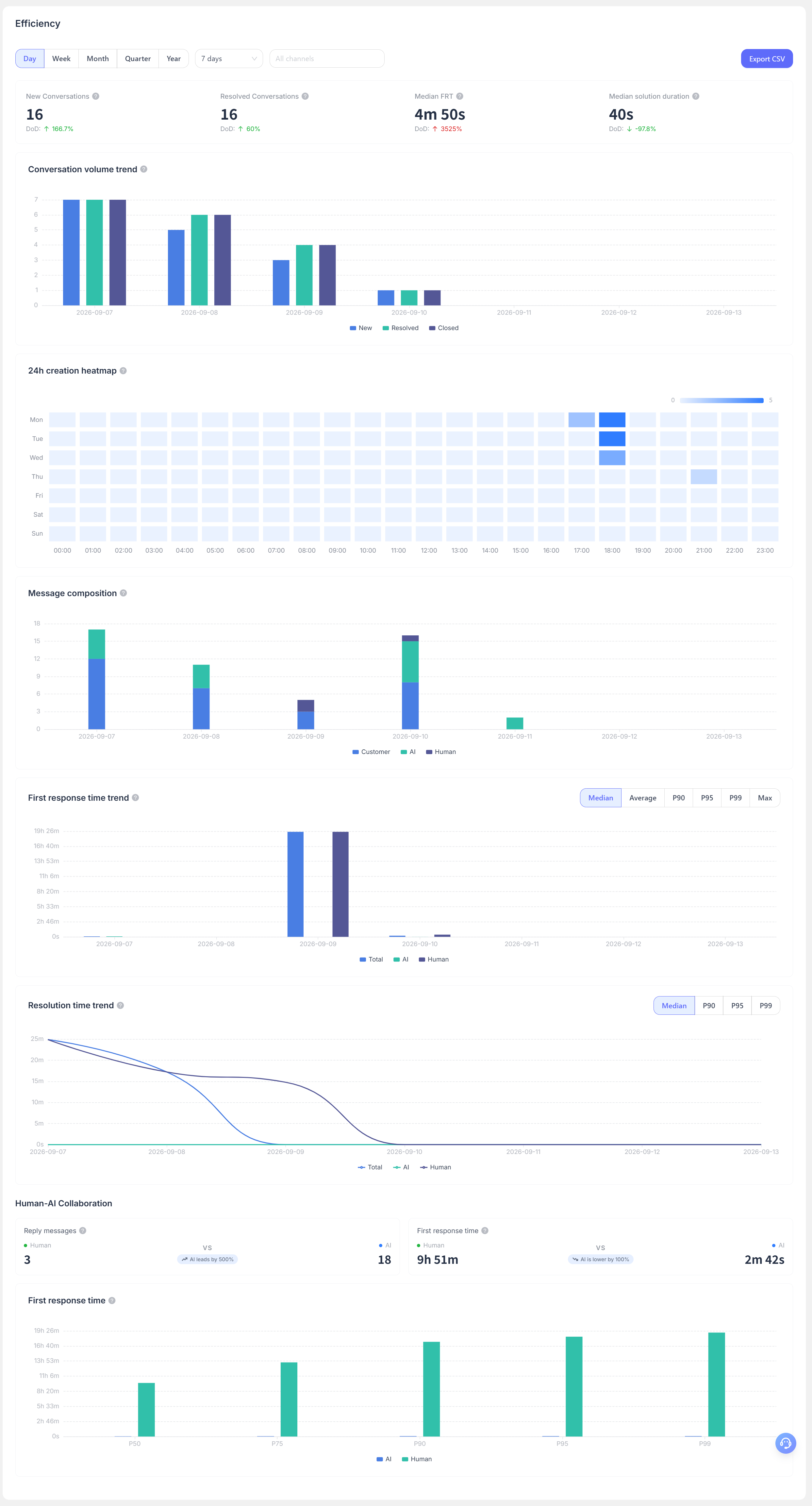
Page Overview
| Section | What you can see | What it can help determine |
|---|---|---|
| Core metrics | Number of new conversations, number of resolved conversations, median first response time, and median resolution time | Whether conversations are accumulating and whether customers are waiting too long |
| Conversation volume trends | Changes over time in new, resolved, and closed conversations | Whether service volume matches the resolution rate |
| Conversation creation heatmap | Number of new conversations during each hour of the week; peak periods can be highlighted | When to add coverage or adjust staffing schedules |
| Message volume composition | Trends in the number of customer messages, AI replies, and human replies | Whether the proportions handled by AI and human agents have changed |
| First response time trends | Median and high-percentile trends for first response time | Whether a small number of customers are waiting unusually long |
| Resolution time trends | Changes in overall, AI-handled, and human-handled resolution times | Which handling method or time period has become slower |
| Human-AI collaboration comparison | Comparison of reply volumes and response speeds between AI and human agents | Whether AI is effectively handling part of the service volume and whether human agents are taking on more complex issues |
Metric Descriptions
- Number of new conversations: The number of conversations first created during the statistics period.
- Number of resolved conversations: The number of conversations whose status changed to "Resolved" during the statistics period.
- Median first response time (FRT): The median time from when a customer sends their first message to when they first receive a reply from AI or a human agent. A lower value means most customers spend less time waiting for their first reply.
- Median resolution time (AHT): The median cumulative handling time from when a conversation begins to be handled until it is resolved. If a conversation is reopened and resolved again, it is counted as a new resolution sample. Time spent after a conversation is resolved or closed is not included.
- High-percentile response time: Used to identify customers who have been waiting particularly long. For example, an increase in P95 indicates that the wait time for a small proportion of the slowest conversations is increasing, which requires attention even if the median appears normal.
Recommendations
- First, review the trends for new and resolved conversations. If new conversations remain higher than resolved conversations, conversations requiring handling may be accumulating.
- Then, review the heatmap and first response time trends to determine whether response times slow down during peak periods.
- Finally, review the AI/human reply composition and the human-AI collaboration comparison to determine whether metric fluctuations are caused by changes in volume, changes in AI handling, or insufficient human handling capacity.
Different metrics are calculated based on different business time references. For example, new conversations are calculated based on creation time, while resolved conversations are calculated based on the time their status changes. Therefore, the two should not be compared on a one-to-one basis.
LiveDesk Efficiency helps teams identify service bottlenecks and improve response timeliness and resolution efficiency.
